Are you a team member in a veterinary practice?
Are you a pet parent planning a trip with your furry pal?
Taking a Pet Into Canada: A Complete Guide
Bringing your pet to Canada doesn't have to be a major headache. When you know what to expect, the process is actually quite simple. It boils down to three key things: an identifying microchip, an up-to-date rabies vaccination, and an official veterinary health certificate. Getting these items sorted out ahead of time is the real secret to a smooth, stress-free move for both you and your pet.
Your Pet's Journey to Canada: An Overview
Moving your animal companion to the Great White North can feel like a huge task, but I'm here to break it down for you. Think of this as your personal roadmap to a successful relocation, making sure you and your pet have a great experience from start to finish.
The whole journey begins with the essentials. For dogs and cats, the two most important requirements are the microchip and a current rabies vaccination. These aren't just friendly suggestions—they're the absolute foundation for entry.
Why Are These Rules in Place?
Canada takes animal health and public safety very seriously, and for good reason. The country has seen a big jump in the number of dogs being imported over the last decade. The annual number of imported dogs shot up to over 37,000 by 2019, and nearly 29% of them came from countries considered high-risk for canine rabies.
This increase in pet imports is exactly why the rules around vaccination and identification are so strict. It’s all about protecting the animals already living in Canada as well as the ones just arriving.
Beyond the initial steps, you'll need to get an official health certificate from a licensed veterinarian. This document is basically your pet’s passport, officially stating they are healthy, fit for travel, and free of contagious diseases. Border officials will definitely ask to see it. If you're coming from the US, our specific guide on taking a pet from the United States to Canada dives even deeper into the details.
For a quick reference, here’s a breakdown of the key requirements.
Key Requirements for Pet Entry at a Glance
This table offers a quick summary of the essential documentation and health requirements for common pets entering Canada, helping you see at a glance what applies to your furry (or feathered) friend.
Requirement | Applies to Dogs & Cats | Applies to Other Pets (Birds, Reptiles) | Key Detail |
|---|---|---|---|
Microchip | Yes | Varies by species | Should be an ISO-compliant 15-digit microchip. |
Rabies Vaccination | Yes | Not typically needed | Must be given after microchipping. Proof is needed. |
Veterinary Health Certificate | Yes | Yes | Issued by a licensed vet, often within a specific timeframe before travel. |
Import Permit | Not for personal pets | Often Yes | Needed for many exotic pets, birds, and commercial imports. Check with CFIA. |
Keep in mind that this is a general overview. Always double-check the specific rules for your pet's species and your country of origin with the Canadian Food Inspection Agency (CFIA) before you travel.
Planning for a Smooth Trip
It’s also important to remember that not all pets are viewed the same under Canadian import rules. The rules for a young puppy or kitten can be different from an adult dog or cat, and bringing in a parrot or a reptile involves a completely different set of steps.
A successful move with a pet is all about careful planning and attention to detail. Starting the process early and creating a checklist are the best ways to avoid last-minute stress and ensure all requirements are met on time.
Finally, while you're focused on your pet's paperwork, don't forget about your own. Many international visitors will need to meet the Canada ETA requirements for entry, which is a key part of your own travel prep. By getting a clear picture of the whole process—for both you and your pet—you can set yourselves up for a smooth and happy arrival in Canada.
Preparing Your Pet's Health and Paperwork
Getting your pet’s paperwork right is probably the most nerve-wracking part of moving a pet to Canada. The Canadian Food Inspection Agency (CFIA) has its reasons for being strict—they’re protecting the country's animals, both resident and visiting. If you pay close attention to the details, you can avoid any ruff situations at the border.
The whole process is a series of steps where one has to happen before the next. Think of it as a domino effect. To help you see how it all fits together, here’s a quick overview of the main steps, from the microchip to the final health certificate.
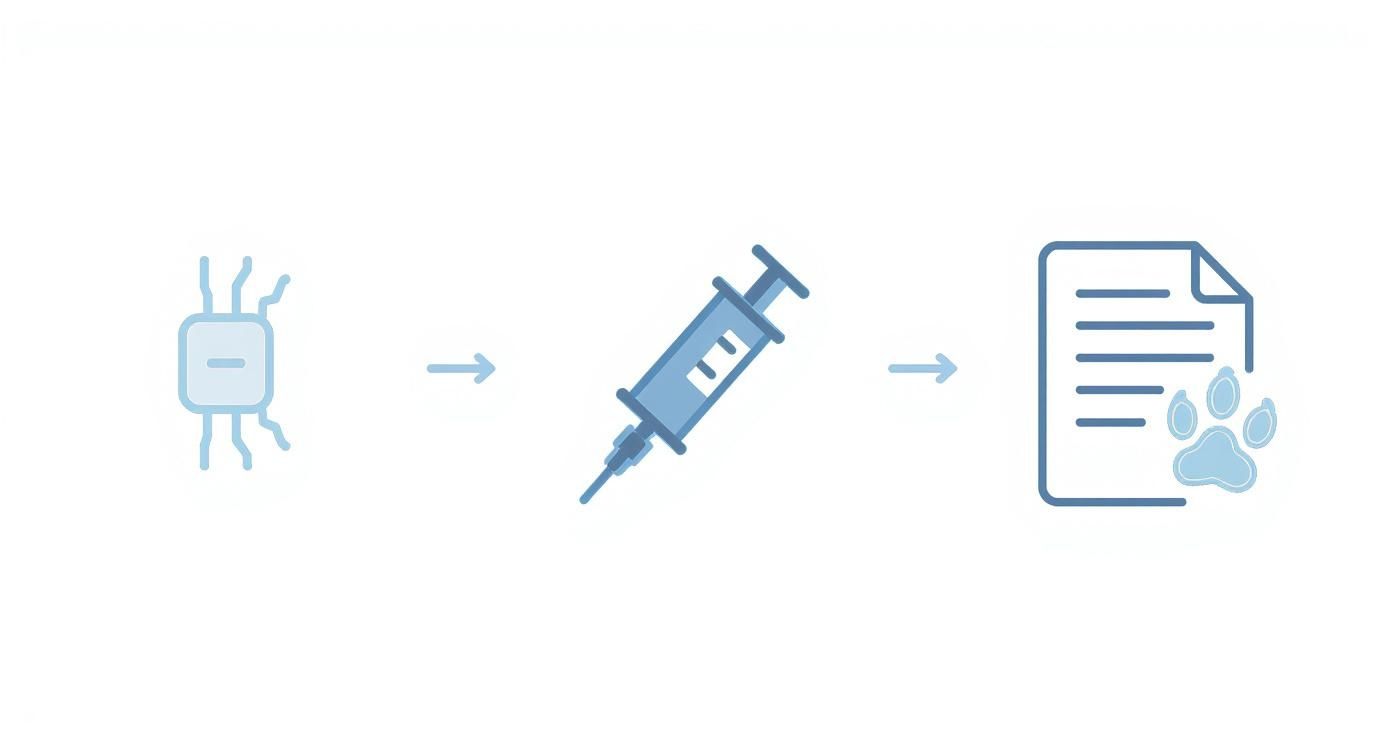
As you can see, each step builds on the last. Getting the order wrong can undo all your hard work, so it's important to follow the sequence.
Start with a Compliant Microchip
First thing's first: your pet needs a microchip. This is a must and has to be done before anything else. A microchip is your pet's permanent ID, and it's how Canadian officials connect your furry friend to all their health documents.
Canada prefers an ISO-compliant 15-digit chip. If your pet already has a different kind of chip, you’ll have to bring your own compatible scanner. Honestly, it’s just easier to get the right microchip implanted from the start.
And remember, the microchip must be implanted before the rabies vaccination. Any vaccine given before the chip is in place is not considered valid for travel to Canada.
Understanding the Rabies Vaccination Rules
A valid rabies vaccination is a must-have for dogs and cats. The timing and the paperwork here are very specific, so you need to get it exactly right.
Here’s the breakdown:
Timing is Everything: The vaccine must be given after the microchip is implanted. If it's your pet's first rabies shot after being microchipped, you have to wait 21 days before the vaccine is considered valid for travel.
Keep the Certificate: You need the original rabies vaccination certificate, signed by a licensed veterinarian. This is a separate document from a pet passport, although a compliant pet passport might be accepted if it has all the necessary details.
Certificate Details: Make sure the certificate lists your pet's microchip number, the date the vaccine was given, its expiration date, and the vaccine's trade name and serial number.
A common mistake we see is getting the rabies shot before the microchip is implanted or properly scanned. Always confirm with your vet that they scan the microchip and record the number before giving the shot. This simple check can save you a world of trouble.
The All-Important Veterinary Health Certificate
The final piece of your paperwork puzzle is the veterinary health certificate. This is the official document that confirms your pet is healthy and fit for travel. Border agents will look at this document very closely.
This certificate has to be filled out and signed by a licensed veterinarian in your home country. For many countries, it then needs a second signature—an endorsement from an official government vet. The timing is also very tight; it usually has to be issued within a specific window, often just a few days, before you land in Canada.
For a deeper dive into what makes this document valid and how to avoid common pitfalls, check out our guide on getting a pet health certificate for international travel.
Special Considerations for Young Pets
Traveling with a very young pet? The rules can be a bit different. For instance, puppies and kittens under three months old coming from a country that Canada considers rabies-free don't need a rabies shot. You will, however, need good proof of their age.
Things get much more complicated for commercial imports or pets flying alone. These situations often need special import permits and more health checks. It's a big deal—in one recent year, Canada imported live animals worth around US$752.36 million. By tackling these requirements step-by-step, you can walk up to the border with confidence, knowing you've got everything covered for a smooth entry into Canada with your pet.
What About Other Kinds of Pets?
While dogs and cats are the usual suspects when it comes to travel, Canada's import rules cover a whole menagerie of other animals. It’s a common mistake to think the process is the same for every pet. Bringing a parrot, a rabbit, or even a turtle across the border involves a completely different set of steps.
Once you step outside the world of canines and felines, the paperwork gets a lot more specific. This is because different animals can pose unique risks to Canada's native wildlife and agriculture, so the rules are tailored to them. Let's break down what you need to know for some of these less common travel companions.
Feathered Friends: The Rules for Pet Birds
Thinking of bringing your pet bird to Canada? Buckle up. This process is very different from the requirements for dogs and cats. The Canadian Food Inspection Agency (CFIA) has very strict rules to prevent avian diseases from entering the country, so you’ll need to do some serious planning.
For most pet birds, getting a CFIA import permit is a must, and you need it in hand before you travel. A key part of the application is a statement that you've personally owned the bird for at least 90 days in a country Canada recognizes as free of highly pathogenic avian influenza.
One of the biggest hurdles for bird owners is the required quarantine. Your bird will almost certainly need to be quarantined upon arrival, sometimes for up to 45 days, to ensure it's healthy. You can't just pick any spot—the quarantine location must be pre-approved by the CFIA as part of your permit application.
Small Mammals: Rabbits and Ferrets
What about smaller furry friends like rabbits or ferrets? Good news—the process is less intense than for birds. While they generally don't need a rabies vaccination certificate, you will need a veterinary health certificate.
This document is your vet's official word that the animal is healthy and has been with you since birth or for at least 60 days before your trip. The main goal here is to confirm they aren’t carrying any diseases that could spread to other animals in Canada.
Exotic Pets: Reptiles and Amphibians
Bringing a reptile or amphibian into Canada adds another layer of complexity, often tied to international wildlife protection laws. This is where you'll likely hear about a CITES permit.
CITES (the Convention on International Trade in Endangered Species of Wild Fauna and Flora) is a global agreement to protect endangered plants and animals. If your pet turtle, snake, or lizard is on the CITES list, you’ll likely need special permits from both your home country and Canada to move them legally.
Here are a couple of real-world scenarios to show the difference:
A Parrot from the UK: The owner will need to get a CFIA import permit and a health certificate, plus they'll have to arrange for a pre-approved quarantine facility. It’s a multi-step process that takes time.
A Turtle from the US: Someone driving across the border with their pet turtle might need a CITES permit if it’s a protected species, but they likely won’t face the strict CFIA quarantine or health certificate rules that apply to birds.
Importing pets beyond the standard cat and dog means taking a closer look at the regulations. The paperwork and procedures can differ a lot based on the species, their country of origin, and even international conservation laws.
Comparing Import Requirements for Different Pet Types
This table breaks down the different documentation and procedures for various categories of pets entering Canada.
Pet Type | Key Requirement | Health Certificate | Quarantine Potential |
|---|---|---|---|
Birds | CFIA Import Permit | Required | High (often needed) |
Rabbits/Ferrets | Proof of Ownership Duration | Required | Low (rarely needed) |
Reptiles/Amphibians | CITES Permit (if species is listed) | Varies by species | Low (unless specific concerns) |
Dogs/Cats | Rabies Vaccination Certificate | Required for some | Low (rarely needed) |
As you can see, there's no single set of rules. Always check the most current requirements for your specific pet with the CFIA to avoid any surprises at the border.
It’s no surprise that the variety of animals entering the country is huge. Between 2014 and 2020, Canada imported over 1.8 million live wildlife animals, with birds and reptiles making up most of that number. A huge chunk of these were headed for the pet market, which is exactly why these specific rules are so important. You can learn more by checking out these insights about Canadian wildlife imports and their origins.
Arranging Safe and Compliant Pet Transportation
Once you've handled the maze of paperwork, the next big step is figuring out how your pet will actually make the journey to Canada. Getting the logistics right is just as important as having the correct documents, as this is where you can make a huge difference in your pet's travel experience.
Their safety and comfort are the top priority.
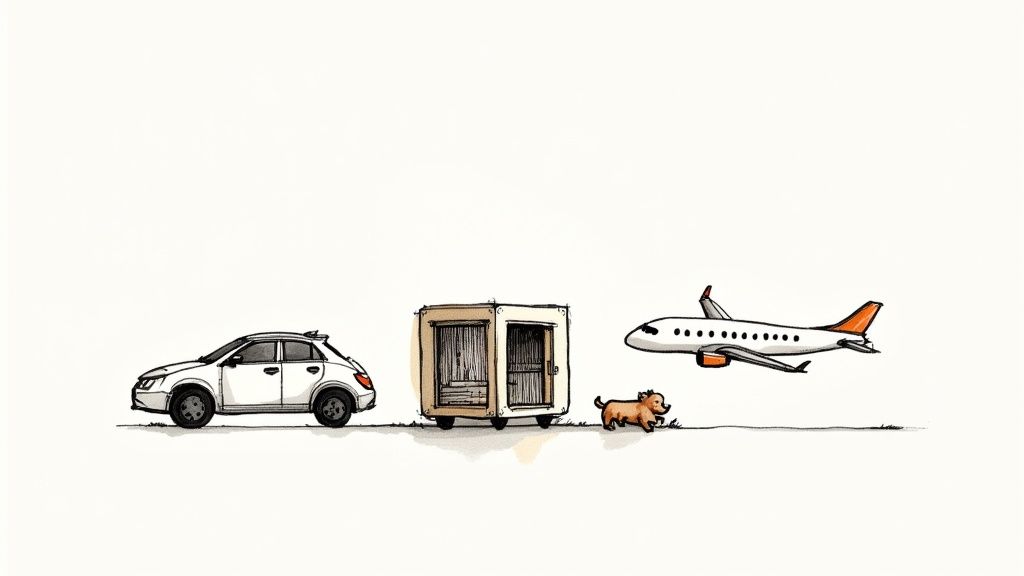
Whether you’re planning to drive or fly, each option comes with its own set of rules and things to consider. The best choice really depends on your pet’s temperament, where you're coming from, and your budget.
Choosing Your Travel Method: Driving vs. Flying
For many folks, especially those coming from the United States, driving across the border is a popular and often less stressful choice. It puts you in the driver's seat—literally. You have more control over the environment, can pull over for breaks whenever needed, and keep your best friend right beside you.
Flying, on the other hand, is usually the only practical option for long-distance or international moves. It’s certainly faster, but it also needs a lot more prep work, from picking a pet-friendly airline to getting your pet comfortable with the whole process. It can be a real toss-up, and you can explore more detailed comparisons in our guide on how to transport pets across the country.
Navigating the Skies: Airline Pet Policies
If flying is the way to go, your first call should be to your airline. Every carrier has its own specific policies for pet travel.
Here's what you'll need to check with them:
In-Cabin vs. Cargo: Can your pet fly with you? Small animals that fit comfortably in a carrier under the seat might get the green light. Larger pets, however, will need to travel in the temperature-controlled cargo hold, which is a completely different ball game.
Breed Restrictions: Some airlines won't fly certain breeds, particularly brachycephalic (snub-nosed) dogs like pugs and bulldogs. This is due to the increased risk of breathing difficulties at high altitudes.
Temperature Embargoes: For your pet's safety, airlines will not transport animals in cargo during periods of extreme heat or cold at any point of the journey—departure, arrival, or layovers. Always check the forecast.
A key piece of equipment for air travel is an IATA-compliant travel crate. This isn't just any carrier. It has to meet strict standards for size, ventilation, strength, and security. The airline will check it, and they can refuse to fly your pet if the crate doesn't meet the standards.
Preparing Your Pet for the Journey
A smooth trip starts long before you head to the airport. Your main goal should be to make the experience as familiar and stress-free as possible for your pet.
One of the most important things you can do is crate train them well in advance. Start by making the travel crate a happy place. Put their favorite blanket and some toys inside, and even feed them their meals in it. This helps them associate the crate with safety and comfort, not fear.
A well-prepared pet is a calm pet.
One thing veterinarians strongly advise against is sedating your pet for travel. Sedation can affect their ability to regulate body temperature and balance, which can be dangerous during a flight. It's much better to focus on positive reinforcement and calming techniques.
When to Call in the Professionals
Feeling a bit overwhelmed by all the moving parts? That's completely normal, and it might be the right time to look into a professional pet transport service. These companies are experts at moving pets into Canada and can handle every last detail for you.
They typically:
Book the most direct, pet-friendly flights.
Help ensure all paperwork is perfect and meets both airline and CFIA standards.
Provide IATA-compliant travel crates.
Arrange for ground transport to and from the airport.
Using a service can be a lifesaver, especially for complex international moves, for pets with special needs, or if you simply want the peace of mind that comes with expert handling. It turns a daunting task into a manageable one.
What to Expect at the Canadian Border
You've made it. After months of planning, organizing paperwork, and traveling, you and your pet have finally arrived in Canada. This is the last checkpoint, and knowing what to expect can make it a quick, stress-free finale to your journey. All your careful preparation is about to pay off.
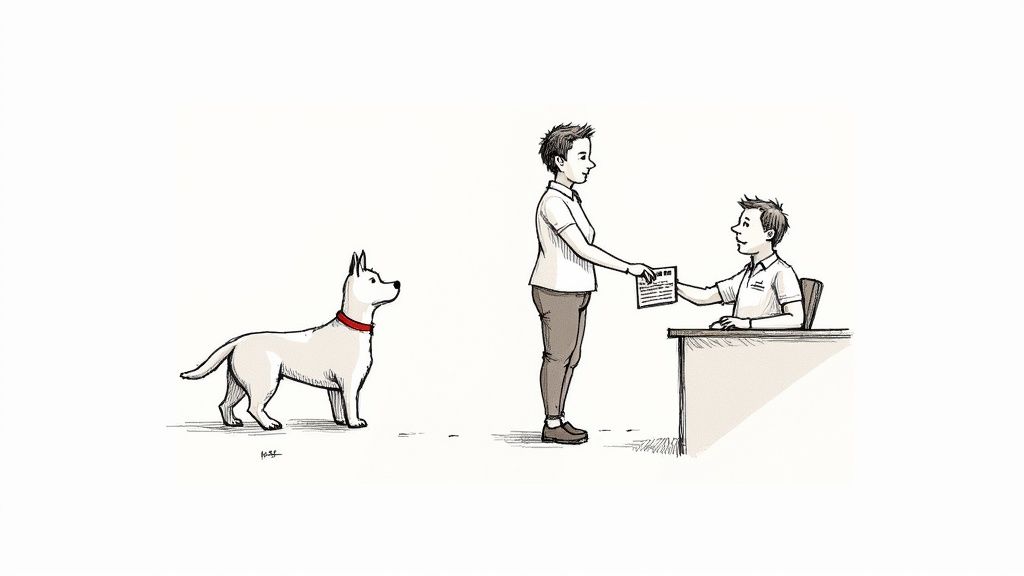
Whether you arrive by air or land, your first stop will be with an officer from the Canada Border Services Agency (CBSA). They're the front line for everyone and everything entering the country, and that includes your furry, feathered, or scaled companion.
Your Interaction with the CBSA Officer
Think of the CBSA officer as the gatekeeper. After reviewing your own travel documents and asking about your trip, they'll turn their attention to your pet. This is the moment to have your pet's entire folder of paperwork ready to go.
Make sure these documents are organized and easy to grab:
Rabies Vaccination Certificate: This is the big one. The officer will check that it's valid, properly signed, and includes your pet's microchip number.
Veterinary Health Certificate: They'll verify it was issued within the required timeframe and correctly filled out by a licensed vet.
Proof of Ownership: This might be adoption papers, a bill of sale, or other documents showing the pet is yours.
The officer might ask a few simple questions about your pet—their age, breed, or where you're coming from. Just answer clearly and confidently. The goal is to show you've done your homework and followed all the rules.
The Role of the CFIA Inspector
In most cases, the CBSA officer handles everything. But if they have any questions, spot a potential issue with your paperwork, or if you're traveling with a species that has more complex rules (like certain birds), you'll be referred to an on-site inspector from the Canadian Food Inspection Agency (CFIA).
The CFIA inspector is an animal health specialist. They'll do a more detailed review of your documents and a visual inspection of your pet. Don't be intimidated; their job is simply to confirm your pet is healthy and meets all of Canada's import requirements, which are in place to protect both animal and public health.
The most common reason for a secondary CFIA inspection is a simple paperwork mistake. A missing signature, an incorrect date, or a rabies certificate that isn't perfectly clear can trigger it. Flawless documents are your best bet for avoiding extra delays.
What Happens During the Pet Inspection
The inspection itself is usually quick and not at all stressful for your pet. The officer or inspector will likely just ask you to take your pet out of their carrier for a moment.
They'll perform a brief visual check to:
Confirm your pet matches the description and microchip number on the documents.
Make sure the animal appears healthy, alert, and shows no obvious signs of illness.
They won't be doing a full veterinary exam. As long as your pet looks well and the paperwork is solid, the whole thing is typically over in a few minutes. It’s nothing to be nervous about—just a final check before you're officially welcomed into the country.
Import Fees and Potential Issues
Be ready to pay a standard inspection fee for animals entering Canada. The fee is currently around $30 CAD per animal, but it's always smart to check the latest fee schedule on the CFIA website before you leave.
So, what happens if there's a problem? If a document is missing or filled out incorrectly, the CFIA officer will calmly explain your options. Depending on the issue, you might need to have a Canadian veterinarian complete the necessary paperwork at your own expense.
For a more serious problem, like a missing or invalid rabies vaccine, the consequences can be more significant. This is why it’s so important to ensure your vet gets all the documentation right from the start. You can learn more about what makes a valid proof of rabies vaccine in our detailed guide. Arriving at the border with complete and accurate paperwork is your ticket to a purr-fectly smooth entry.
Common Questions About Pet Travel to Canada
Even with the most organized plan, it’s natural to have a few questions when you're moving a pet to another country. It’s a detailed process, and a little uncertainty is totally normal.
To help you feel more confident, we’ve put together answers to some of the most common questions we hear. Think of this as your final check-in to make sure all the small but critical details are covered, so you aren’t caught off guard at the border.
How Far in Advance Should I Start Preparing?
This is a big one, and my answer is always the same: start as early as you can.
Ideally, you should kick off the process at least three to six months before you plan to travel. This gives you plenty of breathing room to get everything sorted without the last-minute scramble.
Some steps just can't be rushed. For instance, if your pet needs a new rabies shot after getting a microchip, there's a waiting period before they can travel. Plus, airlines have limited spots for pets, especially in cargo, so booking well in advance is a must.
A longer preparation window is your best friend. It’s a buffer for any unexpected hiccups, like a vet appointment you need to reschedule or paperwork that takes longer than expected to get endorsed. Giving yourself that extra time is the single best way to keep stress levels down for everyone involved—especially your pet.
Does My Pet Need a Canadian-Specific Microchip?
Nope, you don't need a microchip from a Canadian company, but it should be the right type. Canada prefers an ISO 11784/11785 compliant 15-digit microchip. This is the global standard, so most chips implanted in recent years will meet this requirement.
What if your pet has an older, non-ISO chip? You have two choices:
Have your vet implant a second, ISO-compliant chip.
Bring your own compatible microchip scanner with you.
Honestly, the first option is much safer. Relying on your own scanner just adds another potential point of failure during the border inspection. It’s a complication you don't need.
What if My Pet Is a Mixed Breed?
For mixed-breed dogs, the process is pretty much the same as for purebreds. The most important thing is that your vet accurately describes your dog on all the official paperwork, like the health certificate. An entry like "Mixed Breed" or "Shepherd Mix" is perfectly fine.
The one major thing to watch out for is breed-specific legislation (BSL) at the provincial level. The province of Ontario, for example, has rules about pit bull-type dogs. If your mixed-breed dog has physical traits that resemble a specific breed, you could run into issues trying to enter that particular province. Always research the local rules for your final destination.
As you plan your pet’s journey, it's a good time to sort out your own travel details, too, like looking into whether travel insurance is mandatory for visitors to Canada to make sure all your bases are covered.
Can I Bring Pet Food with Me?
Bringing pet food across the border can be surprisingly complicated. As a general rule, you can bring a small, personal amount of commercially packaged, unopened food if it was made in the United States. Think just enough to get you through the first day or two.
But here’s the catch: bringing any pet food with beef or other ruminant ingredients from countries other than the US is generally not allowed because of disease prevention rules. The regulations are strict, and to avoid having your food taken at the border, it’s often much easier to just plan on buying a new bag once you arrive in Canada.
What If My Paperwork Is Not Perfect?
This is where all your careful preparation pays off. If a border officer finds an error on your documents—a missing signature, a wrong date, or a rabies certificate that is not complete—your pet will likely be held until it's fixed.
What happens next depends on the seriousness of the mistake:
For minor errors: You might have to find a licensed Canadian veterinarian to examine your pet and issue new, correct paperwork right then and there, all at your own expense.
For serious issues: If the problem is major, like an invalid rabies vaccination, your pet could be refused entry altogether.
This is exactly why you need to triple-check every single document before you leave home. A simple oversight can quickly turn your smooth arrival into a stressful and expensive ordeal.
Preparing for international pet travel requires serious attention to detail, but it doesn't have to be a nightmare. Passpaw gives veterinary practices the tools they need to manage pet travel documents seamlessly, helping to ensure every requirement is met with accuracy. We make the complex process of getting international health certificates simpler, so you can focus on the exciting journey ahead with your furry family member. Learn more at Passpaw.
More articles
From regulatory changes to best practices for veterinarians and pet owners, our resources keep you ahead of the curve.