Are you a team member in a veterinary practice?
Are you a pet parent planning a trip with your furry pal?
A Complete Guide to Pets Moving Abroad
Moving your pet to another country can feel like a huge task, but with the right game plan, it's absolutely doable. The secret? Start your research early and map out a detailed timeline. This simple approach breaks a complicated process down into clear, manageable stages, leaving you feeling confident and prepared for the journey.
Your Pet's Journey to a New Home
Moving abroad with a furry family member is more common than you might think. It’s a real testament to the deep bond we share with our pets—we see them as irreplaceable family, not just animals.
This feeling is driving a huge boom in the pet relocation industry. The global market for these services was valued at a whopping USD 1.2 billion in 2023 and is on track to more than double by 2032. This growth is fueled by more global job opportunities and the simple truth that home just isn't home without our pets.
This guide is designed to replace that sense of being overwhelmed with a spirit of adventure. We'll break down everything you need to know, from important health documents to airline rules, so you have a clear path forward.
Why Planning Ahead is So Important
Getting a head start—months in advance—is the single most important thing you can do. Rushing often leads to expensive mistakes, and some countries have waiting periods that are simply impossible to speed up.
Here’s why you can't procrastinate:
Complex Timelines: Many destinations, especially rabies-free countries like Japan or Australia, need specific blood tests followed by a waiting period of several months before a pet is even allowed to enter.
Document Coordination: You'll be juggling a stack of documents—vaccination records, microchip details, and an International Health Certificate—and the timing for each has to be just right relative to your departure date.
Airline and Crate Prep: Booking a spot for your pet on a flight and getting them comfortable with their travel crate both take time and patience. Don't leave this to the last minute!
To give you a better sense of the overall process, here's a look at the major stages involved.
Overview of the International Pet Move Timeline
This table gives you a high-level summary of the key stages involved in moving a pet internationally, helping you understand the journey at a glance.
Stage | Primary Focus | Recommended Timeline |
|---|---|---|
Initial Research & Planning | Understanding destination country rules, choosing an airline, and creating a master checklist. | 6-12 months before travel |
Veterinary Preparations | Microchipping, rabies vaccination, and any required blood titer tests. | 4-7 months before travel |
Booking & Logistics | Booking your pet’s flight, purchasing an IATA-compliant crate, and starting crate training. | 2-4 months before travel |
Final Documentation | Scheduling the final vet visit for the International Health Certificate and getting USDA endorsement. | 10-30 days before travel |
Pre-Departure | Final health checks, confirming all reservations, and packing your pet’s travel essentials. | The week of travel |
As you can see, the entire process is a puzzle where every single piece has its place.
A well-organized timeline, like one you can build with a dedicated pet travel planner, acts as your guide, ensuring no detail gets missed.
To really kick off this journey well-prepared, it's a good idea to understand the full scope of how to safely relocate with a pet. Thinking ahead prevents that last-minute panic and helps ensure a smooth, paws-itive experience for everyone.
Let's get this amazing adventure started.
Handling Essential Vet Visits and Paperwork
Once you’ve figured out your destination’s rules, it's time to tackle the most detailed part of moving a pet abroad: the vet visits and paperwork. This is where precision and timing become everything. Think of it as building your pet’s passport for their big adventure—every single stamp, signature, and date has to be perfect.
Navigating this can feel like a maze, but breaking it down into clear steps makes it entirely manageable. Getting this part right is the difference between a smooth journey and getting hit with unexpected, expensive delays at the border. Let's walk through the key health preparations that form the backbone of your pet's international travel plan.
This timeline gives you a bird's-eye view of the major phases involved in prepping for an international move with your pet.
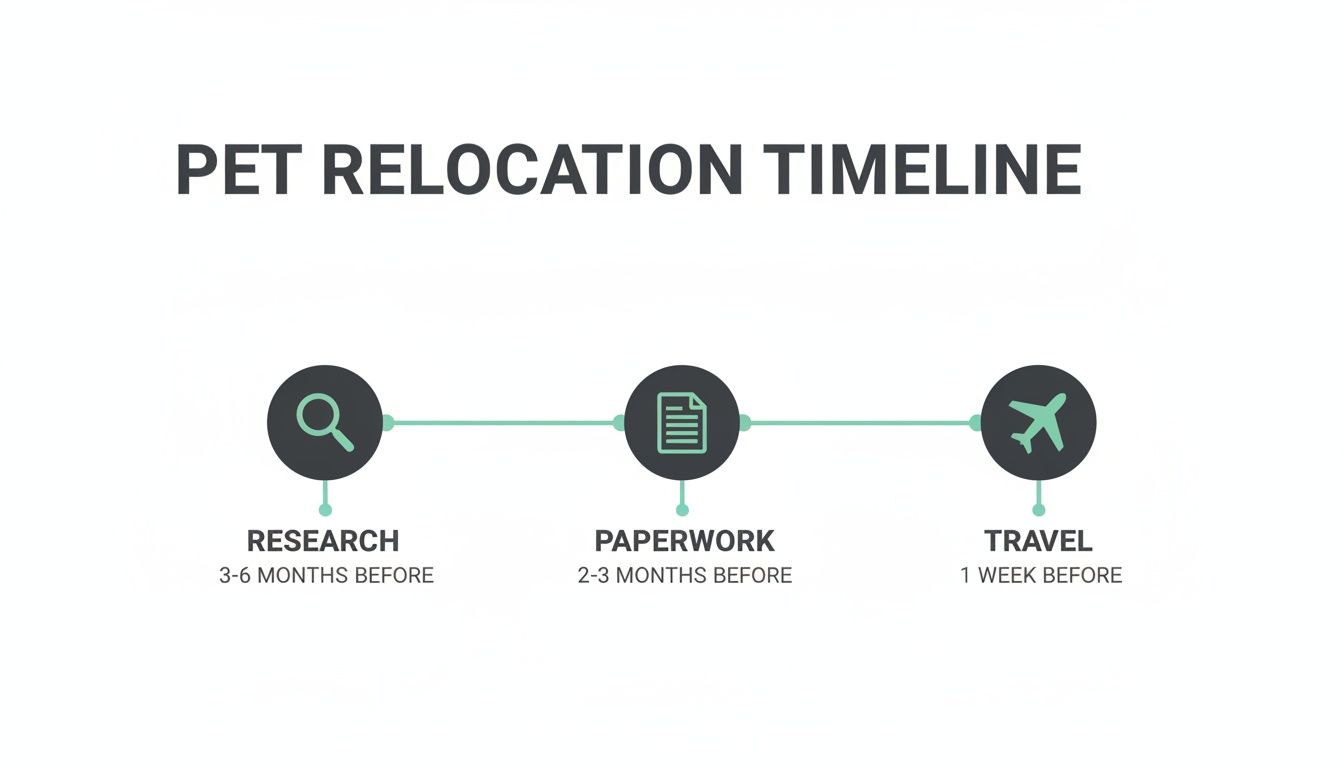
As you can see, the paperwork phase is the critical bridge between your early research and the actual travel day. It requires serious attention to detail.
The Universal First Step: A Microchip
Before a single vaccine is given or test is run, your pet needs an ISO-compliant microchip. This is the first step for almost every country on the planet. An ISO-compliant chip is a 15-digit microchip that can be read by standard scanners worldwide, ensuring your pet can be identified no matter where they are.
If your pet is already chipped, your vet can do a quick scan to confirm its type. If it's not ISO-compliant, you’ve got two choices: implant a second, compliant chip, or carry your own scanner. Honestly, implanting a second chip is usually the simplest and most reliable route.
Here’s the important part: the microchip should be implanted before the rabies vaccination. Any vaccines given before the chip is in place are often not considered valid for travel. This tiny detail can completely derail your timeline, so always make sure the vet scans and records the chip at the visit.
Rabies Vaccinations and Titer Tests
The rabies vaccine is another cornerstone of international pet travel, but the timing is what really trips people up. Most countries ask for the vaccine to be given at least 21 to 30 days before travel. This waiting period is to ensure the vaccine has become fully effective.
But for many rabies-free or rabies-controlled destinations (like countries in the EU, Japan, or Australia), a simple vaccination isn't enough. These places also ask for a Rabies Titer Test—a blood test that shows the vaccine has provided enough immunity.
You should follow this sequence exactly:
Implant the Microchip: This absolutely should happen first.
Administer the Rabies Vaccine: Done after the microchip is confirmed.
Wait: There's usually a waiting period (often 30 days) after the shot before blood can be drawn for the titer test.
Draw Blood for the Titer Test: The sample must be sent to a government-approved lab for analysis.
Wait Again: After a successful result, another waiting period (typically 3 months or more) is required before your pet can enter the country.
This multi-month timeline is precisely why you need to start early. One mistake in this sequence, and you could be starting all over again.
Decoding the International Health Certificate
The final key document is the International Health Certificate (IHC). This is an official form completed by a USDA-accredited veterinarian declaring your pet is healthy, parasite-free, and fit to travel. It also confirms that every single one of the destination country's import rules has been met.
The IHC is extremely time-sensitive. Most countries ask for it to be issued within 10 days of your pet's arrival. After your vet fills it out, the certificate may then need to be endorsed (stamped and signed) by a government body like the USDA's Animal and Plant Health Inspection Service (APHIS) in the U.S. That government endorsement is the final seal of approval.
For a deeper dive into this crucial document, you can learn more about the specifics of the veterinary international health certificate.
Real-World Scenario: Moving a Dog from the US to Spain
Let's say you're moving your dog, Luna, from Texas to Madrid. Spain is in the EU, and their rules are strict. Here’s how Luna’s paperwork journey would play out:
6 Months Out: Luna gets her ISO-compliant microchip. At the same appointment, her rabies vaccine is updated.
5 Months Out: 30 days after her rabies shot, Luna goes back to the vet to have her blood drawn for the rabies titer test. The sample is sent off to an approved lab.
4 Months Out: The successful results come back. Now, the 3-month waiting period begins, counting from the date the blood was drawn.
10 Days Before Flight: You take Luna to her USDA-accredited vet for a final health check. The vet completes the official EU Health Certificate.
7 Days Before Flight: You overnight the completed certificate to the USDA for its official endorsement.
3 Days Before Flight: The endorsed, official certificate arrives back. You now have all the paperwork needed for Luna’s trip.
This example shows how every step is a domino—one must fall correctly for the next one to follow. Tracking these dates with precision is absolutely vital to avoid a cat-astrophe at the airport.
Understanding Country-Specific Import Rules
When it comes to moving pets abroad, here’s the golden rule: no two countries are the same. Every single nation sets its own import regulations, and trying to apply a one-size-fits-all approach is a recipe for disaster. Think of it like a human visa—your pet needs their own special "visa" made up of health documents tailored exactly to your destination.
This is why your very first step, before booking flights or packing bags, is to find the official, most current import requirements for your destination country. Getting this right from the start is what prevents a bad scenario where your pet is denied entry or forced into a lengthy, expensive quarantine. It’s not just paperwork; it’s their ticket to a new life with you.
Finding Official Government Sources
The internet is full of advice, but for something this important, it's best to go straight to the source. Your primary resource should always be the official government website for your destination, which is usually the Ministry of Agriculture or a similar agency.
Navigating these government sites can feel a bit clunky, but the information you’ll find there is the only information that truly matters. Keep a sharp eye out for any recent updates, as regulations can and do change without much warning. It's a smart move to bookmark the official page and check it from time to time as you plan your move.
If you’re feeling overwhelmed, Passpaw is a great place to start. We compile requirements for many popular destinations to give you a clear roadmap for the journey ahead. You can see a list of our supported countries to get a feel for what’s needed.
Why Rules Vary So Drastically
So, why are the rules so different from one place to another? It really boils down to biosecurity, and the big one is rabies. A country's rabies status is the single biggest factor determining how complex its import process will be.
Rabies-Free Countries: Nations like Australia, Japan, New Zealand, and the UK are incredibly strict to protect their rabies-free status. Moving a pet here often involves long waiting periods after rabies titer tests and, in some cases, mandatory government quarantine upon arrival.
Rabies-Controlled Countries: Most countries in the European Union and North America fall into this category. They have solid vaccination programs and clear protocols. The process is still strict, but it's generally more straightforward and rarely involves a long quarantine if you follow every step perfectly.
This difference is very important because it shapes your entire timeline. Moving a dog to Germany, for instance, is a completely different project from moving that same dog to Singapore. One might take a few months of planning, while the other could require more than six.
A Tale of Two Kitties: A Practical Comparison
To see just how much these rules can diverge, let’s compare the real-world process of moving a cat from the United States to two popular destinations: the United Kingdom and the United Arab Emirates. This isn’t just a theoretical exercise; it shows exactly why the small details matter so much.
The table below gives you a snapshot of what to expect. Just remember, these rules are for illustration and can change—always verify everything with official government sources.
Example Country Requirement Comparison for a Cat
A look at how entry requirements for a pet can differ dramatically between two popular destinations.
Requirement | United Kingdom | United Arab Emirates |
|---|---|---|
Microchip | ISO-Compliant 15-digit chip required. | ISO-Compliant 15-digit chip required. |
Rabies Vaccination | Required at least 21 days before arrival. | Required, plus other core vaccines like FVRCP. |
Rabies Titer Test | Not required for pets entering from the US. | Required, with blood drawn at least 21 days after vaccination. |
Import Permit | Not required for a non-commercial move. | Required. Must be obtained before travel. |
Parasite Treatment | Tapeworm treatment required 1-5 days before arrival. | Internal and external parasite treatments required within 14 days of travel. |
Quarantine | No quarantine if all rules are met. | No quarantine if all rules are met. |
As you can see, even for two countries that don't require quarantine, the specific tests, treatments, and permits are completely different. The UAE asks for a titer test and an import permit, neither of which the UK asks for from US-origin pets. Meanwhile, the UK has that very specific tapeworm treatment window that you have to hit perfectly.
A small mistake, like getting the tapeworm treatment six days before your UK flight instead of five, could mean your pet is denied entry. This is why double-checking every detail isn't just recommended—it's essential for a smooth and purr-fectly executed move.
Choosing the Right Airline and Travel Crate
Of all the decisions you'll make when moving your pet abroad, picking the right airline and travel crate is easily one of the most important. Your pet’s entire journey hinges on their safety and comfort, and these two choices have the biggest impact. Getting this part right means they arrive safe and sound; a mistake can lead to major stress or, worse, a canceled trip.
First things first: you need to research airlines known for being genuinely pet-friendly. Not all carriers are the same. Some have fantastic reputations and dedicated programs for animal transport, while others… don't. Look for airlines with solid pet safety records and clear, accommodating policies.
In-Cabin, Checked Baggage, or Manifest Cargo
Your pet can fly in one of three ways. The best option really depends on their size, your destination, and the airline's specific rules.
In-Cabin: This is the dream for small pets who can fit in a carrier under the seat in front of you. It's usually the least stressful method since your pet is with you the whole time, but it’s strictly for the little guys.
Checked Baggage: Some airlines let pets travel as excess baggage in the cargo hold. While it can be convenient, this option is becoming less common for international flights because of inconsistent regulations between countries.
Manifest Cargo: This is how most pets fly internationally, especially larger dogs or animals traveling to countries that require it (like the UK). They travel in a pressurized, climate-controlled section of the cargo hold designed specifically for live animals. It might sound a bit scary, but reputable airlines have very strict procedures to keep them safe.
You also have to watch out for airline restrictions. Many have temperature embargoes, which means they won't fly pets in cargo during the peak of summer or the dead of winter. This is to protect them from extreme heat or cold on the tarmac and can throw a real wrench in your travel dates if you're not prepared.
Finding the Paw-fect Travel Crate
Think of the travel crate as your pet’s private suite for the flight. It must be secure, comfortable, and follow all the rules. The International Air Transport Association (IATA) sets the global standards for travel crates, and airlines are very strict about these regulations. Show up with a non-compliant crate, and you'll be turned away at check-in. No exceptions.
Here’s what to look for in an IATA-compliant crate:
The Right Size: Your pet has to be able to stand up, turn around completely, and lie down in a natural position. Measure your pet from the top of their head to the floor (for height) and from their nose to the base of their tail (for length) to get the right fit.
Strong and Secure: The crate should be made of hard plastic, wood, or metal. The door has to be metal—absolutely no plastic doors or side latches. All the hardware, like the nuts and bolts holding it together, should be metal, too.
Good Ventilation: To ensure there's enough air, the crate needs to have ventilation on at least three sides.
Food and Water Bowls: It should come with separate food and water dishes that clip onto the inside of the door. This allows airline staff to refill them from the outside without opening the crate.
For a deep dive into all the specifics, check out our complete guide on selecting an airline travel pet carrier.
Real-World Scenario: Preparing an Anxious Dog for a Long Flight
Let's say you're moving with Max, a nervous Golden Retriever. The key to a smooth flight isn't sedation—it's making the crate his happy place. You should start this process weeks, or even months, ahead of your flight.Put his favorite blanket and toys inside. Start feeding him his meals in the crate. Every time he goes in on his own, praise him. Slowly, you can start closing the door for longer periods until he’s totally relaxed in there. This positive association works wonders and is so much safer than sedatives, which most vets and airlines strongly advise against.
Your Travel Day Checklist and Common Mistakes
The big day is here. After all the planning, paperwork, and crate training, it’s finally time to get your pet on their way. Staying organized and keeping a cool head is everything right now—a little preparation at home will save you a ton of stress at the airport.
This final pre-flight checklist is designed to help you feel completely ready for takeoff. We'll also walk through some common, easy-to-make mistakes that can cause major headaches at the check-in counter. Nailing this last step is the key to a calm, successful departure.
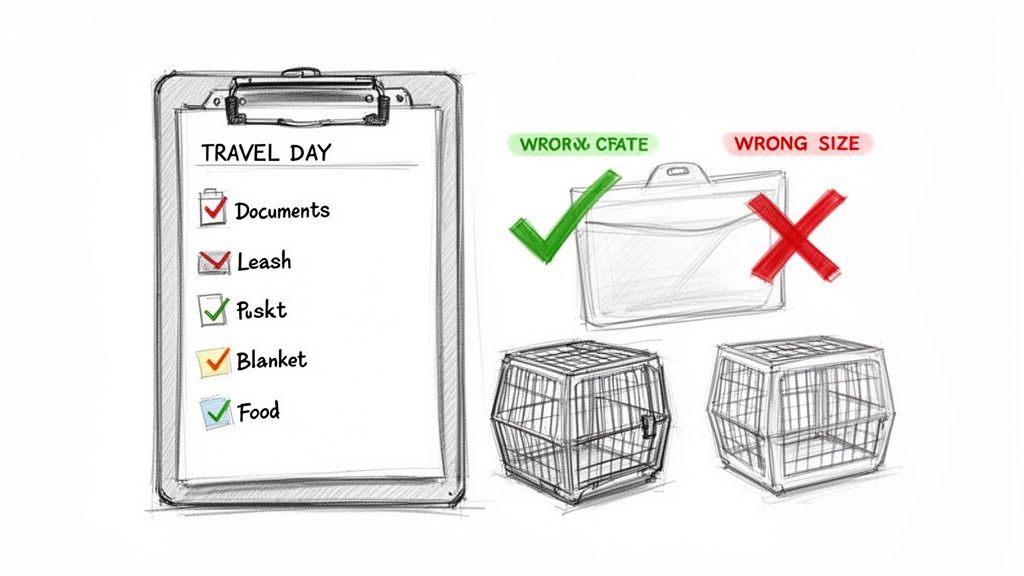
The Ultimate Travel Day Checklist
Think of this as your pet’s carry-on. Having these items organized and within easy reach will make the entire airport process go much more smoothly.
Document Fortress: Keep every single original document—the International Health Certificate, rabies certificate, and any import permits—tucked away safely in a waterproof folder. Yes, have digital backups on your phone, but airline staff and customs officials will absolutely need to see the original hard copies.
Pet Go-Bag: Pack a small, accessible bag with essentials for your arrival. This should include their leash, a familiar blanket or toy to offer some comfort, a small bag of their usual food, and a collapsible water bowl.
Crate Comfort: Double-check that their travel crate is set up properly. It needs absorbent padding on the floor, food and water bowls securely attached to the inside of the door, and clearly visible "Live Animal" stickers on the outside.
Remember, a calm owner usually means a calm pet. They pick up on your energy, so take a deep breath and trust that you've done the work.
A final tip: a few hours before heading to the airport, take your dog for a nice long walk or have an energetic play session with your cat. A tired pet is much more likely to settle down and rest during the journey.
Common Pitfalls and How to Avoid Them
Even the most organized planner can hit a snag on travel day. Knowing the most common traps is the best way to sidestep them entirely.
There’s a good reason for all this careful planning: pet travel is booming. The market was valued at USD 2.4 billion and is projected to more than double by 2033. This growth is largely driven by younger generations who view their pets as non-negotiable family members. With so many more pets taking to the skies, airlines and destination countries are stricter than ever. You can learn more about the trends shaping the pet travel industry.
Miscalculating the Final Vet Visit
This is one of the most frequent and heartbreaking errors we see. Most countries ask for the International Health Certificate to be completed and signed within a very tight window, often just 10 days before you land.
The Mistake: Booking the vet appointment too early (which invalidates the certificate) or cutting it too close (leaving no time for the government endorsement).
How to Avoid It: The moment your flight is booked, grab a calendar. Count backward from your arrival date to pinpoint the exact window for your vet visit. Schedule it right then and there, and put reminders in your phone, on your fridge—everywhere.
Using the Wrong Microchip
All that paperwork becomes worthless if your pet’s microchip doesn’t match what’s on the forms or, worse, can’t be read by a standard scanner. An ISO-compliant, 15-digit microchip is the universal standard for a reason.
The Mistake: Simply assuming your pet’s old chip is compliant without checking. Another classic error is forgetting the rule that the microchip should be implanted before the rabies vaccination is given.
How to Avoid It: At your very first travel prep appointment, ask your vet to scan and confirm the microchip type. If it’s not an ISO-compliant chip, get one implanted on the spot.
Buying a Non-Compliant Crate
Showing up at the check-in desk with the wrong travel crate is an absolute dealbreaker. Airlines do not make exceptions to the IATA rules.
The Mistake: Grabbing a crate with a plastic door, plastic fasteners, or not enough ventilation. Another common slip-up is getting a crate that’s too small for the pet to stand up and turn around in comfortably.
How to Avoid It: Buy your crate weeks ahead of your travel date. Check it against IATA standards: it should have a metal door, metal nuts and bolts holding it together (no plastic clips!), and ventilation on at least three sides. Let your pet get used to it at home so it becomes their safe, familiar den long before the flight.
Steering clear of these simple mistakes can save you a world of last-minute stress and money. A smooth departure is the first step to a happy arrival as you start your new life together.
Frequently Asked Questions About Moving Pets Abroad
Even the most organized person will have questions when moving a pet internationally. It’s a process with a ton of moving parts, and it’s perfectly normal to want some clarity on the details. This section tackles the most common questions we hear from pet owners and vets alike.
Think of this as your quick-reference guide for those moments of doubt. We'll cover everything from planning timelines to crucial documents, clearing up any confusion so you can finalize your plans with confidence.
How Far in Advance Should I Plan My Pet's Move?
The golden rule? Start planning at least six months ahead. I know that sounds like a long time, but for certain destinations with strict biosecurity rules, it’s an absolute necessity. Countries like Australia or Japan, for instance, have timelines due to rabies titer tests that require long, mandatory waiting periods.
For many other places, you can often get by with a 3-4 month lead time. But trust me, giving yourself more time is always better. An early start gives you a comfortable buffer for scheduling vet visits, processing paperwork, booking flights, and—most importantly—getting your pet happy and comfortable in their travel crate. It's the best thing you can do to keep stress levels low for everyone.
What Is an International Health Certificate?
An International Health Certificate (IHC) is the official document completed by a USDA-accredited veterinarian. It's the formal proof that your pet is healthy and meets every single import requirement of your destination country—from vaccinations to specific parasite treatments.
This document is incredibly time-sensitive. It typically has to be issued and then endorsed by a government authority (like the USDA in the US) just before you leave, often within 10 days of your pet's arrival. It’s a completely separate document from an EU Pet Passport, which is only used for travel between EU member states once your pet is already living there.
The IHC is your pet’s official ticket to fly. A simple error on this form—even a wrong date or a transposed number—can lead to serious problems at the border. Accuracy is everything.
Should I Sedate My Pet for the Flight?
This question comes up all the time, but the answer from nearly every expert is a firm no. The vast majority of veterinarians and airlines strongly advise against sedating pets for air travel. Sedation can mess with a pet's ability to regulate their body temperature and maintain balance, which is risky at high altitudes.
The American Veterinary Medical Association (AVMA) specifically recommends against it. Instead of sedatives, your energy is much better spent on positive crate training. The goal is to make the crate a safe, familiar, and even cozy space for your pet long before the flight. If your pet has extreme anxiety, talk to your vet about non-sedative calming options well in advance. For more general advice, Romingo also has a great section covering general pet travel questions.
What Happens If My Pet’s Paperwork Has an Error?
A paperwork mistake can cause a complete cat-astrophe. Seriously. Depending on the error and how strict the destination country is, the consequences can be severe. Your pet could be denied entry and put on the next flight back home—at your expense.
In other cases, they could be forced into a long and costly quarantine until the paperwork is corrected. This is precisely why every single detail, from the microchip number to a vet's signature, has to be perfect. On this part of the process, there is simply no room for error.
Feeling a little overwhelmed by the deadlines and details? Passpaw is here to help. Our platform creates a clear, manageable path for veterinarians to prepare all the necessary documents for pets moving abroad, ensuring every detail is correct and accounted for. Make your pet’s journey a smooth one by visiting https://passpaw.com to see how we can help your vet clinic.
More articles
From regulatory changes to best practices for veterinarians and pet owners, our resources keep you ahead of the curve.