Are you a team member in a veterinary practice?
Are you a pet parent planning a trip with your furry pal?
Pet Shipping Rates: A Guide to Pet Shipping Costs
So, how much does it really cost to ship a pet? For a domestic trip within the US, you can generally expect to pay anywhere from $500 to over $2,000. If you're planning an international move, the range widens considerably, from $2,000 to $10,000 or even more.
These pet shipping rates cover a lot more than just a ticket—they're an investment in making sure your furry family member travels safely, comfortably, and without a hitch.
Your Quick Guide To Pet Shipping Rates
Moving a pet isn't like mailing a package or even booking a flight for yourself. It’s more like arranging a special travel experience for a VIP—a Very Important Pet. The price reflects all the detailed planning needed to ensure their journey is safe, secure, and meets all travel guidelines. It's not just about getting from A to B; it's about doing it with the highest standard of care.
While the numbers might seem high at first glance, they cover a whole suite of essential services. These services go far beyond the flight itself and are all designed to protect your pet's well-being.
What Goes Into The Price Tag
The final quote you receive is a sum of several different parts, and each one plays a key role in a successful move. Understanding these components helps demystify the cost and shows you the value behind the investment in your pet’s journey. The main costs usually include:
Airfare or Ground Transport: This is typically the largest chunk of the fee. It's determined by your pet's size, weight, and the distance they're traveling.
Travel Crate: A sturdy, airline-compliant crate is a must-have. It's a key piece of equipment for their safety and comfort.
Veterinary Services: This covers the necessary health check-up and the official health certificates needed for travel.
Administrative and Handling Fees: These fees account for all the behind-the-scenes logistics, paperwork processing, and professional coordination of the entire move.
The whole point of hiring a professional pet shipper is to have someone manage all these moving parts seamlessly. By handling the complex requirements, they help prevent delays or other issues that could add stress for both you and your pet.
For a deeper dive into what influences the final price, you can explore our complete guide to pet transportation costs, which breaks down every single factor.
To give you a clearer picture of where your money goes when arranging your pet's travel, we've put together a quick overview of the main cost components and what they typically cover.
At-A-Glance Breakdown Of Pet Shipping Costs
This table summarizes the main factors that contribute to the total pet shipping rate, helping you quickly understand the services you are paying for.
Cost Component | Typical Price Range (USD) | What It Covers |
|---|---|---|
Airline or Ground Fee | $300 - $8,000+ | The core travel ticket, based on pet size, weight, and distance. |
Veterinary Services | $100 - $1,000+ | Health exams, vaccinations, and required travel certificates. |
Travel Crate | $75 - $500 | An IATA-compliant crate ensuring your pet's safety and comfort. |
Agent/Handling Fees | $300 - $2,000 | Professional coordination, booking, and document management. |
Seeing it all laid out like this makes it easier to understand that you're not just paying for a flight, but for a complete service dedicated to your pet's welfare.
The Core Factors That Drive Pet Shipping Costs
Ever look at a pet shipping quote and wonder where the numbers come from? It's a lot like booking your own plane ticket—the final price isn't just one flat fee. It’s a mix of different costs, just like your ticket price changes based on the destination, seat choice, and how many bags you check.
Getting a handle on these variables is the first step to understanding any quote you receive. It helps you see exactly where your money is going and appreciate what it takes to get your best friend safely to their new home. So, let's break down the main factors that shape the final cost.
This diagram shows how the total cost is built from three main pillars: the flight, vet and health needs, and the travel crate.
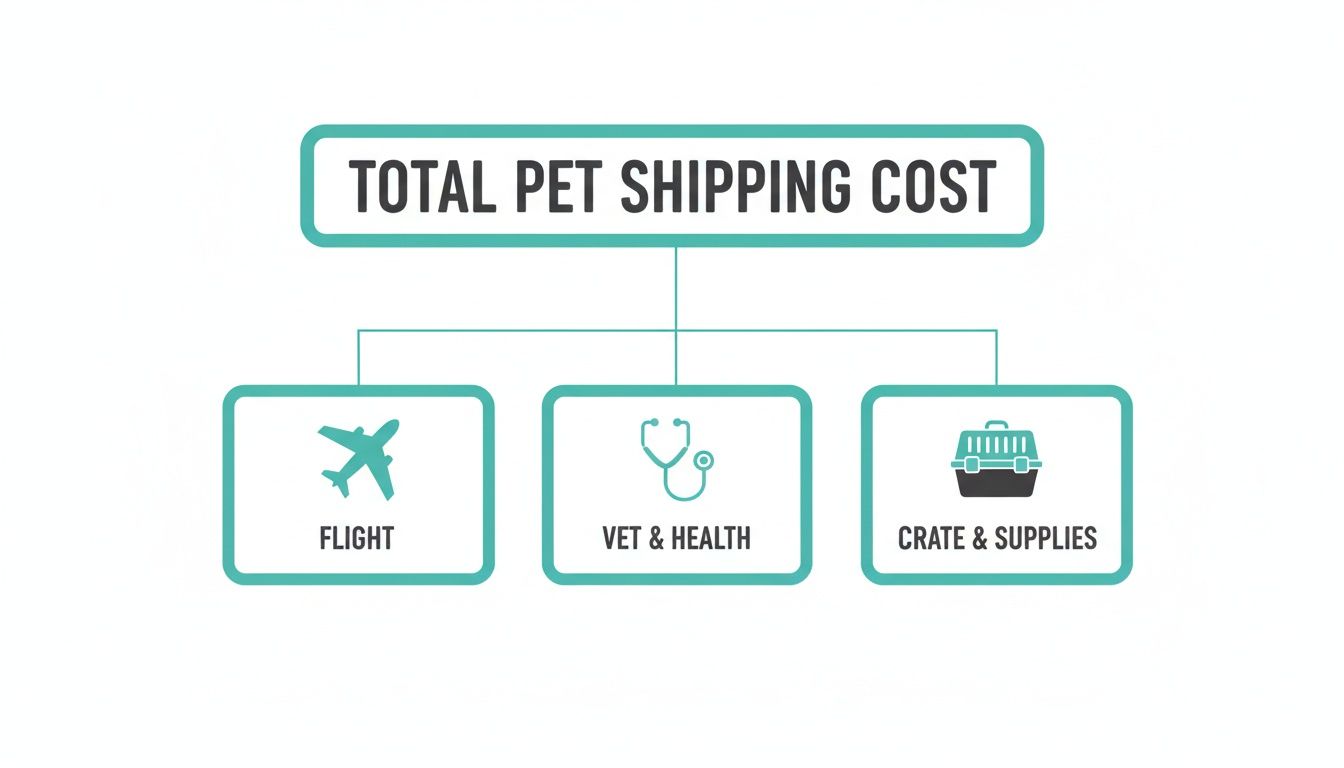
As you can see, the final rate is a sum of these essential parts. Each one plays a key role in a safe and smooth journey.
Your Pet’s Size and Weight
This is almost always the biggest driver of the price, especially for air travel. Airlines don't just charge based on your pet's actual weight; they charge for the space the travel crate takes up in the cargo hold. A Great Dane in a giant crate will naturally cost more to fly than a Chihuahua in a small carrier because it takes up more room on the plane.
Think of it like shipping a big piece of furniture versus a small box. The bigger and bulkier the item, the more it costs. Airlines use a formula called volumetric weight, which considers both the size and weight of the crate to calculate the fee.
Key Takeaway: A bigger travel crate means a higher airline fee. Measuring your pet correctly to get the right-sized crate isn't just about comfort—it's essential for getting an accurate quote.
The Journey’s Distance and Route
No surprises here: a short, domestic flight is going to be cheaper than a long-haul international trip. Flying a pet from Chicago to Denver is a much simpler (and less expensive) puzzle than moving them from Chicago to Tokyo. The farther they go, the higher the airfare.
But it’s not just about mileage. The specific route also plays a big part. Direct flights are usually preferred and can sometimes be more cost-effective. Routes with multiple layovers often come with extra handling fees and add layers of complexity, bumping up the price. International destinations also bring their own import rules and taxes into the mix.
Mode of Transportation: Air vs. Ground
You've really got two main options for moving your pet: flying or driving. Each has its own pricing structure and makes sense for different situations.
Air Travel: This is the go-to for long-distance domestic moves and pretty much all international relocations. It's fast. The cost is driven by the crate size, the pet's size, and the airline's specific cargo fees.
Ground Travel: For shorter, regional moves—think a day's drive or less—ground shipping can be a great, and often more affordable, alternative. These services typically charge by the mile and can be a lot less stressful for pets that aren't a good fit for flying.
The right choice comes down to balancing cost, distance, and your pet’s personality and health. What works for a tiny kitten moving one state over is definitely not the right call for a large dog heading overseas. The core principles behind these transport decisions are rooted in foundational animal care knowledge and general standards for animal welfare.
The All-Important Travel Crate
Your pet’s travel crate is more than just a box—it’s their personal travel suite. It has to be IATA-compliant, meaning it meets strict international standards for safety, ventilation, security, and size. You can't just grab any old carrier from the pet store.
This is an expense you can't skip. An airline will refuse to board a pet if the crate isn't up to snuff. A proper, airline-approved crate can cost anywhere from $75 to over $500, depending on the size and quality you need. It’s an upfront investment, but it's an absolute necessity for your pet's safety.
The demand for professional pet transport has grown. The global market for these services was valued at around $2.4 billion in 2023-2024, which shows just how many owners are prioritizing safe, expert-led transport for their animals.
Unpacking The Other Fees In Your Pet Shipping Quote
The airline ticket or ground transport fee is a big piece of the puzzle, but it's really just the starting point. A complete quote pulls together several other important fees that make sure your pet’s journey is safe, compliant, and goes off without a hitch. It's easy to think of these as "hidden costs," but a better way to see them is as essential investments in your pet's well-being.
These extra services are all the behind-the-scenes work that makes a complicated move feel simple. From the vet paperwork to expert handling at the airport, each line item covers a vital step. Let's pull back the curtain on these charges so you can read your quote with confidence.
The All-Important Veterinary Health Certificate
Before any pet can travel, a vet has to give them the official all-clear. This comes in the form of a health certificate, a document confirming your pet is healthy, vaccinated, and fit to fly. This isn't just a suggestion; it's a firm rule for airlines and destination countries.
For a simple domestic trip, you might spend between $100 and $250. International travel, however, is a whole different ballgame. It often requires specific blood tests (like a rabies titer), parasite treatments, and official government endorsements, which can push the vet bill from $200 to over $1,000. It’s a necessary step to meet all the entry rules.
Why Professional Pet Shipper Fees Are Worth It
Trying to figure out pet travel on your own can feel like a headache of airline rules, confusing import laws, and a mountain of paperwork. This is where a professional pet shipper saves the day. Their fee covers the expert coordination of your pet’s entire move from start to finish.
A great pet shipper handles things like:
Booking the best, pet-friendly flight with an airline known for safety.
Making sure every document is correct and filed on time to avoid expensive delays or, worse, being turned away at the border.
Coordinating with people on the ground at both airports for a smooth handover.
Providing 24/7 support and updates so you can actually breathe while your best friend is in transit.
Their expertise helps you avoid the common mistakes that could lead to much higher costs down the line, like a last-minute canceled flight because of the wrong form. They’re your pet’s personal travel agent and logistics pro, all in one.
A professional shipper's fee isn't just for booking a flight. It's for their deep knowledge of a complex global system, saving you from stressful and expensive mistakes that are all too easy to make on your own.
Airport Handling and Terminal Fees
Even with a flight booked, there's a lot that needs to happen on the ground at the airport. This is where handling fees come in. These charges cover the specialized services needed to safely get your pet from the check-in counter to the plane, and from the plane back to you when they land.
These fees pay for the dedicated staff who make sure your pet waits in a safe, temperature-controlled area, gets loaded onto the plane last (and unloaded first), and is handled with care the whole time. These charges usually run between $125 and $350 per airport and are standard for keeping your pet secure.
To give you a clearer picture, here’s a breakdown of the additional fees you'll likely see on a complete pet shipping quote.
Common Additional Fees In Pet Shipping
This table outlines common service and compliance fees that are often part of a complete pet shipping quote, helping you budget more accurately.
Fee Type | Common Cost Range (USD) | Purpose Of The Fee |
|---|---|---|
Veterinary Certificate | $100 - $1,000+ | Covers the required health exam, vaccinations, and official travel documents. |
Pet Shipper/Agent Fee | $400 - $2,500 | For professional logistics management, booking, and document coordination. |
Airport Handling Fees | $125 - $350 per airport | Pays for specialized staff to care for your pet at departure and arrival terminals. |
Quarantine Reservation | $250 - $2,000+ | A stay in a government facility required by some rabies-free countries. |
These fees are not add-ons but core components of a safe and successful move. Understanding what they cover helps you see the true value in a professionally managed relocation.
The Possibility of Quarantine Costs
Some destinations, especially rabies-free countries like Australia, New Zealand, and Japan, have very strict rules to protect their local animals. One of these is a mandatory quarantine period upon arrival. This means your pet will have to stay at a government-run facility for a set number of days or weeks before they can come home with you.
These costs are paid directly to the destination government. The fee covers your pet's boarding, food, and care during their stay, and it can range from a few hundred to several thousand dollars. If you're moving to one of these countries, it’s crucial to factor this into your pet shipping rates so it doesn't come as a fur-raising surprise.
How Travel Distance And Destination Impact Your Rate
It’s one thing to see a list of cost factors, but how do they actually add up in the real world? The journey itself—both how far your pet is going and where they land—is one of the biggest drivers of your final quote. A simple domestic hop has a completely different price tag than a complex international move, and it’s about more than just the mileage.
To make this tangible, let's walk through a few real-world scenarios. We'll explore the typical price ranges for common routes to show you how geography and local rules shape the final bill. Just remember, every pet’s move is different, so think of these as helpful benchmarks, not exact quotes.
Domestic Travel Across The United States
For a straightforward domestic flight, like from New York to Los Angeles, the rate is mostly determined by your pet's size and the airline's cargo fees. This is the most direct type of pet shipping you'll encounter.
Typical Price Range: $700 – $2,500
Main Variables: The single biggest factor here is the size of the travel crate. A small cat will be on the lower end, while a Great Dane needing a custom crate will push the cost toward the higher end. Your choice of airline also plays a part, as some have higher base fees for live animals.
North America to Europe
Moving a pet across the Atlantic introduces a layer of international rules, which adds both complexity and cost. A trip from Chicago to Frankfurt, for instance, requires much more than just a flight booking.
Typical Price Range: $2,500 – $5,000
Main Variables: This kind of move demands an international health certificate with specific EU requirements, bumping up the veterinary costs. You'll also face airport handling fees on both sides of the pond. The final price will swing based on the airline, your pet's size, and whether you need a hand navigating customs clearance upon arrival.
When your pet's journey involves multiple flights, logistics become even more critical. Coordinating efficient airport transfers between Guarulhos and Congonhas, for example, shows how ground transport between flights can add another layer to both the cost and the planning.
Complex International Relocation To Australia
Destinations like Australia have some of the toughest import rules on the planet, all designed to protect their unique ecosystem. Moving a pet there from the U.S. is a long, multi-step process, and the price reflects that.
Typical Price Range: $5,000 – $10,000+
Main Variables: The high cost is driven by mandatory government quarantine upon arrival, extensive blood tests (like the Rabies Titer test) needed months in advance, and complex import permits. These administrative and veterinary hurdles make it one of the most expensive moves you can plan for a pet.
Why Destination Matters So Much
It’s not just about the distance; local infrastructure and demand play a huge role. For example, why do rates vary so much between different regions? It often comes down to market imbalances. North America accounts for a massive 40.2% to 40.6% of global pet travel revenue. In other words, for every $10 spent worldwide on moving pets, about $4 is spent right here.
This concentration of services can make popular routes more competitive, but it also means less-traveled routes can be more complicated. A country that sees few incoming pets might have less streamlined customs processes, adding time and expense.
Navigating the rules for a move to Asia, for example, can be incredibly detailed. That’s why resources like our guide on moving a pet from the United States to Japan are so essential for planning. Every country writes its own rulebook, making the final destination just as important as the starting point in calculating your pet's shipping rate.
Smart Ways To Manage Pet Shipping Costs
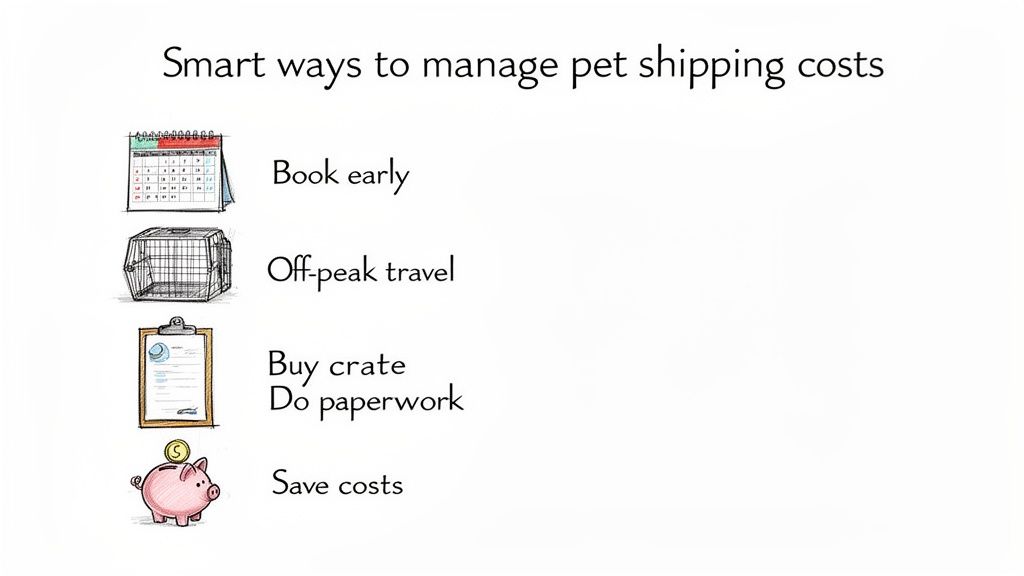
Watching the numbers on a pet shipping quote add up can be a little jarring, but there are plenty of smart ways to manage the costs without ever cutting corners on your pet's safety. The best strategy is a proactive one. With a bit of planning, you can avoid surprise fees and make the whole process smoother for both you and your furry travel companion.
The absolute key is to think ahead. Last-minute arrangements almost always cost more because you'll have fewer flight options and may face rush fees for getting paperwork in order. When you start early, you give yourself the time and space to find the best solutions for your pet and your wallet.
Book Your Pet's Travel In Advance
This one works just like it does for human air travel: booking your pet’s flight well in advance can lead to some serious savings. Airlines have very limited space for pets in their cargo holds, and these coveted spots fill up fast, especially on popular routes. Waiting until the last minute might leave you with only expensive choices—or even no available flights at all.
Booking at least a month or two ahead gives you the flexibility to choose the most cost-effective and direct route for your pet. It’s a simple step that helps you lock in better pet shipping rates before they climb due to high demand.
Travel During The Off-Peak Season
If your moving dates have some wiggle room, think about traveling during the off-season. The busiest (and most expensive) times to fly pets are typically during the summer months and around major holidays. Airlines often raise their prices during these periods because of the surge in demand for all types of cargo.
Opting for a move in the spring or fall can often result in lower airfare. As a bonus, avoiding peak travel times means airports are generally less crowded, which can create a much calmer travel experience for your pet from start to finish.
Proactive planning is the most effective tool for managing pet shipping costs. By making smart decisions about timing, crate selection, and paperwork, you can significantly reduce your final bill while ensuring a safe journey.
Get The Right Crate Early
Your pet's travel crate is a must-have expense, but you can definitely be strategic about it. Instead of buying one from the airline or a pet shipper at the last minute, purchase a high-quality, airline-compliant crate yourself well in advance. This gives you plenty of time to shop around for the best price.
Buying the crate early has another huge benefit—it gives your pet lots of time to get used to it. When you make the crate a familiar, comfortable space with their favorite blanket or toys, you can dramatically reduce their stress on travel day. That kind of preparation is priceless.
Finally, managing the paperwork is another area where you can control costs. For straightforward domestic moves, some owners feel comfortable handling the vet appointments and forms themselves. For more complex journeys, our guide on how to transport pets across the country can offer valuable insights. However, for international moves with complex rules, hiring a professional can prevent costly mistakes that far outweigh their fee.
When it comes to pet shipping, you might think the biggest costs are the flight or the crate. But one of the most common sources of budget-busting surprises is something much smaller: the paperwork.
A simple mistake—a missing signature, a wrong date on a health certificate—can set off a chain reaction of expensive problems. We’re talking about canceled flights, steep rebooking fees, or even an unexpected and costly quarantine stay for your pet.
This is where getting the documents right the first time becomes one of the most powerful money-saving tools you have. It’s not just about filling out forms; it’s about making sure every single detail is perfect to avoid any cat-astrophic delays.
The Real Financial Risk of a Paperwork Mistake
Think of your pet’s travel documents like their own personal passport. If your passport had the wrong birthdate, you wouldn’t get very far at the airport. It’s the same idea here, but the consequences can be a lot more expensive than just a missed flight.
A single documentation error can lead to:
Last-Minute Flight Cancellations: Airlines are strict. They can deny boarding if the paperwork isn't correct.
Expensive Rebooking Fees: Trying to get your pet on another flight at the last minute can be incredibly pricey.
Extended Quarantine: An incorrect form might make a destination country require a longer, more expensive quarantine period than you planned for.
Extra Vet Visits: Rushing to fix documents often means paying for another urgent vet appointment.
These surprise costs can easily tack on hundreds, if not thousands, of dollars to your final bill. What started as a well-planned budget can quickly turn into a financial headache.
Ensuring every "t" is crossed and every "i" is dotted on your pet's travel forms isn't just about following rules. It’s a direct investment in cost certainty, giving you confidence that the price you were quoted is the price you'll actually pay.
Modern tools are now helping veterinarians sidestep these costly human errors by making the document creation process smarter and more reliable. By automating parts of the workflow, these platforms help ensure every form is accurate and compliant right from the start.
For a closer look at what goes into these critical documents, you can learn more about the complexities of a veterinary international health certificate in our detailed guide. Taking this proactive approach is the best way to avoid the financial sting of paperwork mistakes and gain some invaluable peace of mind.
Your Top Questions About Pet Shipping Rates, Answered
Even after breaking down the costs, you probably have a few questions buzzing around. That’s completely normal—this is a big decision! To help clear things up, we've tackled some of the most common things pet owners ask about shipping costs and logistics.
We’ve kept it straightforward so you can get the answers you need without getting tangled in the details.
Is It Cheaper To Ship A Pet By Ground Or Air?
It really depends on the distance. For shorter trips—think journeys you could comfortably drive in a day—ground transport is almost always the more budget-friendly choice. These services typically charge by the mile, making them a great fit for regional moves.
But for any long-distance domestic trip or international travel, flying is the standard. It's simply the most efficient and often the kindest option for your pet. While airline costs are based on the crate’s size and weight, the real priority should always be choosing the route that guarantees the shortest, most comfortable journey.
Why Can't My Large Dog Fly In The Cabin With Me?
This one comes down to simple physics and airline safety rules. Airlines have very strict size and weight limits for pets traveling in the cabin, and for good reason. Only small pets who can fit comfortably in a carrier that slides under the seat in front of you are allowed.
Larger animals have to travel in the cargo hold. This isn't just a luggage compartment; it's a dedicated, temperature-controlled, and pressurized space designed for their safety. The process involves more complex logistics and specialized handling, and that extra level of care is reflected in the higher pet shipping rates.
The rules for cabin versus cargo travel are all about ensuring the safety and well-being of every animal on board. The cargo hold is a secure environment managed specifically for live animal transport.
Do I Really Need To Hire A Professional Pet Shipper?
Honestly, for a very simple domestic flight, some experienced pet owners might feel comfortable managing the process themselves. But the moment you cross a border, a professional pet shipper becomes your best friend. In many cases, they're a lifesaver.
These experts are masters of navigating the maze of different airline rules, country-specific import regulations, and the mountain of customs paperwork. The fee you pay for their service can save you from making paws-itively costly mistakes that could delay your pet’s travel, lead to fines, or cause much more serious headaches.
How Much Does The Vet Visit For A Health Certificate Cost?
This is one of the most variable costs in the whole process, as it depends entirely on your vet's fees and where you're headed. A standard domestic health certificate visit might run you anywhere from $100 to $250.
International travel is where things get much more complex. The process often requires specific vaccines, blood tests (like rabies titers), and official government endorsements on top of the vet's exam. Because of all these extra steps, the total cost for an international health certificate can range from $200 to over $1,000.
Ready to take the guesswork out of your pet's travel paperwork? Passpaw helps your veterinarian create accurate, compliant health certificates, avoiding costly errors and giving you peace of mind. Learn more about how we simplify pet travel at https://passpaw.com.
More articles
From regulatory changes to best practices for veterinarians and pet owners, our resources keep you ahead of the curve.