Are you a team member in a veterinary practice?
Are you a pet parent planning a trip with your furry pal?
Your Guide to the Pet International Health Certificate
So, you’re planning an international adventure with your four-legged co-pilot? That's pawsitively awesome. But before you start packing their favorite squeaky toy, there's one piece of paperwork that’s a must-have: the pet international health certificate.
Think of it as your pet’s passport. It’s the official, signed document that proves to another country that your furry friend is healthy, up-to-date on all their shots, and ready for travel. Without it, your trip might be a non-starter.
What Is a Pet International Health Certificate?
Simply put, a pet international health certificate is the key that unlocks global travel for your animal. Just like a visa shows you meet a country's entry rules, this certificate does the same for your pet. It’s the single document that confirms they are fit to fly and won’t pose a health risk when they land.
For nearly every country, this document is a firm requirement. It's not just a suggestion; it's part of the process.
The Purpose Behind the Paperwork
At its core, the main job of a pet health certificate is to stop the spread of animal diseases across borders. It’s official proof that a specially accredited veterinarian has examined your pet, confirmed they are free from contagious illnesses, and given all the required vaccinations and treatments.
This isn’t just red tape. It's a key part of global animal health. Every country has its own delicate ecosystem, and bringing in a new animal without proper screening could introduce diseases like rabies or parasites that don't exist there. This document is a protective shield for both local wildlife and other domestic animals.
The need for this is bigger than you might think. The global market for pet travel health certificates hit USD 1.14 billion in 2024, serving the needs of an estimated 967 million companion animals worldwide. You can learn more about the scale of pet ownership from these insightful statistics.
Before we get into who issues these certificates, let's break down the important information you'll find on one.
Key Elements of a Pet Health Certificate
Here’s a quick look at the typical parts of a pet health certificate. Every detail matters and should be perfectly accurate.
Component | Purpose |
|---|---|
Pet Information | Identifies your pet by name, breed, age, color, and species. |
Microchip Details | Provides the unique ISO-compliant microchip number and date it was implanted. |
Owner Information | Lists your name, current address, and destination address. |
Vaccination Records | Details all required vaccinations, especially rabies, with dates and manufacturer info. |
Test Results | Includes results for any required blood tests, like a rabies titer test. |
Parasite Treatments | Documents recent flea, tick, and deworming treatments. |
Health Statement | A declaration from the veterinarian that the pet is healthy and fit for travel. |
Government Endorsement | The final, official stamp from the USDA (or similar body) that validates the document. |
Each of these elements works together to create a complete health profile that border officials can trust.
Who Issues a Health Certificate?
Here’s a crucial point: not just any veterinarian can sign off on this document. A pet international health certificate should be completed by a USDA-accredited veterinarian.
These vets have gone through special training with the U.S. Department of Agriculture's Animal and Plant Health Inspection Service (APHIS). They are the only ones authorized to handle the specific forms and strict steps needed for international travel.
Getting this certificate is a team effort:
The Pet Owner: It’s on you to research your destination's rules and get the ball rolling with appointments.
The Accredited Veterinarian: This is your expert who performs the exam, gives the necessary treatments, and fills out the complex paperwork.
The Government Agency (APHIS): This is the final step. APHIS provides the official endorsement—the "stamp of approval"—that makes the certificate valid.
Without that final government stamp, the certificate is just a piece of paper and could be rejected at the border. Getting every single detail right is the only way to avoid a ruff start to your trip and ensure your pet is welcomed safely at your destination.
Decoding the Core Requirements for Pet Travel
Before your pet can get their paws on a valid pet international health certificate, there are a few basic steps you have to get right. Think of these as the building blocks for your pet’s journey. Nail these from the start, and the whole process becomes much easier, saving you from any last-minute chaos.
Each requirement is there for a good reason, from proving your pet’s identity to confirming they’re free from dangerous diseases. Let's walk through the big three that almost every country on the planet will ask for.
The All-Important Microchip
First up is the microchip. This tiny electronic chip, about the size of a grain of rice, is your pet's permanent ID card. It’s placed just under the skin and holds a unique number that a scanner can read, linking your pet directly back to you.
But for international travel, not just any microchip will do. Most countries now look for a specific type: an ISO-compliant 15-digit microchip. This is the global standard, which means scanners worldwide can read it without a problem. If your pet has an older, non-ISO chip, you might need to get a second one implanted or even bring your own scanner along for the trip.
A critical heads-up: the microchip should be implanted before the rabies vaccination. Any shots given before the microchip is in place could be considered invalid by your destination country, forcing you to start all over again. It's a small detail that can create a massive headache.
Navigating Vaccination Rules
Next on the list are vaccinations, and the undisputed headliner is the rabies shot. Rabies is a serious global health concern, so you’ll find that nearly every country asks for proof of a current rabies vaccination before letting a pet cross its borders.
And timing is everything. Many countries have strict rules about when the vaccine needs to be given. For example, popular destinations in the European Union require a 21-day waiting period after the primary rabies vaccination before a pet is even eligible to travel.
This isn’t just about getting the shot; it's about proving it was done correctly and on schedule. Your veterinarian will need to carefully record the vaccine's manufacturer, lot number, and expiration date on the health certificate.
Understanding Blood Tests
For some destinations, a simple vaccination record isn't enough. Countries that are rabies-free or have very strict control programs—think Japan, Australia, or Hawaii—ask for an extra layer of proof called a rabies titer test.
This is a blood test that measures the level of rabies antibodies in your pet's system. It’s the ultimate confirmation that the vaccine is actually working as it should. Think of it as a quality control check on their immunity.
Here’s what you need to know about the titer test:
Long Waiting Periods: This process takes time. After the blood is drawn and sent to an approved lab, you’ll often face a required waiting period that can last anywhere from 30 days to over six months.
Plan Way, Way Ahead: Because of this lengthy timeline, you have to plan for a titer test far in advance. This is often the single longest part of preparing a pet international health certificate.
Strict Lab Requirements: The blood sample can't just go anywhere. It has to be processed at a government-approved laboratory, so your vet will need to coordinate this step carefully.
Getting the correct government endorsement is a critical final step in this journey. To learn more about this specific stage, our comprehensive guide on how to get a USDA-endorsed pet health certificate offers a detailed checklist to ensure your paperwork is perfect before submission. Mastering these core requirements is the first step to ensuring your travel plans are 'paw-sitive' from beginning to end.
Navigating Country-Specific Travel Rules
When it comes to preparing a pet international health certificate, there's simply no one-size-fits-all solution. Think of it like this: getting your dog ready for a trip across the border to Canada is like packing for a weekend road trip. Preparing that same dog for a move to Australia? That’s more like planning a multi-stop international flight with a year of planning behind it. The preparations are worlds apart.
Every country writes its own rulebook for importing pets, and it's all based on their local animal health concerns, especially preventing diseases like rabies. The paperwork that gets your pet into France will look completely different from what’s needed for Japan. Assuming the rules are the same everywhere is a recipe for a truly ruff travel day.
Why Research Is Your Best Friend
Starting your research early is the single most important thing you can do. The complexity of a country's requirements sets your entire timeline. For some destinations, you might need to start the process six months or even a year before you fly.
A classic example is the European Union. Traveling to an EU country requires a very specific bilingual health certificate that’s only valid for 10 days after your accredited vet issues it. That tiny window leaves zero room for error in scheduling, paperwork, or getting that final government stamp of approval. It's a sprint to the finish line.
Understanding these details is what makes or breaks a trip. When the EU mandated new bilingual certificates, it threw a wrench in countless travel plans. Meanwhile, biosecure nations like Australia or Hawaii demand months of specific tests to avoid long, stressful quarantines. It’s no wonder things get complicated, especially when reports show that 23% of dogs and 39% of cats don't have up-to-date vaccine boosters, which could get them denied at the border.
Let’s look at a few popular destinations side-by-side to see just how much these rules can vary.
A Tale of Two Destinations
Imagine you’re in the United States, planning a trip with your pet. Your experience will be dramatically different depending on where you're going.
Traveling to Canada: This is generally one of the most straightforward international trips you can take with a pet. For the most part, all you'll need is proof of a current rabies vaccination. The process is quick, simple, and doesn't involve long waiting periods or complicated blood tests.
Traveling to Australia: This is on the complete opposite end of the spectrum. Australia is a rabies-free country with some of the strictest pet import rules on the planet. The process involves multiple vet visits, a specific rabies titer blood test, required waiting periods stretching for months, an import permit, and a mandatory quarantine period when you land.
This stark contrast is exactly why you need to become a travel detective for your pet. You have to dig into the exact rules for your destination—and don't forget to check the requirements for any layover countries, too.
Example Country Requirement Comparison
The rules can be wildly different, so seeing a direct comparison helps put things in perspective. Here's a quick look at what to expect for a few key destinations, highlighting just how much the requirements can change from one border to the next.
Requirement | European Union (e.g., France) | United Kingdom | Australia |
|---|---|---|---|
Microchip | ISO-compliant 15-digit chip required. | ISO-compliant 15-digit chip required. | ISO-compliant 15-digit chip required. |
Rabies Vaccination | Required, with a 21-day waiting period after the primary shot. | Required, with a 21-day waiting period. | Required, with a longer wait and additional steps. |
Rabies Titer Test | Not typically required for pets from the U.S. | Not typically required for pets from the U.S. | Mandatory. Must be done months in advance at an approved lab. |
Tapeworm Treatment | Only required for a few specific EU countries. | Mandatory. Must be given by a vet within a specific 1 to 5-day window before arrival. | Required, with multiple treatments needed. |
Import Permit | Not required. | Not required. | Mandatory. Must be obtained well in advance. |
Quarantine on Arrival | No. | No. | Mandatory. A minimum 10-day quarantine at a government facility is required. |
As you can see, every column tells a different story. What works for one country could get your pet denied entry to another.
To get a clear picture of what lies ahead for your specific trip, you can explore a detailed list of our supported countries. Doing this research upfront is the best way to ensure there are no stressful surprises at the airport, making your pet’s journey as safe and smooth as possible.
A Step-By-Step Pet Travel Preparation Timeline
Getting a pet ready for an international trip can feel like you're trying to assemble a puzzle with a thousand moving pieces. With so many different deadlines and requirements, it's easy to get overwhelmed. But if you break it down into a clear timeline, the chaos turns into a calm, step-by-step checklist.
Think of this as your roadmap to a smooth departure. We're going to walk through the journey in stages, making sure you and your furry co-pilot are ready for takeoff without any last-minute surprises. A little structure goes a long way.
6+ Months Before Travel: The Planning Phase
This is where the real work begins, and a bit of early research will save you a world of headaches later. The choices you make now lay the groundwork for the entire process of getting your pet international health certificate. Don't put this off—the early bird gets the approved paperwork.
Research Your Destination: This is priority number one. Dive deep into the specific import rules for your destination country using their official government websites. Is it a rabies-free nation? Do they require a long quarantine period?
Initial Vet Consultation: Book a visit with a USDA-accredited veterinarian. Talk through your travel plans, make sure your pet’s microchip is ISO-compliant and readable, and get their vaccination history organized.
Start the Clock on Long Waits: If your destination requires a rabies titer test, now is the time to get the blood drawn. The required waiting period after this test can be three to six months long, so you absolutely cannot delay this step.
The rules of the game are always changing, which is why starting early is so important.
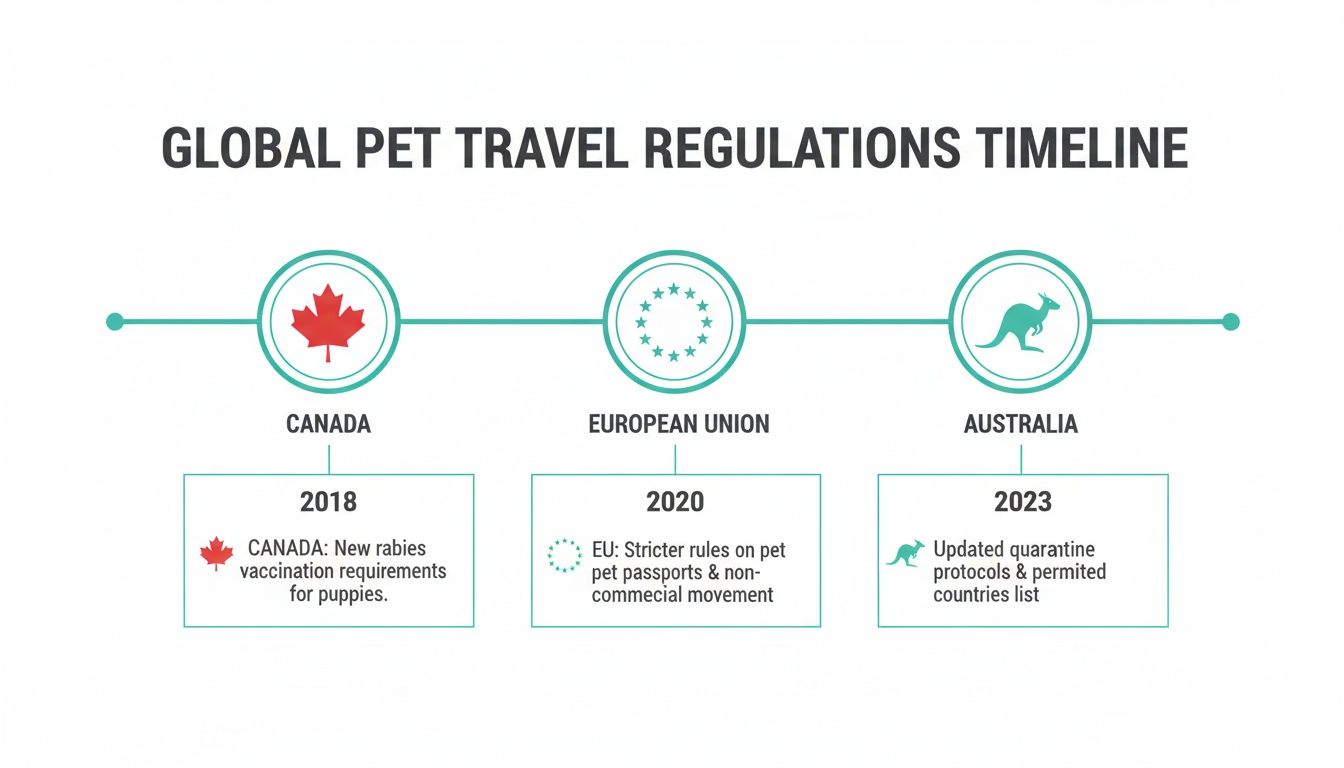
As you can see, countries update their regulations all the time. This just shows the need to do your homework and check the current, destination-specific rules well before your travel date.
2 to 3 Months Before Travel: The Logistics Phase
With the long-lead items officially in motion, it’s time to nail down the logistics of the trip itself. This phase is all about booking travel, figuring out airline rules, and gathering the right gear to make the journey comfortable and safe for your pet.
First up, book your flight. It's so important to call the airline directly to understand their specific pet policies. You'll need to know about carrier size restrictions, breed limitations, and any health forms they require beyond the main international certificate. Don't just assume the rules are the same everywhere—not all airlines are equally pet-friendly.
Next, get an airline-approved travel carrier and give your pet plenty of time to get comfortable with it. Leave it open in your living room with their favorite blanket or a toy inside. The goal is to turn it into a familiar, safe den rather than a scary box they see for the first time on travel day.
1 Month Before Travel: The Paperwork Phase
You’re in the home stretch now. The focus narrows to finalizing all the documentation and scheduling those last critical appointments. This is where all your early research and prep work come together in one official document.
Schedule the final veterinary exam and the appointment for the USDA APHIS endorsement. Pay close attention to the strict timelines—many countries require the final vet visit to happen within 10 days of travel. You'll need to work backward from your flight date to pinpoint the perfect day for this appointment.
A very common mistake is scheduling the final vet visit too early. Do that, and the health certificate could be invalid before you even leave. You have to coordinate closely with your vet to make sure every date lines up perfectly with your destination's and airline's requirements.
Keeping track of all these moving parts is tough. Using a dedicated tool can be a total game-changer. Our helpful pet travel planner can help you organize these crucial deadlines and documents so nothing falls through the cracks. It's a great way to keep your plans from getting tangled.
Finally, put together a travel kit for your pet. This should include some food, water, a leash, waste bags, a favorite toy, and of course, copies of all their travel documents. Having everything in one place will make for a much smoother experience at the airport and a paw-sitive start to your adventure.
Common Pet Travel Pitfalls to Avoid
Getting a pet international health certificate ready can feel like trying to solve a puzzle against the clock. With so many moving parts, one tiny mistake can throw everything off. A little foresight goes a long way, and it’s worth it to avoid any last-minute drama.
Let's be real—nobody wants their travel plans derailed by a paperwork snag at the airport. By learning from the mistakes others have made, you can navigate the process like a pro. It’s all about spotting the potential traps before you fall into them.
The Microchip Mix-Up
One of the most common—and totally avoidable—hiccups is the microchip. You might think any chip will work, but that's a gamble you don't want to take. The global standard is a 15-digit ISO-compliant microchip, and that's exactly what border officials in most countries are trained to look for.
The other classic error is all about timing. The microchip should be implanted before the rabies vaccine is given. If the shot comes first, many countries will simply refuse to recognize it. That means starting the whole vaccination and waiting period over again. It’s a small detail with huge consequences for your timeline.
How to get it right: Well before your departure, have your vet scan your pet’s chip. Double-check that it’s a 15-digit ISO chip and reads clearly. This one simple step can save you a world of trouble.
Missing Critical Deadlines
The world of international pet travel runs on a very tight schedule. Whether it's the 21-day wait after a rabies shot for travel to the EU or the 10-day window for the final vet exam required by most airlines, these dates are not flexible. Get one wrong, and your health certificate could be worthless.
A frequent oversight is forgetting to factor in shipping time for government endorsement. If your documents take three days to get to the USDA and back, you’ve just lost three days from that already-tight 10-day window.
In the U.S., there are over 86.9 million households with pets, but only a tiny fraction are ready for the maze of international travel rules. Simple slip-ups with deadlines can lead to expensive delays or, even worse, quarantine. Discover more insights about the scale of pet ownership and preparedness.
Incomplete or Inaccurate Paperwork
A pet international health certificate is an official document where every detail matters. A typo in the microchip number, a missing signature, or a date written in the wrong format can get your paperwork rejected on the spot. It's a true "measure twice, cut once" situation.
Some of the most common paperwork blunders include:
Using an old version of the destination country's health certificate form.
Writing dates like MM/DD/YYYY when the country requires DD/MM/YYYY.
Forgetting to list the manufacturer and lot number for each vaccine.
Leaving required fields completely blank.
How to get it right: Before your vet sends anything off, sit down with them and go over every single line item. Pull up the official requirements from the destination country's government website and compare everything side-by-side. Being a second pair of eyes can catch those small mistakes before they become trip-ruining headaches.
How Passpaw Simplifies the Health Certificate Process
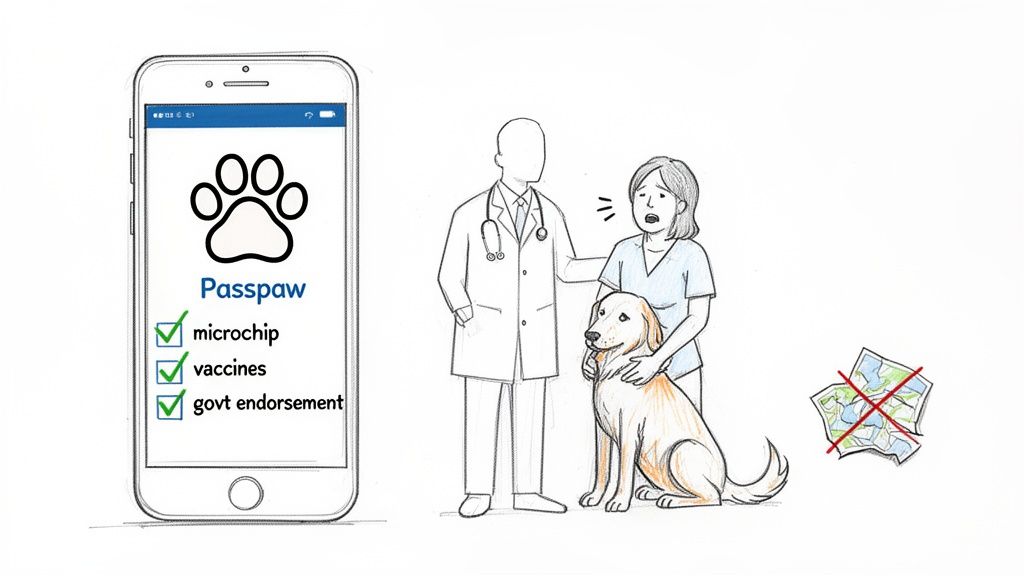
After reading about all the steps, deadlines, and common mistakes, you might be wondering if there’s a better way to handle a pet international health certificate. The old way—juggling paper forms, chasing down records, and trying to make sense of dense government rules—feels a lot like using a crumpled, old map to navigate a foreign city. It’s confusing, stressful, and leaves way too much room for error.
This is where a modern approach makes all the difference. Think of Passpaw as a friendly GPS for your pet's travel journey, guiding both veterinarians and pet owners from start to finish. Our platform transforms a tangled, manual process into a clear, organized, and collaborative workflow.
A Smart Assistant for Veterinary Teams
For any vet practice, managing international travel paperwork is a huge administrative task. It’s a high-stakes job where one tiny mistake can derail a client's entire trip. Passpaw was designed to lift that weight, acting as a smart assistant that keeps every detail on track.
The platform helps veterinary teams by:
Automating Paperwork: It generates the correct, country-specific forms automatically, so you never have to worry about using an outdated version.
Organizing Tasks: Every travel case is sorted by departure date, giving the team an instant snapshot of what needs to happen next.
Preventing Errors: With real-time validation and clear checklists, Passpaw catches potential mistakes before they ever become a problem.
This is a game-changer for clinics. In fact, veterinary practices using tools like ours report up to 50% time savings. By automating workflows and prioritizing what’s most urgent, these platforms turn a tricky task into a seamless, high-value service.
A Clear Window for Pet Owners
As a pet owner, one of the most nerve-wracking parts of the journey is feeling completely in the dark. You put your trust in your vet but are often left wondering what's happening behind the scenes. Are the forms done? Did they meet the deadline? Passpaw closes this gap by giving you a clear window into the entire process.
You’re no longer just a passenger on a confusing ride. You’re an informed partner. The platform keeps you in the loop with progress updates, reminders for upcoming appointments, and easy access to all your pet’s travel documents. That transparency delivers some much-needed peace of mind, letting you focus on the excitement of your trip instead of the paperwork.
The old process is like sending a message in a bottle and just hoping it gets there. With Passpaw, you get a direct line of communication and a real-time tracking number for your pet's travel prep.
This collaborative approach makes preparing for your trip manageable, less stressful, and ultimately more successful for everyone. To see exactly how it all comes together, feel free to explore the various Passpaw features that make this simple process a reality. It’s time to make pet travel less of a hassle and more of an adventure.
Frequently Asked Questions About Pet Travel
Even with the most careful planning, the world of international pet travel can throw a few curveballs. Getting a pet international health certificate is a very detailed process, so it's only natural to have some last-minute "what ifs." We're here to clear up the most common questions and help you feel confident about the journey ahead.
How Early Should I Start This Process?
The short answer? As soon as you possibly can. The timeline for getting a valid health certificate can be anything from a few weeks to more than six months, and it all comes down to where you're headed. A trip to a country like Canada is fairly straightforward, but a rabies-free nation like Australia or Japan is a whole different ballgame.
For those stricter destinations, you really need to kick things off at least 6 to 12 months before you plan to fly. They often demand specific blood work, like a rabies titer test, which is followed by a lengthy and non-negotiable waiting period. Starting early is the best way to make sure the calendar doesn't become your biggest enemy.
What If My Travel Dates Change?
Life happens, and plans change. If your departure date gets pushed back, the first thing to do is figure out how that impacts your certificate's validity—especially that tight 10-day window for the final vet exam and government endorsement.
Tell your vet immediately: They are your co-pilot in this. They need to know about any schedule changes right away.
Review the timeline: A small delay of a day or two might be fine. But a bigger shift could mean that certain steps, like parasite treatments or even the final exam, will need to be redone.
Contact the endorsing agency: If the paperwork has already been sent off, your vet may need to get in touch with them to see if anything can be changed.
Clear and quick communication is the key to avoiding a cat-astrophe and having to start the entire process from scratch.
Where Do I Find the Most Current Rules?
Import regulations are known for changing without much warning. Because of this, you should get your information directly from the source. The most reliable place is always the official government website of your destination country, which is usually its Ministry of Agriculture or similar department.
For anyone traveling from the United States, the USDA APHIS Pet Travel Website is an absolute must. It's an essential resource that provides detailed, country-specific requirements that are kept up-to-date.
Sticking to the official government source ensures you and your veterinarian are working from the most accurate playbook out there.
Planning an international move with your pet doesn't have to be a source of stress. With Passpaw, veterinary teams can manage every single step with clarity and confidence, ensuring every detail is perfect for your pet's big adventure. Learn more about how we make global pet travel simpler.
More articles
From regulatory changes to best practices for veterinarians and pet owners, our resources keep you ahead of the curve.