Are you a team member in a veterinary practice?
Are you a pet parent planning a trip with your furry pal?
A Guide to Moving Overseas with Pets
Taking your pet overseas is a big project, but it's an adventure you can absolutely tackle with the right plan. Think of it less as one huge task and more as a journey in three parts: research, vet visits, and travel plans.
The key to a smooth move? Start early. We're talking at least 6-12 months in advance, especially if you're headed to a country with strict rules, like Australia or Japan. Giving yourself this much time is the best thing you can do to avoid last-minute panic.
Your Pet's Next Big Adventure
Let's be real: moving to a new country is already a huge deal. Adding a furry family member to the mix brings a whole new layer of planning, but it's so worth it. This is an exciting new chapter for both of you, and a little preparation goes a long way in making sure the journey is safe and smooth.
You're definitely not alone in this. The international pet transportation industry is now a massive $8 billion business, which just shows how many of us see our pets as non-negotiable family. Even the U.S. Department of State has taken notice, reporting a 25% jump in pet travel between 2019 and 2022. That’s over 525,000 pets making international moves every year.
Mapping Out the Journey
So, where do you even begin? It helps to break the entire process down into three main stages, each with its own timeline and checklist.
This infographic gives you a pretty clear picture of how your time will be split.
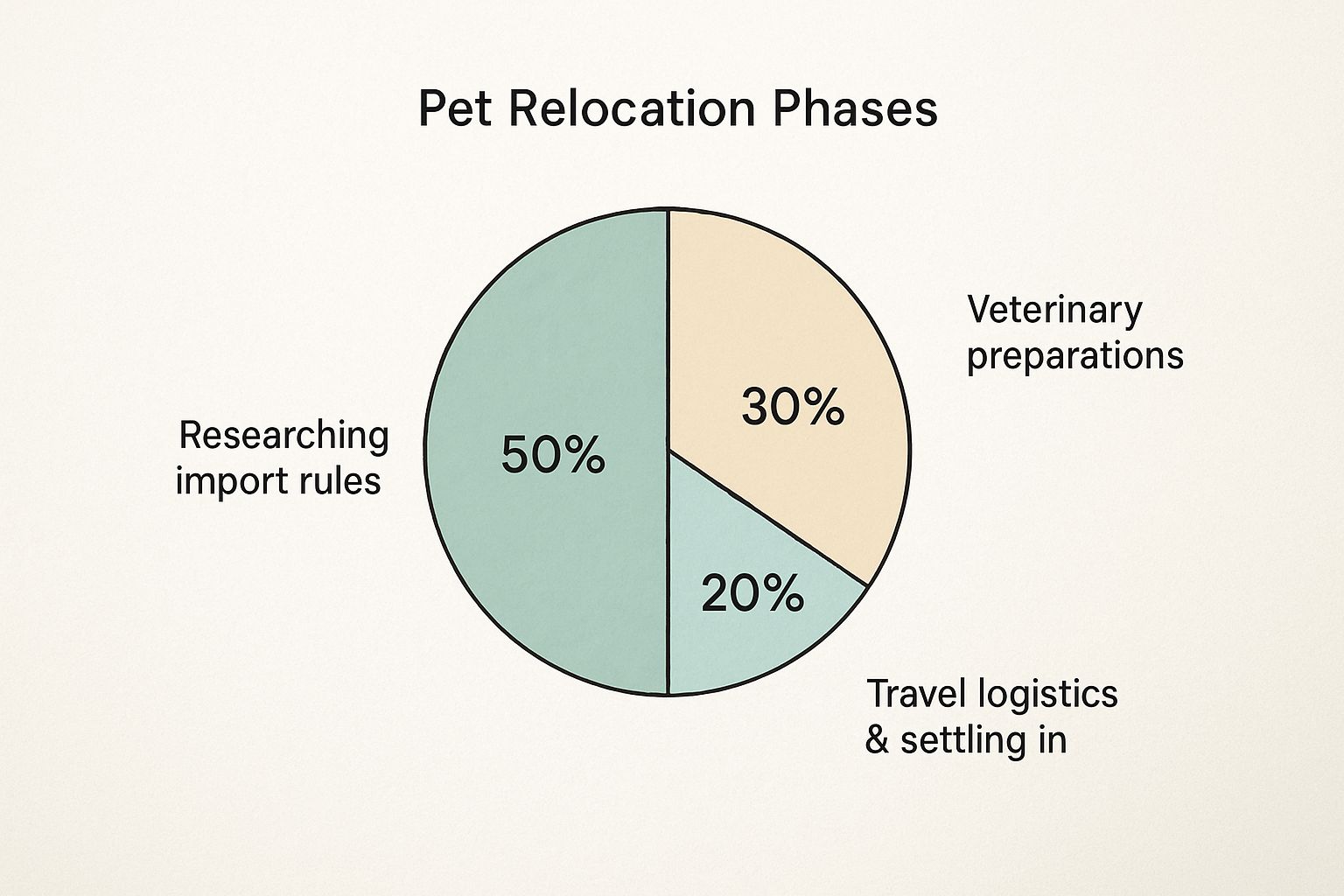
As you can see, a huge chunk of your effort—about half—is spent just figuring out your destination's rules. This initial homework is where you'll find all the specific requirements you need to meet, from microchips to health certificates. Getting these details right from the start is the foundation for everything that follows.
To get a jump on things, you can check out our helpful guides on pet travel to get familiar with the basics before you dive in.
Before you book a single flight or even start daydreaming about your new life abroad, there's a vital first step that's more important than anything else: digging into your destination's pet import rules.
This isn't just about paperwork. It's the entire foundation of a successful move. Every country has a unique set of regulations, and even a tiny misstep could lead to heartbreaking results, from long, stressful quarantines to being denied entry altogether.

Think of it like this: you can't just show up at a new country's border with your pet and hope for the best. You need to have the exact right documents, in the exact right order. Relying on advice from a friend who moved last year or a post you found on an old forum is a huge gamble, because these rules can change. Your most reliable source is the official government website for your destination—usually their Department of Agriculture or a similar agency.
Where to Start Your Search
The first thing you'll discover is that there's no "one-size-fits-all" checklist for moving with pets. The process for Germany is worlds apart from the process for Australia. Your job is to become a temporary expert on one country's rulebook: your new home.
A simple search for "[Country Name] pet import requirements" or "bringing a dog to [Country Name]" is the best place to start. This should point you toward the official government page. Don't get overwhelmed by technical terms; scan the page for a checklist or a step-by-step guide meant for pet owners.
You'll need to pinpoint specifics on things like:
Microchip Rules: Is a 15-digit ISO-compliant microchip needed?
Vaccination Records: Which shots are required, and what are the timelines for each?
Health Certificates: Is there a specific government form your vet should use?
Parasite Treatments: Are there required treatments for things like fleas, ticks, or tapeworms within a specific window before travel?
Import Permits: Do you need to apply for and receive an official permit before your pet is even cleared to fly?
The Ins and Outs of Rabies Rules
The rabies vaccination is the cornerstone of international pet travel, but the details are what trip people up.
For extremely strict, rabies-free countries like Australia or Japan, the process is more involved. They often ask for a Rabies Antibody Titer Test (RNATT) from an approved lab, which must be followed by a long waiting period—often several months—after the successful blood test result.
For most other destinations, the order of operations is critical. The vast majority of countries, including the entire European Union, seem to follow a golden rule: the microchip must be implanted before the rabies vaccine is given. After the shot, there's almost always a waiting period—typically 21 days for EU countries—to make sure the vaccine is fully effective.
Key Takeaway: The "microchip first, then vaccinate" rule is common in many places. Getting this sequence wrong can invalidate the entire vaccination in the eyes of import officials, which could force you to start all over again and delay your travel plans significantly.
How Much Can Rules Really Differ? A Real-World Look
To give you a clearer picture of just how different these requirements can be, let's compare a few popular spots for expats. This isn't a complete guide, but it shows why you can't make any assumptions.
Country Requirement Snapshot Example Comparison
The table below highlights just how much the rules can vary from one country to the next. What's a simple process for one destination can be a complex, multi-month ordeal for another.
Requirement | European Union (e.g., Germany) | United Kingdom | Australia |
|---|---|---|---|
Microchip | ISO 11784/11785 required | ISO 11784/11785 required | ISO 11784/11785 required |
Rabies Vaccine | Required, with a 21-day wait | Required, with a 21-day wait | Required, plus a titer test |
Titer Test | Not required (from US/Canada) | Not required (from US/Canada) | Mandatory with 180-day wait |
Parasite Treatment | Required for dogs (tapeworm) | Required for dogs (tapeworm) | Extensive treatments required |
Quarantine | None (if rules are met) | None (if rules are met) | Mandatory (minimum 10 days) |
As you can see, moving a dog to Germany is a relatively straightforward affair. But moving that same dog to Australia? That’s a much longer, more complicated journey involving blood tests and a mandatory 10-day quarantine upon arrival.
Getting these details right isn't just important—it's everything. For a more detailed breakdown, check out our complete guide to international pet travel requirements. Nailing this from the very beginning will save you from a major cat-astrophe down the road.
Working with Your Vet for a Smooth Journey
When you're moving a pet overseas, your veterinarian becomes one of the most important people on your team. Think of them as your co-pilot, helping you navigate the maze of health certificates, vaccination records, and strict timelines. Finding the right vet and building a solid relationship from the start is the secret to keeping this process from turning into a nightmare.
But here's something many pet owners don't realize: not just any vet can handle this. Your beloved family vet is fantastic for annual check-ups, but international travel paperwork is a whole different ballgame. For this, you'll need a USDA-accredited veterinarian—someone officially authorized by the government to sign off on international health documents.
Finding the Right Kind of Vet
Many clinics have at least one accredited vet on staff, but you have to ask. Don't waste time with a consultation only to find out they can't help. When you first call a clinic, be direct and ask: "I'm moving my pet to another country and need an international health certificate. Do you have a USDA-accredited veterinarian who handles that?"
That one question will save you a world of headaches. An accredited vet who has done this before knows the ropes, from checking microchip frequencies to timing the final parasite treatments. Their experience is priceless.
Creating a Clear Timeline Together
Once you've found your accredited vet, the first big meeting is all about the timeline. Bring the official import requirements you've already researched for your destination country. Together, you'll map out every single step, working backward from your departure date.
This isn't a casual to-do list. It's a precise schedule that should include deadlines for things like:
Microchip implantation (if your pet doesn't have one yet)
Rabies vaccination and any waiting periods that follow
Required blood tests, like the Rabies Antibody Titer Test (RNATT)
Other necessary vaccinations and parasite treatments
Working hand-in-hand with your vet is the only way to get the health certificates, microchipping, and essential dog vaccinations done right. This partnership keeps you organized and prevents those last-minute, heart-stopping surprises.
The sequence of these steps is everything. For many countries, the microchip should be implanted before the rabies vaccine is given. If you get that order wrong, the entire process could be considered invalid. You might have to start all over, potentially delaying your move by months.
The All-Important International Health Certificate
The international health certificate is like your pet’s passport. It's the official document that shows a foreign government that your pet is healthy and meets all of their import rules. And, of course, every country has its own specific form and requirements.
Your accredited vet will handle the final health exam and fill out this document. But their signature is just the first step. The certificate then usually has to be sent to a government agency for an official endorsement—basically, a final stamp of approval. In the U.S., this is done by the USDA's Animal and Plant Health Inspection Service (APHIS).
This is where it gets really tight. The final health exam and the USDA endorsement are incredibly time-sensitive. The certificate often needs to be completed and endorsed within a very specific window before your flight, sometimes just 10 days. If you miss that deadline, the document might be worthless. You could have to get a new exam and a new certificate, which is both expensive and stressful.
This tiny window leaves zero room for error. All the other big-ticket items, like blood tests and waiting periods, have to be long done. To get a better handle on this critical document, you should read our complete guide on the veterinary international health certificate. It will walk you through exactly what to expect so you’re fully prepared for this final, crucial step.
Choosing the Right Way for Your Pet to Travel
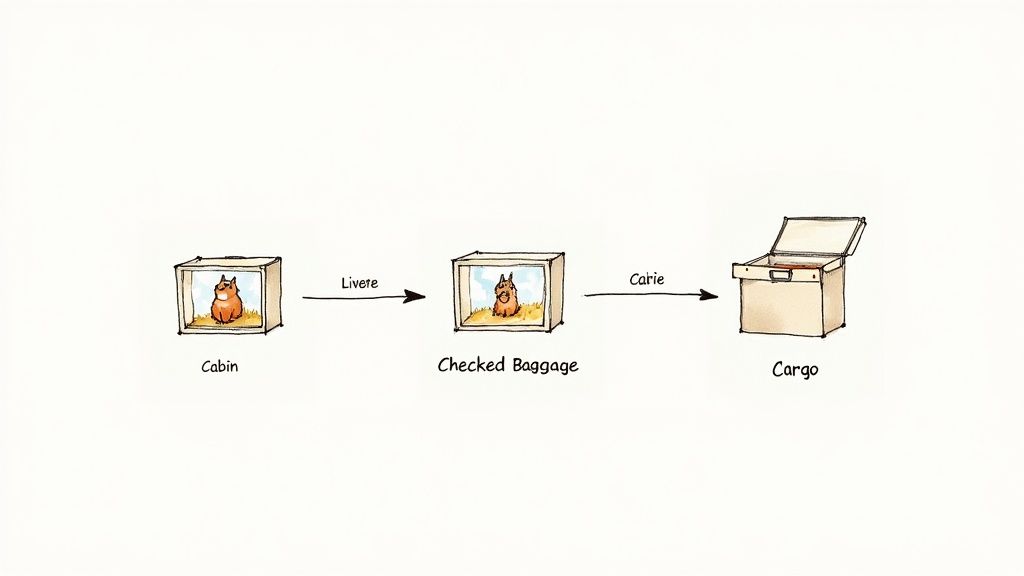
Once you’ve conquered the mountain of paperwork, the next big question looms: how is your pet actually going to get there? This is the part that keeps most pet owners up at night, but a little knowledge goes a long way in calming those nerves.
How your pet travels really comes down to a few key things—their size, the specific airline's rules, and your destination country’s policies. You've got three main options on the table, and each comes with its own set of pros and cons.
In-Cabin vs. Checked Baggage vs. Cargo
For the tiniest of travelers, flying in-cabin is the dream. If your pet is small enough to fit comfortably in a carrier under the seat in front of you, they get to stay by your side for the entire flight. It's hands-down the least stressful option for most pets (and their humans!), but it’s generally limited to animals under about 20 pounds, carrier included.
Next up is flying as checked baggage. This is a common choice for pets too large for the cabin but still traveling on the same flight as you. They fly in a pressurized, temperature-controlled hold—think of it as the pet section of the plane. While you can't see them, knowing you're on the same aircraft simplifies things when you land.
Finally, there’s manifest cargo. This is the standard for larger pets or for any animal traveling unaccompanied. Their booking is handled separately from your passenger ticket through the airline's dedicated cargo department. They travel in the same climate-controlled hold as checked baggage, and for some destinations or snub-nosed breeds with travel restrictions, it may be the only way to fly.
A Quick Note on Weather Embargoes: Airlines are serious about safety. Many have "seasonal embargoes" that stop pet travel during extreme heat or cold. They often won't fly pets as cargo into Phoenix in July or out of Chicago in January. Always, always check the airline's policy for your specific travel dates.
Do You Need a Pet Relocation Service?
Let's be honest: juggling cargo bookings, deciphering airline policies, and clearing customs can feel like a full-time job. This is where professional pet relocation companies can be a lifesaver. They are the experts who manage every single step, from booking the flight and handling paperwork to coordinating the final pickup and delivery.
Hiring a service adds to the cost, no doubt. But it can be worth its weight in gold, especially for:
Complex Moves: If you’re heading to a country with notoriously strict rules, like Australia or New Zealand.
Time-Crunched Owners: When you're already drowning in the logistics of your own international move.
Peace of Mind: Sometimes, just knowing a pro has it covered is priceless.
When you're looking into these services, do your homework. Understanding the essential questions to ask moving companies will help you find a partner you can trust with your furry family member.
The Crate: Your Pet’s Home in the Sky
No matter how your pet flies, one thing is non-negotiable: the travel crate. And this isn't just any old carrier. It should be an airline-approved, IATA-compliant crate. The International Air Transport Association (IATA) sets the global standard to help ensure every animal travels safely.
A proper crate has to be large enough for your pet to stand up, turn around, and lie down naturally. It also needs solid ventilation, a leak-proof bottom, and a secure lock. If you show up with the wrong crate, the airline might refuse to fly your pet. It’s that serious.
One of the kindest things you can do is make that crate a happy place long before you head to the airport. Start crate training months ahead of time.
Leave the crate open in your living room with a comfy blanket inside.
Start feeding them their meals in it.
Toss their favorite toys inside for them to find.
The goal is to reframe the crate as their personal den—a safe space, not a punishment. This single step can dramatically reduce their anxiety on travel day.
For a deeper dive into airline rules and getting your pet ready, check out our guide on flying with pets internationally. With the right preparation, you can make their journey as comfortable as pawsible.
Helping Your Pet Settle Into Their New Home

You did it. After months of planning, paperwork, and travel, you and your furry companion have finally landed. But before you breathe that sigh of relief, remember that for your pet, the most confusing part of the move is just beginning. Helping them get used to a new home is the final, crucial step in your adventure.
The last hurdle at the airport is clearing customs. Have an organized folder ready with all their original paperwork—health certificates, import permits, and vaccination records. Some countries even require a quick veterinary inspection on-site to confirm your pet is healthy and matches their documentation.
Creating a Safe Haven in a Strange New Place
Once you’re out of the airport, your first mission is to make your new house or apartment feel less like a strange building and more like home. Your pet will be processing a flood of new sights, sounds, and smells, which can be very overwhelming.
Before you even think about unpacking your own boxes, set up a small, predictable "safe zone" just for them.
Find a quiet corner and lay down their familiar bed, a favorite blanket, their food and water bowls, and a few well-loved toys. This little slice of home is immensely comforting. It gives them a secure base to retreat to and explore from when they feel ready. Don't push them to investigate the whole place at once; let them come out on their own terms.
Acclimation is a critical, often overlooked, phase of pet relocation. According to animal behaviorists, it can take a pet anywhere from three weeks to three months to fully adjust to a new environment. Key factors influencing this period include maintaining a consistent routine, providing a "safe space" with familiar items, and managing introductions to new stimuli slowly. Discover more insights about helping your pet adjust on ASPCA.org.
Re-Establishing a Comforting Routine
Pets are creatures of habit, and their routine has just been completely thrown out the window. One of the single best things you can do to lower their stress is to get back to your old schedule as quickly as you can. This simple act provides a powerful sense of normalcy.
Try to keep their schedule consistent for:
Feeding Times: Serve their meals at the exact same times you always did.
Walks and Potty Breaks: Stick to your regular walking schedule. This helps prevent accidents and reinforces familiar patterns.
Playtime and Cuddles: Carve out dedicated time for play and affection. It’s a powerful reassurance that your bond is still the same.
Your calm, patient presence is the most important signal they have that everything is going to be okay. This process takes time, so don't be discouraged if they seem anxious or withdrawn for the first few weeks.
Exploring the New Neighborhood Together
After they've had a few days to decompress at home, it’s time to introduce your pet to the great outdoors. Start small. The first few walks should be short and stay close to home, giving them a chance to sniff and process all the new information without getting overwhelmed.
Finding local resources is also a key part of making your new country feel like home for the whole family. Take a little time to locate:
A New Veterinarian: Get a local vet established soon after you arrive. You’ll want a trusted professional for check-ups and peace of mind.
Pet-Friendly Parks: Look up local parks, trails, or beaches where your dog can stretch their legs and play.
Nearby Pet Stores: Find a local shop that carries their favorite food and supplies.
Each positive new experience helps build their confidence. Before you know it, your companion will be just as excited about their new life as you are, proving that home truly is wherever you are together.
Got Questions About the Move? We’ve Got Answers.
Even the most organized person will tell you that moving a pet overseas can feel like navigating a maze in the dark. It’s totally normal for questions and "what if" scenarios to start piling up.
To help clear the fog, we've tackled some of the most common worries we hear from pet owners just like you. Think of this as your quick-reference guide for those late-night concerns.
How Much Does It Really Cost to Move a Pet Overseas?
The honest answer? It varies. A lot. The final bill for moving a pet internationally can land anywhere from $1,000 to over $10,000.
So, what drives the cost? A few big things. Your pet's size is a major factor, as it determines the size of the travel crate and the price of their spot on the plane. Your destination is the other huge variable. A country with a long, mandatory quarantine period like Australia will be much more expensive than, say, a straightforward move to an EU country.
You'll need to account for:
Vet exams and health certificates
Microchipping and specific blood tests
An IATA-compliant travel crate
The airline ticket itself
Government endorsement fees for the paperwork
Any required import permits or quarantine kennel fees
For a little perspective, a small cat flying from the U.S. to Germany might keep you on the lower end of that range. But for a large dog heading to Australia, it’s not unusual for the costs to climb into five figures.
Should I Sedate My Pet for the Flight?
This is a question we hear all the time, and the general expert opinion is no. Nearly every veterinarian and major airline strongly advises against sedating or tranquilizing pets for air travel.
Why? The American Veterinary Medical Association (AVMA) points out that sedatives can interfere with a pet's ability to balance and regulate their own body temperature, especially at high altitudes. In the cargo hold, this can quickly become a dangerous situation.
Our Pro Tip: Instead of reaching for sedatives, channel that energy into positive crate training. The goal is to make your pet view their travel crate as a safe den, not a scary box. It’s a far safer and more effective way to ease their anxiety on travel day.
If you’re still worried about their stress levels, talk to your vet. They might be able to recommend gentle, natural calming supplements that could be a safer alternative.
How Early Do I Need to Start Planning This?
Our golden rule is this: start planning the minute you know you’re moving. Ideally, you want to give yourself a 6 to 12-month runway before your departure date.
That might sound like a long time, but for some destinations, it's not a suggestion—it's a requirement.
Take countries that require a rabies blood titer test. Many have a mandatory waiting period of three months or more after you get a passing result before your pet can even enter the country. If you start too late, you might find it's physically impossible to meet the timeline. Starting early builds in a much-needed buffer for those little hiccups that can pop up along the way.
What Happens if My Pet's Paperwork Is Wrong?
This is the big one. Incorrect or incomplete paperwork is one of the single biggest risks in the entire process, and the consequences can be serious. This isn't a problem you can just smooth over with an agent at the check-in desk.
If your pet’s documents aren't perfect, a few things could happen, depending on the country and the mistake. At best, they might be forced into a long, expensive quarantine until you can get the right documents. At worst, your pet could be denied entry and put on the next flight back home—at your expense.
It's a heartbreaking scenario, which is why paying close attention to detail is so important. Double-check every requirement, follow every instruction to the letter, and only trust official government sources for your information.
Don't let paperwork complexities put your pet's journey at risk. Passpaw offers a smarter way for veterinary teams to manage international health certificates, ensuring every detail is correct and on time. Discover how Passpaw can simplify your pet's move.

More articles
From regulatory changes to best practices for veterinarians and pet owners, our resources keep you ahead of the curve.