Are you a team member in a veterinary practice?
Are you a pet parent planning a trip with your furry pal?
KLM Airlines Pet Policy A Complete Guide
Flying with your furry co-pilot can be a breeze, but getting a handle on the KLM Airlines pet policy is your first and most important step. In short, small cats and dogs can often travel right there with you in the cabin, while larger pets fly safely in a climate-controlled section of the hold.
It really all comes down to your pet's size, weight, and breed—these are the key factors that decide where they'll be on the plane.
Your Guide to Flying with Pets on KLM
Planning a trip with your pet takes a bit more legwork than just booking your own ticket. You've got to know the airline's rules to make sure the journey is smooth and safe for your best friend. Think of this guide as your pre-flight checklist, giving you the full picture of what to expect when you and your pet fly KLM.
Don't worry, navigating the rules doesn't have to be ruff. KLM has very specific guidelines for where your pet can travel, the kind of carrier they need, and all the required paperwork. Getting these details sorted out from the get-go will save you a world of stress at the airport.
The Three Main Ways Your Pet Can Fly
KLM provides a few different ways for your pet to travel, and the right one mostly depends on their size and your destination. Knowing your options is key for planning.
To make it simple, here’s a quick breakdown of how your pet can travel on a KLM flight.
KLM Pet Travel Options at a Glance
Travel Option | Maximum Weight (Pet + Carrier) | Best For | Key Restriction |
|---|---|---|---|
In Cabin | 8 kg (17.6 lbs) | Small dogs and cats | Only allowed in Economy Class (except on European flights for Business) |
In Hold | 75 kg (165 lbs) | Larger pets traveling on the same flight as you | Breed restrictions apply (e.g., snub-nosed breeds) |
As Cargo | Varies by aircraft | Pets traveling alone or to certain countries | Requires booking through Air France-KLM Cargo |
Each option has its own set of rules, from weight limits to carrier dimensions. It’s a good idea to double-check which category your pet falls into well before you book.
A few key points to remember:
In the Cabin: This is for your smallest companions, the ones who can fit comfortably in a carrier under the seat in front of you. The combined weight of your pet and their travel bag can't be more than 8 kg (about 17.6 lbs).
In the Hold: This is for larger pets who are over the cabin limit but can still travel on your flight. They fly in a pressurized, temperature-controlled compartment that's perfectly safe.
As Cargo: This option is for pets traveling by themselves, or on routes where they can't fly as checked baggage.
As of 2025, KLM allows one small dog or cat per passenger in the Economy Class cabin. If you're flying Business Class, pets are only allowed in the cabin on flights within Europe.
Remember: There's a limited number of spots for pets on every flight. It is very important to reserve a spot for your pet as early as you can, ideally right when you book your own ticket.
Preparing for International Journeys
Flying internationally adds another layer to your planning. Every country has its own entry requirements, which can include specific health certificates, vaccination records, and sometimes even microchips. These rules can be strict and there's often no getting around them.
Understanding these international pet travel requirements is vital for a hassle-free trip. Getting all the necessary documents prepared correctly helps ensure your pet will be allowed into your destination country without any delays or quarantine surprises. This prep work is a very important part of following the KLM Airlines pet policy.
Cabin vs Hold: Where Your Pet Will Travel
So, you've decided to bring your pet along for the ride. The next big question is, where on the plane will they be? When it comes to the KLM Airlines pet policy, the answer almost always boils down to one simple factor: size.
Let's walk through the two main options—flying in the cabin right beside you, or traveling safely and comfortably in the aircraft's hold.
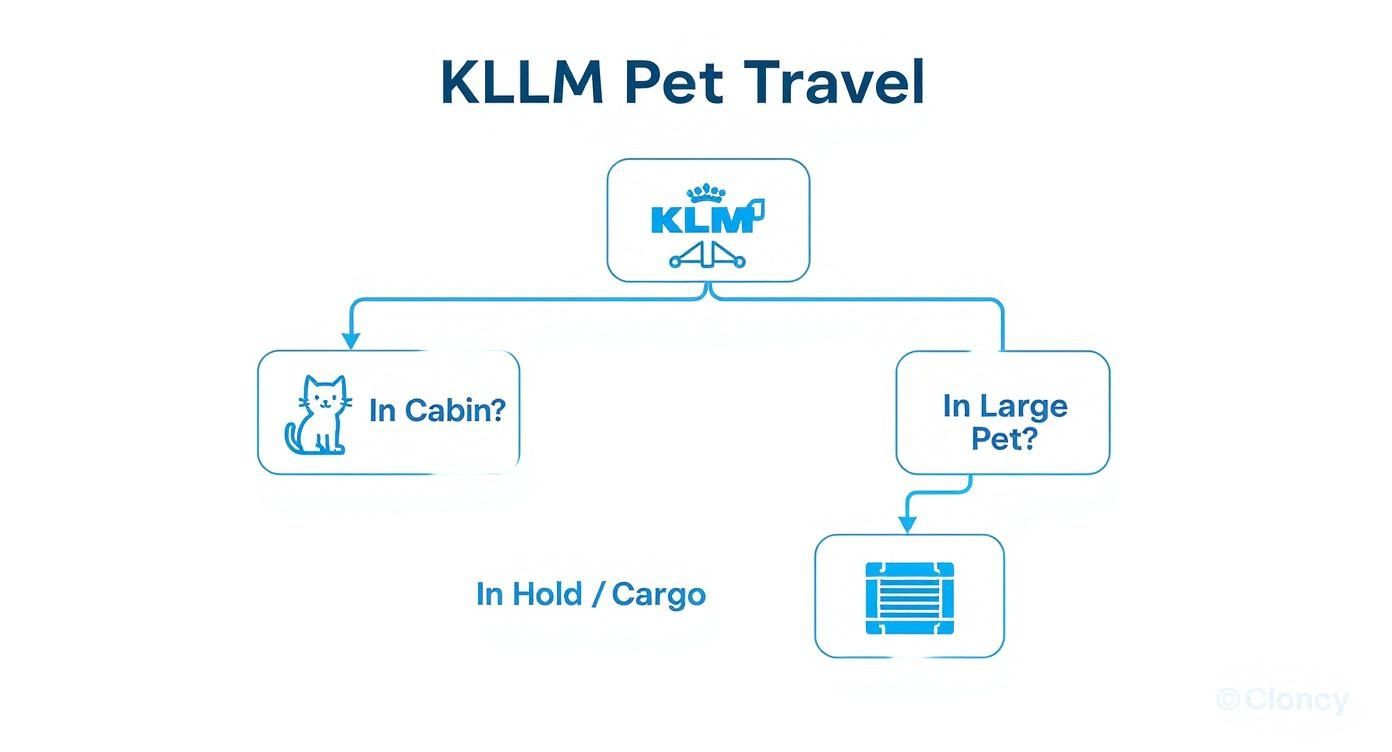
This flowchart really simplifies things. As you can see, the first question you need to answer is about your pet's weight, which points you directly to the right travel option.
Flying with Your Pet in the Cabin
For most of us, keeping our furry friends close is the number one priority. KLM gets that, allowing small cats and dogs to travel in the cabin with you. But to keep everyone safe and comfortable, they have very specific rules.
To get a spot in the cabin, the combined weight of your pet and their travel carrier can't be more than 8 kg (about 17.6 lbs). Think of it as a carry-on bag, but way more precious.
The carrier also has to meet specific dimensions to tuck neatly under the seat in front of you. KLM's maximum size is 46 x 28 x 24 cm. Your pet has to stay inside their carrier for the entire flight, so make sure it’s roomy enough for them to stand up and turn around.
A few other key rules for cabin travel:
It's strictly one pet per passenger in the cabin.
Pet travel in the cabin is generally limited to Economy Class.
On intercontinental flights, pets aren't allowed in Premium Comfort Class or Business Class at all.
When Your Pet Travels in the Hold
What if your companion is a bit on the larger side? If your pet and their crate weigh more than the 8 kg cabin limit, they'll need to travel in the hold. I know this can sound a little scary, but it's a very common and safe way for larger animals to fly.
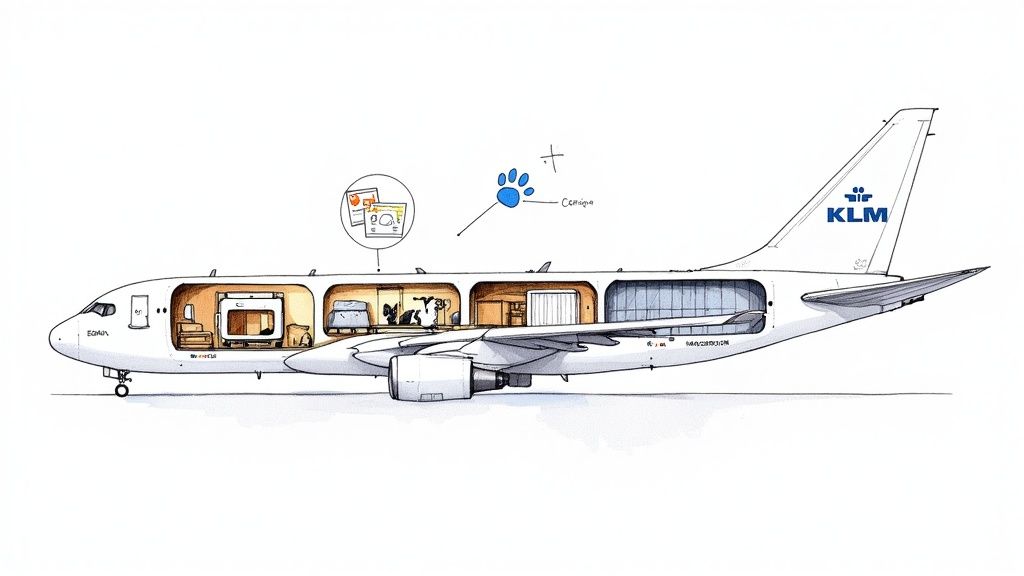
The hold isn't just where the suitcases go. It’s a dedicated, separate area of the aircraft that is climate-controlled and pressurized, just like the main cabin. It’s designed specifically to be a safe, stable environment for animals.
The maximum combined weight for a pet and their crate traveling in the hold is a generous 75 kg (approximately 165 lbs). This accommodates a huge range of dog breeds, making it a workable option for most larger pets.
Of course, the rules for the hold are just as important. Your pet’s crate should be IATA-compliant—meaning it’s sturdy, has proper ventilation on all sides, and is leak-proof. Crate dimensions can also vary depending on the aircraft type (KLM vs. KLM Cityhopper flights), so you should confirm the specifics when you book.
In-Cabin vs Hold Travel: A Detailed Comparison
To make the decision clearer, here’s a side-by-side look at what to expect with each option.
Feature | In-Cabin Travel | In-Hold Travel |
|---|---|---|
Weight Limit | Max 8 kg (17.6 lbs) for pet + carrier. | Max 75 kg (165 lbs) for pet + crate. |
Carrier/Crate | Soft or hard-sided carrier, max 46x28x24 cm. Must fit under the seat. | IATA-compliant hard-sided crate. Should be secure, ventilated, and leak-proof. Dimensions vary by aircraft. |
Pet Location | With you in the cabin, under the seat in front. | In a dedicated, climate-controlled, and pressurized compartment below the main cabin. |
Supervision | You are with your pet for the entire flight. | Your pet travels separately and is handled by trained ground staff. |
Booking Class | Typically restricted to Economy Class. Not available in Premium Comfort or Business on long-haul flights. | Available on most aircraft types, but must be confirmed during booking as some smaller planes cannot accommodate pets. |
Best For | Small dogs, cats, and puppies/kittens that meet the strict weight and size limits. | Medium to large dogs and other pets that exceed the 8 kg cabin limit. |
Choosing between the cabin and the hold ultimately comes down to your pet's size and the airline's safety guidelines. Both are designed with your pet's welfare in mind.
Key Aircraft and Route Restrictions
It's really important to know that not all planes can accommodate pets in the hold. Some smaller aircraft used on shorter, regional routes simply don't have the necessary climate-controlled facilities. This is a crucial detail to double-check when you're booking your flight.
Also, pay close attention to your itinerary if you have a connecting flight. For pets traveling in the hold, KLM generally does not permit transfers that last longer than three hours. This rule exists to minimize stress on your pet and ensure they are not left waiting for an extended period. Always review your layover times and discuss them with the airline when you make your reservation.
Choosing the Right Pet Carrier or Crate
Picking the right travel container for your pet isn't just a helpful hint—it’s an essential part of the KLM Airlines pet policy. Honestly, it's one of the most critical things you can do for their safety and comfort. Think of the carrier as your pet's personal little travel suite; it has to be secure, comfy, and meet every airline rule to make the trip go smoothly.
Whether your pet is flying in the cabin with you or traveling in the hold, the carrier requirements are strict. Getting this piece right from the very beginning will save you a world of headache on travel day.
Cabin Carrier Specifics
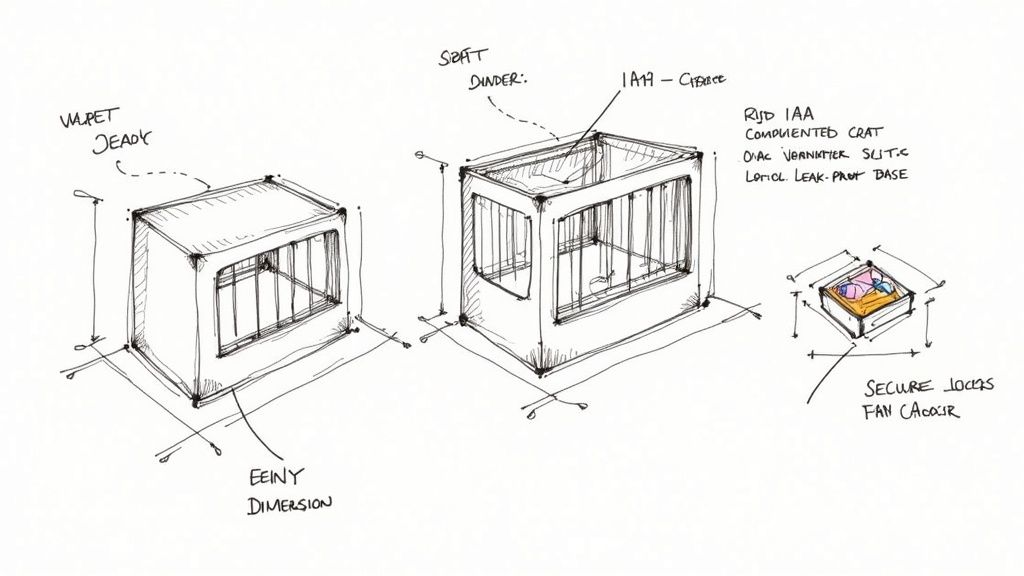
If your dog or cat is small enough to fly in the cabin, their carrier has to be designed to slide neatly under the seat in front of you. KLM is very precise about the dimensions here.
The absolute maximum size for an in-cabin pet carrier is 46 x 28 x 24 cm. You can use both soft and hard-sided carriers, but from experience, a flexible, soft-sided bag is often the better choice. It has a little give, making it easier to fit into that tight under-seat space.
A few must-have features for any cabin carrier:
Good Ventilation: Look for mesh windows on at least two sides. Airflow is key.
Secure Zippers: You'll want zippers that lock or can be secured to prevent any Houdini-style escapes mid-flight.
Leak-Proof Bottom: A waterproof lining is essential, just in case of any accidents.
Remember, your pet has to stay inside the carrier for the entire flight. Their comfort is everything. They need to be able to stand up, turn around, and lie down naturally without being cramped.
Hold Crate Requirements
For larger pets traveling in the hold, the rules get even stricter to ensure their safety. The crate should be IATA-compliant, which is the universal gold standard for animal air transport.
This means the crate should be made of a tough material like rigid plastic or fiberglass. Wire-mesh or "welded mesh" crates are generally not allowed for air travel. The door should be solid metal with a secure locking system that can’t pop open by accident.
According to IATA guidelines, the crate should be equipped with a water bowl that can be filled from the outside without opening the door. It’s also wise to attach a food bowl, but keep it empty during the flight.
KLM also has maximum crate dimensions that vary by aircraft. For mainline KLM flights, the largest accepted crate is 122 x 81 x 89 cm. For smaller KLM Cityhopper flights, that drops to 102 x 69 x 76 cm. For a deeper dive into picking the perfect kennel, check out our detailed guide on choosing an airline-approved pet carrier.
Preparing Your Pet for Their Carrier
Once you've got the right carrier, the next challenge is getting your pet to see it as a safe space, not a scary box. To head off travel day anxiety, KLM suggests getting your pet comfortable with their kennel about five days before your flight. They also recommend holding off on food for two hours before takeoff.
Here’s a simple way to make the introduction a positive one:
Start Early: Just place the carrier in your living room with the door wide open. Let them investigate on their own time.
Make it Inviting: Put a familiar blanket, a favorite toy, or even a t-shirt with your scent inside.
Use Positive Reinforcement: Toss treats near the carrier, then just inside the door, encouraging them to step in.
Short Practice Sessions: Once they're comfortable going inside, close the door for just a few minutes. Gradually increase the time as they get used to it.
This process helps turn the carrier from a strange object into a cozy den. It can make a huge difference in how calm your pet is on the actual travel day.
Navigating Breed Rules and Paperwork
Getting the fine print of KLM's pet policy right is the secret to a stress-free travel day. This really boils down to two big areas every pet owner needs to master: the airline’s rules on specific breeds and the mountain of paperwork your pet needs to fly.
Let's break down these critical details so you know exactly what to expect. First off, it's important to remember that some rules are there purely for your pet's safety. This is especially true for certain breeds that can face health challenges during air travel.

Brachycephalic Snub-Nosed Breed Rules
Like many major airlines, KLM has specific restrictions for flying with snub-nosed (brachycephalic) animals. These breeds, known for their charmingly flat faces, can sometimes struggle with breathing, especially at high altitudes or in stressful situations.
To protect their well-being, KLM will not transport certain breeds in the aircraft hold. This isn't a penalty; it's a safety measure. The list of restricted breeds is quite specific and includes several popular types of dogs and cats.
Examples of Restricted Dog and Cat Breeds:
Dogs: Pugs, Boxers, Bulldogs (English, French, and American), Boston Terriers, and Shih Tzus.
Cats: Persians, Himalayan cats, and Exotic Shorthairs.
Always double-check KLM’s most current list before you even think about booking. If your pet is on this list, they won't be allowed to travel in the hold. However, if they're small enough to fit within the in-cabin weight and carrier size limits—under 8 kg (17.6 lbs)—they might still be able to fly with you under your seat.
The Essential Paperwork for Pet Travel
Once you've confirmed your pet's breed is cleared for takeoff, it's time to tackle the documents. This is where things can get a bit tricky, as the requirements change depending on your destination country. Getting this part wrong can cause serious travel headaches, so careful preparation is everything.
A big part of this prep involves getting health certificates from a veterinarian. For convenience, some pet owners might look into understanding mobile vet services to get this done at home.
The main documents you'll likely need include:
International Health Certificate: This is the big one. It's an official document, signed by an accredited vet, declaring your pet healthy and fit to fly. It's your proof they are free from contagious diseases.
Vaccination Records: Proof of an up-to-date rabies vaccination is a very common requirement. Depending on where you're headed, other shots might be necessary, too.
EU Pet Passport: If you're traveling within or into the European Union, a pet passport is usually the standard. It neatly consolidates all your pet's health and vaccination info in one booklet.
Getting the right paperwork in order is perhaps the most detail-oriented part of planning your trip. The requirements are not flexible, and airlines must check them carefully.
It’s also crucial to remember that policies can change. For example, KLM's decision to no longer accept emotional support animals in the cabin, requiring them to be shipped as cargo, is a direct result of shifting global rules. Staying on top of these kinds of updates is key.
Staying Organized and Seeking Help
Trying to manage all these documents can feel like a full-time job. Each country has its own timeline for when health certificates must be issued—some need it done within 10 days of travel, while others have different windows. This is where specialized tools can be a total lifesaver.
Platforms like Passpaw help both veterinarians and pet owners make sense of this entire process. By automating the workflow and making sure all country-specific requirements are met, they take the guesswork out of getting it right. This support helps ensure your veterinary international health certificate is correctly filled out, endorsed, and ready for your journey.
Ultimately, being proactive about the breed rules and the paperwork is what separates a smooth trip from a nightmare at the check-in counter. It protects your pet and ensures you won't face any unwelcome surprises on travel day.
Booking Your Pet's Spot and Paying the Fees
Booking your own flight is straightforward, but adding your pet to the journey is a whole different ballgame. It's a hands-on process you can't just complete with a few clicks online. Getting this step right is very important if you want your furry friend on that plane with you.
First, you need to lock in your own ticket. As soon as your seat is confirmed, your next move is to contact KLM directly to reserve a spot for your pet. This isn't just a friendly suggestion—it's a key part of the KLM Airlines pet policy.
The Step-by-Step Booking Process
You have a very small window to act: you should try to reserve your pet’s spot within 24 hours of booking your own flight. Why the rush? Simple. Airlines only allow a small, fixed number of animals on each flight. If you wait, you’re rolling the dice on whether there will be any space left.
Here’s exactly what you need to do:
Book Your Ticket First: Go ahead and secure your own seat on the KLM website like you normally would.
Contact KLM Immediately: As soon as you have your booking reference, call KLM’s customer service. You can also reach out via their social media channels, but a phone call is often faster.
Provide Pet Details: Be ready to share all the key info: your pet’s breed, their weight, and the exact dimensions of their travel carrier or crate.
Wait for Confirmation: This is the hard part. KLM has to manually check for space and will get back to you with a confirmation, which can take a couple of days. Don't just assume you're good to go—wait until you have that official "yes" from the airline.
Honestly, the best approach is to make that call the second your own booking confirmation hits your inbox. The sooner you get in the queue, the higher your chances of snagging one of those limited spots.
Understanding the Fee Structure
Bringing your pet along comes with a fee, but it’s not a one-size-fits-all price. The cost depends entirely on your destination and whether your pet is traveling in the cabin with you or in the temperature-controlled hold. You'll typically pay this fee directly to the airline at the airport on the day you fly out.
Expect prices to fall somewhere between EUR 75 and EUR 400 for a one-way trip. The final amount is calculated based on the travel zones of your departure and arrival cities. For a deeper dive into how these fees stack up across different airlines, check out our guide on pet transportation costs.
Important Note: This airline fee only covers the transport of your pet. It doesn't include other necessary expenses like vet visits for health certificates, the cost of an airline-approved crate, or any customs fees you might encounter when you land.
Navigating Layovers and Connections
If your travel plans include a connecting flight, there are a few extra rules you absolutely need to know about. These are in place for your pet's safety and well-being, so planning your connections carefully is a huge part of sticking to the KLM Airlines pet policy.
Pets in the Hold: For any pets traveling in the hold, KLM prohibits transfers that last longer than three hours. This rule is there for a good reason—it minimizes the amount of time your animal has to wait on the tarmac between flights.
Self-Transfer Flights: If you've booked separate tickets (a "self-transfer"), you'll have to collect your pet and their crate, go through customs and immigration, and then re-check them for your next flight. This takes a lot of time, so make sure your layover is long enough to handle the entire process without rushing.
Always double-check your full itinerary, paying close attention to layover times. If anything seems tight or confusing, bring it up with the KLM agent when you're booking your pet's spot. It might feel like a hassle, but getting these details sorted upfront is the key to a smooth and stress-free journey for everyone.
A Few Common Questions About Flying with KLM
Even the most organized traveler has a few last-minute questions. When you're planning for your pet, those "what ifs" can feel even bigger. Let's clear up some of the most common queries about the KLM Airlines pet policy so you can feel completely confident on travel day.
Think of this as your final check-in before the big adventure. Getting these details sorted is the key to a smooth, stress-free journey for you and your best friend.
Can I Bring More Than One Pet?
This is a big one, and the answer depends entirely on where on the plane your pets will be traveling. It's a critical detail to get right before you book anything.
In the Cabin: It's a strict one pet per passenger rule. Your pet, safe in their carrier, counts as your single piece of carry-on luggage.
In the Hold: You have more flexibility here. You can check up to three pets in the hold. They can travel in their own separate crates, but sometimes they can share. Two adult animals of a similar size (up to 14 kg each) or three puppies/kittens from the same litter (under 6 months old) might be able to travel together in one IATA-approved crate.
What About Snub-Nosed Breeds?
If you have a Pug, French Bulldog, Persian cat, or another brachycephalic (snub-nosed) breed, you need to pay close attention. Because of their unique anatomy, these breeds can face breathing difficulties at altitude. For their safety, KLM does not permit them to travel in the aircraft hold.
But that doesn't mean it's an automatic "no." If your snub-nosed pet is small enough to fly in the cabin—weighing 8 kg (17.6 lbs) or less with their carrier—they might still be able to join you. You should absolutely confirm this directly with KLM when you call to make your reservation.
Do I Need to Sedate My Pet for the Flight?
The answer from veterinarians and airlines, including KLM, is a clear and firm no. Sedating an animal for a flight is not just discouraged; it can be outright dangerous.
Sedatives can mess with an animal's natural ability to regulate body temperature and keep their balance, leading to serious health risks at high altitudes.
Instead of reaching for medication, the best thing you can do is help your pet get comfortable with their travel carrier long before you head to the airport. A familiar blanket or a favorite toy can make a world of difference in keeping them calm. A relaxed pet is a safe pet, and acing the crate training is the best preparation you can possibly do.
Feeling buried in paperwork? Passpaw is here to dig you out. We simplify the entire process of getting international health certificates for your pet. Our platform helps your vet manage every document, track deadlines, and ensure you've met every single requirement for your destination. It makes pet travel compliance a walk in the park. Plan your next adventure with total confidence by visiting https://passpaw.com.
More articles
From regulatory changes to best practices for veterinarians and pet owners, our resources keep you ahead of the curve.