Are you a team member in a veterinary practice?
Are you a pet parent planning a trip with your furry pal?
Find an international health certificate for dogs near me today
Taking your dog on an international trip sounds like an amazing adventure, but let's be honest—the paperwork can feel a bit ruff. If you're searching for an "international health certificate for dogs near me," you're looking for a very specific kind of veterinarian: a USDA-accredited vet. They are the only professionals authorized to issue the official travel documents your dog needs to cross borders.
Your Guide to International Dog Travel Paperwork

Planning a trip overseas with your dog is a lot more than just buying a plane ticket. It takes a good bit of preparation to make sure your best friend meets all the entry rules for your destination country. Think of this guide as your co-pilot, here to make the whole process a lot less confusing.
We'll walk you through the first key steps, helping you get organized and feel confident you've got everything under control.
Why Is This Paperwork So Important?
Every country has rules in place to protect its local animals and people from diseases that could be brought in from other parts of the world. The international health certificate is the official proof that your dog is healthy, vaccinated, and doesn't pose a health risk. Showing up without one can lead to major headaches, long delays, or even your dog being denied entry.
It's not just pets, either. The same idea applies across industries. For example, in global trade, understanding critical international shipping documents like a letter of origin is essential for getting goods through customs smoothly. In both cases, having the right paperwork in order is the key to avoiding problems.
Key First Steps for Your Pet's Travel
Before you even pick up the phone to book a vet appointment, doing a little homework will save you a ton of time and stress down the road. It's not just about finding any vet; it's about knowing exactly what you need them to do.
Here's where to start:
Figure Out Your Destination’s Rules: This is the big one. Every country has its own unique list of requirements. You need to research the specific import rules for where you're headed, and do it as far in advance as possible. Our guide on international pet travel requirements is a great place to begin your research.
Find a USDA-Accredited Veterinarian: This is a must. Only a vet with this special federal accreditation has the authority to complete the exam and sign the official forms. Your regular vet might not be accredited, so you need to check.
Get Your Dog's Records in Order: Make sure your dog’s microchip and rabies vaccination are up-to-date and, just as importantly, properly documented. These two things are the foundation for nearly every country's pet import rules.
So, What Exactly Is an International Health Certificate?
If you're planning an international trip with your dog, you've probably heard the term "international health certificate." But what is it, really? It's not just a simple note from your vet giving your dog the all-clear. This is an official, multi-page government document that acts as your dog's passport for entry into another country.
Think of it as a formal document confirming your furry travel companion is in good health, free of contagious diseases, and meets every import rule for your destination. It's a detailed health report card that requires a sign-off from a very specific type of veterinarian.
The Key Players in This Process
Getting this certificate isn't a one-stop shop. It's a team effort between you, your vet, and the U.S. government, and knowing who does what is the key to a stress-free experience.
Two main authorities are involved here:
USDA-Accredited Veterinarian: This isn't your regular vet. These are professionals who have completed special training and are authorized by the U.S. Department of Agriculture (USDA) to perform the required exams and sign these federal documents. When you search for an "international health certificate for dogs near me," you're looking for one of these accredited vets.
USDA APHIS: This is the Animal and Plant Health Inspection Service, a branch of the USDA. After your accredited vet fills out and signs the certificate, it has to be sent to APHIS for an official government endorsement. This is the final, official stamp of approval. Without it, the certificate isn't valid for travel.
Why This Document Is Such a Big Deal
At its heart, the international health certificate is all about biosecurity. Every country has its own rules to protect its local animal—and human—populations from foreign diseases. For example, countries that are rabies-free have very strict regulations to keep it that way.
This paperwork helps prevent the spread of diseases across borders. It ensures that traveling pets don't introduce new health risks, which is why countries take it so seriously. A single missing signature or an expired document can lead to your dog being quarantined or even sent back home.
As more people bring their pets along for their travels, the demand for these certificates has grown. The global market for pet travel health certificates hit $1.2 billion in 2024 and is projected to more than double by 2033. International certificates make up a whopping 60% of this market, which tells you just how many pets are crossing borders these days. You can see more on this trend over at marketintelo.com.
For anyone traveling from the United States, a common form you'll encounter is APHIS Form 7001. However, a growing number of countries now require their own specific health certificate forms instead. Your accredited vet is the one who will know exactly which form your destination requires.
To get a better handle on the basics, you should check out our guide on what a pet health certificate for travel really entails. It’s the perfect place to start your journey on the right paw.
How to Prepare for Your Vet Appointment
Getting your dog's international health certificate starts long before you ever step foot in the vet clinic. Think of it like packing for a major trip; a little organization upfront saves you from that sinking feeling of realizing you’ve forgotten something important. Showing up prepared makes the entire process smoother for you, your vet, and your dog.
It all boils down to having your paperwork in order. Your vet needs a complete picture of your dog's health history and travel plans to fill out the forms correctly. This isn’t something you can throw together at the last minute—one missing detail can bring everything to a screeching halt.
Gathering Your Essential Documents
Before your appointment, do yourself a favor and create a dedicated travel folder for your pup. Tossing every important document in one place will save you a world of stress. Your vet will appreciate your preparedness, and you’ll be one step closer to your adventure.
Here’s what you absolutely need to bring:
Complete Vaccination Records: The star of the show is the rabies vaccination certificate. Make sure it's signed by a licensed vet and clearly lists the microchip number, vaccination date, and vaccine details. For a deeper dive, check out our guide on why having proof of a rabies vaccine is so important for travel.
Microchip Information: You'll need the implantation date and the full microchip number. This number has to match perfectly across every single one of your documents. No exceptions.
Destination Country Forms: Some countries have their own special forms. Head over to the USDA APHIS Pet Travel Website, find your destination, and print out anything they require you to bring.
Travel Details: Your vet needs your exact destination address and your travel dates. This is important for making sure the certificate’s timeline aligns perfectly with your departure.
To help you get everything in order, we've put together a quick checklist.
Pre-Appointment Document Checklist
This table summarizes the key items you'll want to have ready for your appointment. Being organized not only speeds things up but also helps prevent costly errors.
Document or Information | Why It's Needed | Pro Tip |
|---|---|---|
Rabies Certificate | This is a highly scrutinized document and is needed for nearly all international travel. | Double-check that the microchip number on the certificate matches your pet's records. |
Full Vaccine History | Proves your dog is protected against other common diseases as required by the destination. | Ask your regular vet for a complete printout of your dog's medical history. |
Microchip Details | Serves as your dog's official ID and must be documented correctly on all forms. | Know the date of implantation. Some countries require the microchip to be implanted before the rabies shot. |
Travel Itinerary | The vet needs your departure date and destination address to validate the certificate's timeline. | Print out your flight or travel confirmation to show the vet. |
Destination-Specific Forms | Many countries have unique forms that must be completed by a USDA-accredited vet. | Check the USDA APHIS site a week before your visit, as rules can change without notice. |
Having these items on hand makes the vet's job much easier and ensures the certificate process gets started on the right foot.
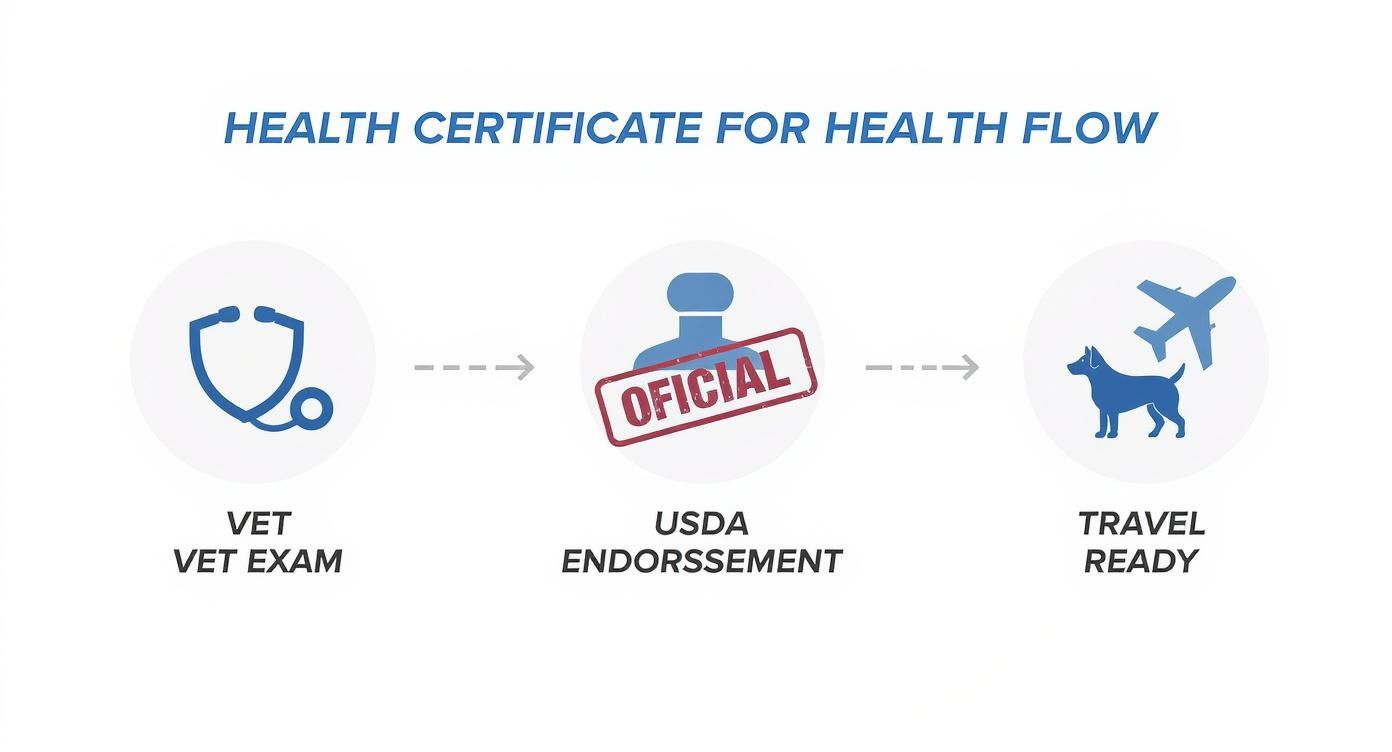
As you can see, the vet exam is just the first domino to fall. The official USDA endorsement is what makes the document ready for your trip.
Understanding Country-Specific Rules
Every country plays by its own rules, and some of them can be very specific. Japan, for example, often requires two rabies vaccinations plus a blood titer test done months ahead of time.
On the other hand, travel within the EU has been simplified by the EU Pet Passport system. In fact, as of 2025, over 10 million EU Pet Passports have been issued, which shows just how common it is for pets to travel between member states.
A complete health profile is also vital. If your dog has any ongoing conditions, it’s important to discuss them with your vet. For instance, if your dog struggles with allergies, having information from a vet-approved guide on dog allergies can help your veterinarian provide the best advice and accurately complete the necessary forms.
Finding a USDA-Accredited Vet Near You

So you've started searching for an "international health certificate for dogs near me." This is where the journey gets real, because not just any vet can sign off on these official travel documents. You need a specific professional: a USDA-accredited veterinarian.
This special accreditation means the vet has completed federal training and is authorized to work through the paperwork required for international pet travel. Your regular clinic might not have an accredited vet on staff, so checking this first is your most important move. It's time to unleash the search for the right expert.
Starting Your Search for the Right Vet
The most direct way to start is by using the USDA's own search tool. They keep an official database of all accredited vets, which is a far more reliable source than a generic Google search. It instantly filters out all the clinics that can't help you.
Once you have a shortlist of local clinics, pick up the phone. A few minutes on a call can save you hours of frustration and prevent you from booking an appointment with the wrong provider.
When you call, be direct and ask these questions:
"Do you have a USDA-accredited veterinarian on staff who can issue an international health certificate for my dog?"
"Have you prepared health certificates for [Your Destination Country] before?"
"What is your process for handling the paperwork and getting the USDA endorsement?"
Their answers will tell you everything you need to know about their experience level. A vet who is already familiar with your destination country's quirks is an incredible advantage—they’ll know the common pitfalls and tiny details that are easy to miss.
Vetting Your Potential Veterinarian
Finding an accredited vet is one thing; finding one with the right experience is another. For example, a vet who has recently handled travel to the UK will be very familiar with the mandatory tapeworm treatment rules. In contrast, a vet who mostly deals with travel to Mexico might not be as sharp on EU-specific regulations.
An experienced accredited veterinarian is like your co-pilot for this entire process. Their firsthand knowledge of the destination’s requirements, timelines, and potential hang-ups can be the difference between a smooth departure and a stressful, last-minute scramble.
Don't be shy about asking for specifics. A good vet will appreciate your diligence—it shows you understand how important it is to get every detail perfect.
For a closer look at what happens after you find your vet, our guide breaks down exactly how to get a USDA-endorsed pet health certificate. This resource gives you a clear roadmap from the vet's signature all the way to that final government stamp of approval.
Nailing the Timeline and Budget for Your Dog's Health Certificate
When you're prepping for an international trip with your dog, timing isn't just a suggestion—it's everything. The whole process runs on a surprisingly tight schedule, and one misstep can force you to start from scratch. The most important deadline to remember is this: many countries require the health certificate to be signed by your vet within 10 days of your arrival.
That short window means you have to juggle your vet visit, the official USDA endorsement, and your flight date with precision. There’s almost no room for error, so planning is your best friend. Don't let the calendar foil your travel plans.
The Critical 10-Day Rule
This "10-day rule" is a big one, especially for popular destinations like the European Union. It means that from the moment your USDA-accredited vet gives your dog the final all-clear and signs the paperwork, a clock starts ticking. You have ten days to get that paperwork endorsed by the USDA and land in your destination country.
Let's make that real. Say your flight to France takes off on May 20th. The absolute earliest your vet can sign that health certificate is May 10th. This ensures the document is still valid when you land. Pro tip: aim to schedule that exam 8-9 days before your flight. It gives you a tiny bit of breathing room for those "just in case" moments, like a flight delay.
A quick heads-up: the 10-day window isn't universal. Some countries are stricter with a 5-day rule, while others are more relaxed with a 30-day window. Always, always, always double-check the specific rules for your destination on the USDA APHIS website before you book a single appointment.
Budgeting for Your Dog's Travel Certificate
Beyond the schedule, you'll want a clear picture of the costs. The final price tag can swing quite a bit depending on your location and how complex your destination's rules are. It’s not a single fee but a series of them that add up, so knowing what to expect helps avoid any last-minute financial surprises.
Here’s a realistic breakdown of what you're likely looking at:
Veterinarian Exam Fee: This covers the consultation with your USDA-accredited vet. Expect this to run anywhere from $150 to $400, depending on the clinic and how in-depth the required exam is.
Certificate Preparation Fee: This is a separate charge some vets have for the time and specialized knowledge it takes to fill out the mountain of paperwork correctly. This can add another $100 to $300 to the bill.
USDA Endorsement Fee: This is the government's fee for their official review and stamp of approval. As of late 2024, the fee starts at $38 for a simple certificate with no lab tests. But if blood work or other tests are involved, that price can climb.
Shipping Fees: You'll need to send the documents to the USDA office and get them back, which means paying for overnight shipping. Plan on $60 to $100 for a round-trip priority label.
Common Mistakes to Avoid
Getting an international health certificate can be a breeze if you're prepared, but a few simple slip-ups can throw a major wrench in your travel plans. Knowing the common pitfalls ahead of time is the best way to guarantee a smooth journey for you and your dog.
One of the biggest mistakes we see is simply waiting too long to get started. The whole process—from figuring out the rules to getting the final USDA stamp of approval—can take weeks, and sometimes even months. Procrastination is not your friend here, especially when countries like Japan or Australia require blood tests with long waiting periods.
Another frequent hiccup is misunderstanding the destination country's specific rules. It's easy to assume the requirements are similar everywhere, but they can vary wildly from one border to the next.
Double-Check These Key Details
Tiny errors on the paperwork can cause massive delays. A single wrong digit in a microchip number or a misspelled name could get your documents rejected by the USDA or customs officials abroad.
Microchip Number: This is your dog's official ID. Make sure the number on the health certificate exactly matches what's on the rabies certificate and in your vet's records.
Dates: Check that all vaccination, treatment, and exam dates are recorded correctly and fall within the required timeframes. A date that’s off by even one day could invalidate the entire document.
Using a Non-Accredited Vet: Only a USDA-accredited veterinarian can sign these federal forms. Booking an appointment with your regular vet without first confirming their accreditation is a common and expensive mistake.
We hear this story all the time: pet owners assume their trusted, long-time vet can handle the paperwork. They go through the whole exam, only to find out at the last minute that the vet isn’t accredited. This kicks off a frantic search for an "international health certificate for dogs near me," putting their travel dates at serious risk.
Finally, don't forget about the final step: logistics. Once the vet signs the certificate, you still need to get it to a USDA office for endorsement. Forgetting to include a pre-paid overnight return shipping label is a small oversight that can easily add days to the process. When you're on a tight travel schedule, those days matter. A little careful planning goes a long way in avoiding these preventable headaches.
Your Pet Travel Questions Answered
We get it—this whole process can feel a bit overwhelming. As you start searching for an "international health certificate for dogs near me," a few key questions always seem to pop up. Let's tackle them head-on so you can move forward with confidence.
How Long Is an International Health Certificate Valid?
This is one of the most time-sensitive parts of the entire journey. For many popular destinations, like countries in the EU, the health certificate must be issued by your vet within 10 days of your travel date. But please, don't assume that's a universal rule.
Every country sets its own timeline. Some might give you a bit more breathing room, while others could be even stricter. Getting this detail wrong is a classic pitfall that can lead to major headaches at the border, and nobody wants that. Always, always confirm the specific window for your destination.
Can My Regular Vet Issue the Certificate?
Only if they are a USDA-accredited veterinarian. This is a crucial distinction. Most general practice vets are not, because accreditation requires special federal training and gives them the authority to sign official export documents like the APHIS 7001 form.
Before you even think about booking an appointment, you have to ask one simple question: "Are you USDA-accredited?" If the answer is no, you'll need to find a vet who is.
What Happens If There Is a Mistake on the Paperwork?
Even the tiniest error can derail your plans. A simple typo in your dog's microchip number or a miscalculated vaccination date can cause the USDA endorsement office to reject the entire certificate. This forces you to scramble and start the process all over again, usually with only days to spare.
The worst-case scenario? Your dog could be denied entry when you land. It's a stressful, heartbreaking situation that is entirely avoidable with careful, accurate preparation.
Navigating the maze of international pet travel is tough, but you don’t have to figure it out alone. Passpaw gives veterinary practices the tools to get every detail right, every time. We help clinics reduce errors, save time, and give pet owners total peace of mind. Learn how we simplify the process at https://passpaw.com.
More articles
From regulatory changes to best practices for veterinarians and pet owners, our resources keep you ahead of the curve.