Are you a team member in a veterinary practice?
Are you a pet parent planning a trip with your furry pal?
How to Obtain a Pet Passport: A Guide to Global Pet Travel
Getting a pet passport is really about three key things: making sure your pet is microchipped, has a current rabies vaccination, and getting an official Animal Health Certificate from an accredited veterinarian. Think of it as your pet's official travel ID, proving they're healthy and safe to cross borders.
Your Pet's Ticket to Traveling the World
Planning an international trip with your furry co-pilot is an incredible adventure, but it definitely requires some homework. The "pet passport," or more commonly today, the Animal Health Certificate (AHC), is hands-down the most important document for your pet’s journey.
Getting one isn't as intimidating as it sounds. It's less about navigating a maze of rules and more about following a clear, simple process to ensure their health and safety.
This guide will walk you through everything you need to do, from that first vet visit to getting the final paperwork stamped. It’s all about being prepared so you can head to the airport feeling confident, not stressed.
Why a Pet Passport Is So Important
A pet passport is basically a universally recognized health record. It’s the official proof that your pet has met all the necessary health requirements to enter another country, which is a huge deal for preventing the spread of diseases.
Without it, your travel plans could come to a screeching halt. We're talking stressful delays, unexpected quarantine, or even being denied entry altogether.
And more people are traveling with their pets than ever before. The pet travel services market is booming, hitting $2.4 billion in 2024 and showing no signs of slowing down. A whopping 78% of American owners travel with their pets, which just goes to show how important it is to have the right paperwork ready. This surge in pet-friendly travel makes getting the documentation right absolutely critical.
What to Expect in This Guide
We’re going to break down the entire process into simple, easy stages. You’ll get the full scoop on:
The first steps of microchipping and vaccinations.
How to handle the official health certificate paperwork without the headache.
Why checking your destination’s specific rules is a must-do step.
A "pet passport" isn't just one document but a collection of health verifications that prove your pet is fit for travel. The goal is to make border crossings smooth and predictable for everyone involved—especially your pet.
Before we dive in, here’s a quick overview of the key documents you'll need to get in order.
Quick Checklist for Your Pet's Travel Documents
This table summarizes the essential requirements for getting your pet's travel documents sorted. It's a great starting point to make sure you haven't missed anything crucial.
Requirement | Key Detail | Typical Timing |
|---|---|---|
Microchip | Must be an ISO-compliant 15-digit chip implanted before the rabies vaccine. | Can be done at any vet visit. |
Rabies Vaccination | Must be given after microchipping. A waiting period (often 21 days) applies. | At least 1 month before travel. |
Rabies Titer Test | Needed for certain countries (e.g., EU from a non-listed country). | Test must be done 30 days after vaccination; results can take weeks. Plan 3-4 months ahead. |
Animal Health Certificate (AHC) | Issued by a USDA-accredited vet within a strict timeframe (often 10 days) before travel. | Within 10 days of your departure. |
USDA Endorsement | The AHC must be officially endorsed (stamped) by the USDA. | Allow several days for shipping and processing. |
Parasite Treatments | Some countries need specific tapeworm or tick treatments before arrival. | Typically 1-5 days before entering the destination country. |
Remember, this is a general checklist. Always, always confirm the specific requirements for your destination country, as rules can vary.
We’ll cover everything from timelines to common mistakes people make. Once your pet's passport is sorted, you can start dreaming about all the incredible global travel destinations you'll explore together.
This process might seem like a lot at first, but with a little planning, it’s completely doable. Let’s get you and your best friend ready for takeoff.
Starting with Microchips and Vaccinations
Before you start dreaming of Parisian cafes with your poodle or beach days with your beagle, there are two foundational steps you absolutely have to tackle first. Think of microchipping and vaccinations as the must-do items at the top of your travel checklist.
Getting these right from the very beginning is key for a smooth journey. It's the bedrock of the entire pet passport process.
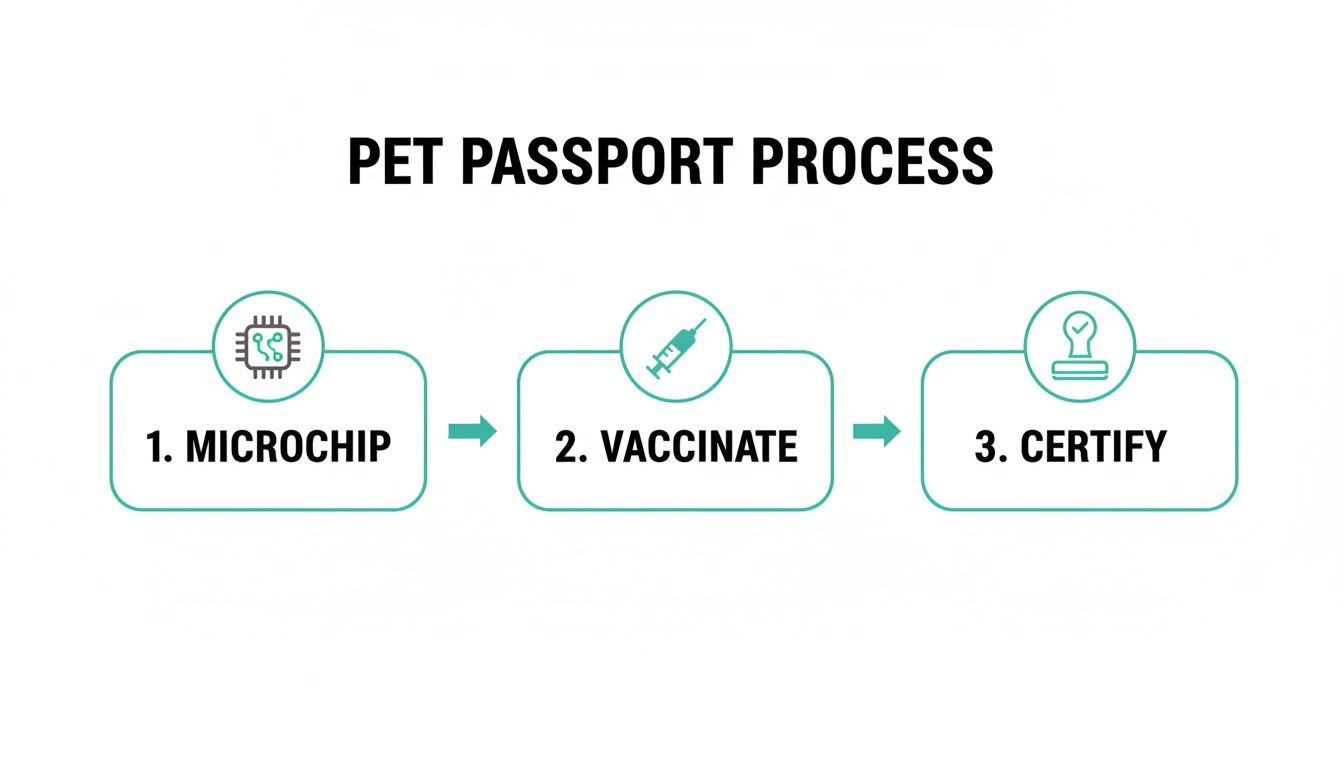
As you can see, the journey always begins with a microchip. Then come the vaccinations, and only after that can any official certification happen. Let’s dig into why this specific order is so important.
The Mighty Microchip: Your Pet's Permanent ID
First things first: your pet needs a microchip. This is a tiny electronic chip, about the size of a grain of rice, that a vet implants just under your pet's skin. It’s a safe, simple procedure that can be done during any regular check-up.
But not just any microchip will do. For international travel, the gold standard is an ISO 11784/11785 compliant 15-digit microchip. This is the specific format recognized and scannable in most countries around the world, making sure your pet can be identified no matter where you go.
Critical Timing Tip: The microchip MUST be implanted before the rabies vaccination. If the vaccine is given first, it may not be considered valid for travel, and you might have to get your pet revaccinated after the microchip is in place.
This isn't a suggestion—it's a strict rule in many regions, including the entire European Union. The microchip number is your pet’s unique identifier, and it has to be recorded on every health document that follows, starting with their rabies certificate.
All About the Rabies Vaccination
Once the microchip is in, it’s time for the rabies vaccine. Rabies is a serious global health concern, so proving your pet is protected is a cornerstone of international pet travel rules.
Your vet will administer the vaccine and record every single detail. This includes the date, the vaccine manufacturer, and its expiration date. It's very important that every detail is captured accurately. For a deeper look, check out our guide on what makes up valid proof of rabies vaccine documentation.
Just know that this isn't a one-and-done shot. The initial vaccination starts a clock that you need to watch very carefully.
Understanding the 21-Day Waiting Period
Here’s a detail that trips up a lot of pet owners. After your pet gets their primary rabies vaccination (the first one they get after being microchipped), there is a 21-day waiting period.
Your pet is not considered fully immunized—or eligible to travel—until 22 days after that vaccine was given. This waiting period is enforced to ensure the vaccine has had enough time to become effective.
Initial Vaccination: The first rabies shot given after microchipping, or a booster given after the previous one has expired. This always triggers the 21-day wait.
Booster Vaccination: If your pet gets a booster shot before the previous one expires, there is usually no waiting period. Staying up-to-date is the key to avoiding delays!
This waiting period is a perfect example of why starting the pet passport process so far in advance is a good idea. You just can’t rush it. This boom in pet travel is part of a larger trend where pets are truly seen as family, fueling a global pet travel services market expected to hit $4.3 billion by 2033. As more people travel with their companions, understanding these timelines becomes very important.
Forgetting this 21-day rule is one of the most common reasons for last-minute travel panics. Mark your calendar and plan accordingly to avoid any ruff patches in your preparations.
Handling the Official Health Certificate Paperwork
Okay, the microchip is in and the vaccinations are all sorted. You've laid the groundwork. Now comes the main event: the official health certificate. This is the document that ties everything together and gets that final, important government stamp of approval.
Don't let the word "paperwork" send you running. The process itself isn't complicated, but the details and timing? They're everything. This isn't just another form; it's your pet's official permission slip to see the world.
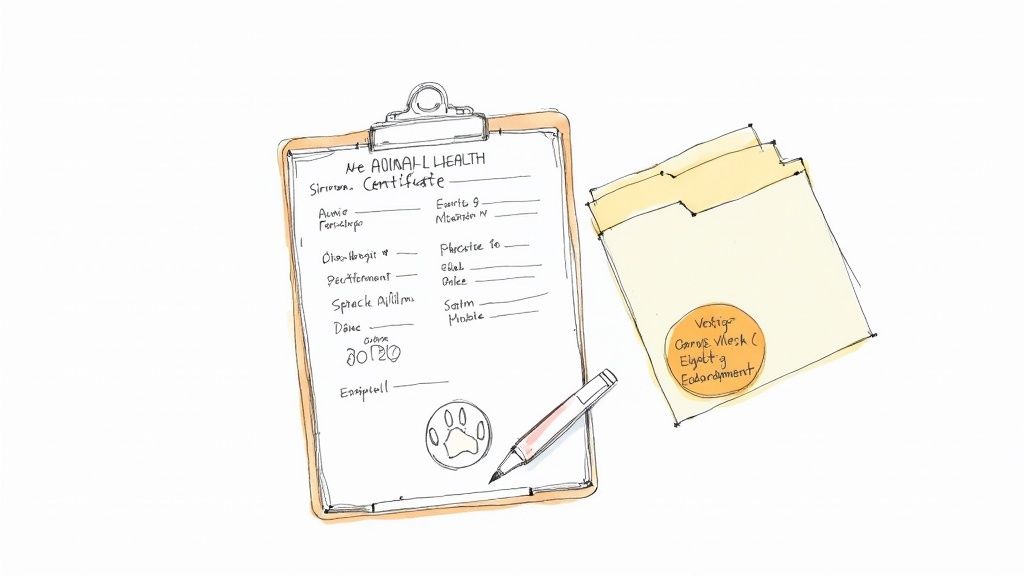
Finding a Government-Accredited Veterinarian
Here’s the first hurdle: you can’t just go to any vet. The international health certificate, often called an Animal Health Certificate (AHC), has to be signed by a veterinarian who is specifically accredited by your country's government.
In the United States, that means you need a USDA-accredited veterinarian. These vets have taken extra training and are authorized by the federal government to handle official animal export documents. It's a special designation, and not every clinic has one on staff.
Before you even think about booking an appointment, you need to confirm this. A quick search on the USDA's website or a simple phone call to your vet's office can save you a massive headache. Just ask, "Is Dr. Smith USDA-accredited for international pet travel?"
What Information Goes on the Certificate
Think of the health certificate as your pet's own passport application. It’s a detailed snapshot of their identity and health, and every single field needs to be perfect. One small mistake can derail the whole thing.
Here’s what you’ll typically find on the form:
Your Pet’s Information: Full name, breed, color, and birth date.
Microchip Number: That 15-digit ISO-compliant number, which must match all your other records exactly.
Rabies Vaccination Details: The date of the shot, plus the vaccine's manufacturer and lot number.
Parasite Treatments: If your destination needs a tapeworm treatment, for example, the vet will record the exact date, time, and product used.
Clinical Examination: A confirmation from the vet that your pet is healthy, happy, and free of any contagious diseases.
This document is where all your hard work comes together. For a deeper dive into each section, check out our guide on the veterinary international health certificate.
The All-Important Government Endorsement
Once your accredited vet signs the certificate, you’re still not done. There’s one final, important step: getting it endorsed by the government. This is the official seal that makes the document valid for international travel.
In the U.S., this means the completed form must be sent to the USDA’s Animal and Plant Health Inspection Service (APHIS). They review the paperwork, verify your vet’s signature, and apply an official embossed seal or stamp.
So many people make the mistake of thinking the vet's signature is the final step. It's not. The USDA endorsement is what turns that piece of paper into an official travel document. Without it, you're not going anywhere.
This careful process is a huge part of why the global pet travel market is set to grow from $2.4 billion in 2024 to $5.3 billion by 2034. As more families want to travel with their pets, these official systems are what make it safe and possible.
Timing Is Everything: The 10-Day Rule
This is where things can get stressful. Most countries have a very strict rule: the health certificate must be issued within a tight window before you fly—often just 10 days.
That 10-day period has to cover the vet appointment, the vet signing the certificate, shipping it to the USDA, waiting for the endorsement, and getting it shipped back to you. There is absolutely no room for error.
Let’s say your flight to France is on June 20th. You would need to have the vet exam and certificate completed no earlier than June 10th. If you go on June 9th, the certificate could expire and be invalid by the time you travel. It’s a nail-biting timeline that demands a perfect plan.
Checking Your Destination's Specific Rules
You’ve done the heavy lifting—the microchip, the vaccinations, the health certificate. It feels like you're on the home stretch, but there's one more important mission before you can relax: confirming the specific entry rules for your destination. One of the most common mistakes is assuming that one set of rules applies everywhere. That assumption can land you and your pet in a ruff spot.
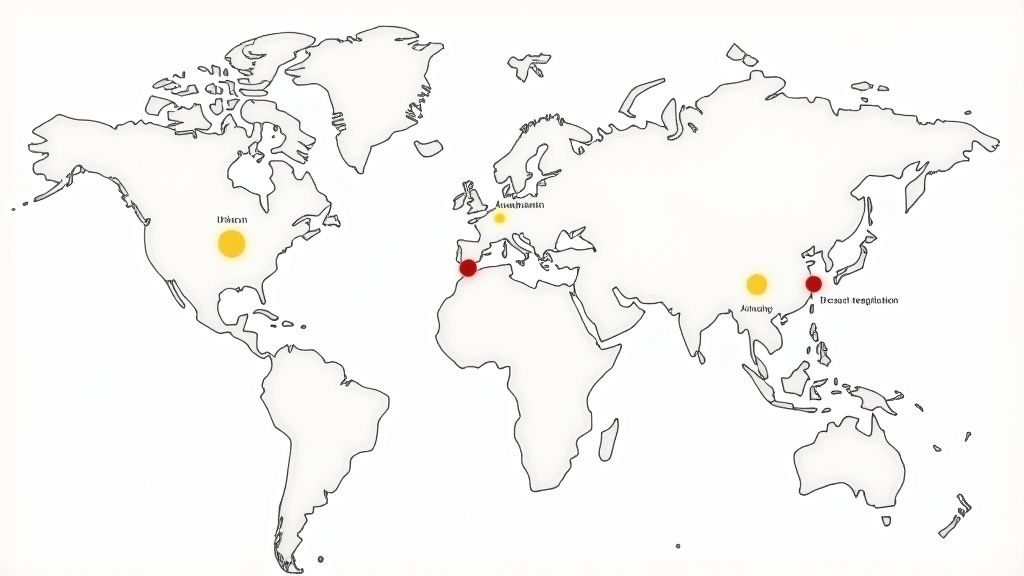
The reality is, every country has its own unique set of requirements for bringing pets across its borders. Think of it as a custom security check for your furry friend, designed around that location's specific health and safety concerns. A health certificate that gets your pet into France won't necessarily work for a trip to Japan or Australia.
Why Rules Differ So Much
Different countries have different statuses when it comes to animal diseases, especially rabies. Nations that are completely rabies-free—like the United Kingdom, Japan, and Australia—have very strict rules to protect their local animal populations. They simply can't afford to take any chances.
This is why requirements vary so widely. Some destinations are relatively straightforward, while others involve a complex series of steps spread out over several months. Now is not the time to "wing it" or rely on outdated advice from a friend. Official sources are your best friend here.
The Rabies Titer Test: A Major Hurdle
For many rabies-free or rabies-controlled countries, a standard vaccination record just isn't enough. They want scientific proof that the vaccine actually worked. This is where the rabies titer test comes into play.
A titer test is a simple blood test that measures the level of rabies antibodies in your pet’s system, confirming they are properly immunized.
The real catch with the titer test is the timing. It often needs to be done months in advance. Many countries require the blood sample to be drawn at least 30 days after the rabies vaccination. Then, you might have to wait another three to six months after the blood test before your pet is even allowed to enter.
This is a huge timeline consideration that can catch even the most organized pet owner off guard. If your destination needs a titer test, it should be one of the very first things you plan for. Don't let it become a last-minute surprise.
Mandatory Parasite Treatments
Beyond rabies, many countries are also deeply concerned about parasites like tapeworms and ticks. This is another area where you'll find significant differences in the rules.
For instance, to bring a dog into the United Kingdom, Ireland, Finland, or Norway, they must receive a specific tapeworm treatment. The rules are very precise:
The treatment must be given by a veterinarian.
It must be administered no less than 24 hours and no more than 120 hours (that's one to five days) before your scheduled arrival.
The vet has to record the exact date, time, and product used on the official health certificate.
Missing this window by even a few hours can result in your pet being denied entry or forced into a costly quarantine. It’s a perfect example of why a detailed, destination-specific checklist is so important. To keep all these moving parts organized, a digital tool like our pet travel planner can be a lifesaver.
To give you a clearer picture of how much things can differ, here’s a quick comparison of requirements for a few popular destinations.
Sample Destination Requirement Comparison
Requirement | European Union (e.g., France) | United Kingdom | Australia |
|---|---|---|---|
Microchip | ISO 11784/11785 Compliant | ISO 11784/11785 Compliant | ISO 11784/11785 Compliant |
Rabies Vaccination | Required (at least 21 days before travel) | Required (at least 21 days before travel) | Required |
Rabies Titer Test | Not required from the US | Not required from the US | Required, with a long waiting period after the test |
Tapeworm Treatment | Not required | Required (1-5 days before arrival for dogs) | Required (multiple treatments) |
Quarantine | Not required | Not required | Required (minimum 10 days upon arrival) |
As you can see, the requirements for Australia are far more detailed than for the EU, highlighting why you can't make any assumptions. Always check the official rules for your specific destination.
Finding Official and Current Information
So, where do you find this crucial, up-to-the-minute information? Relying on general blog posts or old forums is risky because rules can and do change without notice.
Your primary sources should always be official government websites. Here’s where to look:
The Destination Country's Embassy or Consulate: Check the website for the country you're visiting. They almost always have a dedicated section on "bringing pets" or "animal importation."
The Department of Agriculture: Look for the destination's equivalent of the USDA. This is the government body that sets and enforces animal import rules. For example, in the UK, it’s the Department for Environment, Food & Rural Affairs (DEFRA).
These sources provide the most accurate information. I always recommend printing out their requirements and using them to create a custom checklist for your trip. It might feel like extra work, but it’s the only way to travel with complete peace of mind.
Beyond the official checklists and government forms, a little practical wisdom goes a long way. Think of this as advice from someone who’s been through it—small things you can do now to avoid massive headaches later.
Getting your pet's travel papers in order isn't a sprint; it's a marathon. If I could give you only one piece of advice, it would be this: start the process much, much earlier than you think you need to. Timelines can be tricky, and unexpected delays are frustratingly common.
Organization Is Your Best Friend
You're about to juggle a stack of critical documents, from vaccination records to signed certificates. Losing just one of them can derail your entire plan. I suggest creating a dedicated travel folder for your pet from the moment you start.
Better yet, keep both a physical and a digital version.
Physical Folder: A simple binder works perfectly. Keep all the original, hard-copy documents here and carry it with you when you travel.
Digital Folder: Scan every single document as soon as you get it. Save everything to a cloud service like Google Drive or Dropbox so you have a secure backup you can pull up from anywhere.
With this two-part system, you're ready for anything. If an airline agent needs a copy, you can email it on the spot. If your physical folder gets misplaced, your digital backup is a lifesaver.
Pro Tip: Meticulously double-check every detail on your documents. A misspelled name, a wrong digit in the microchip number, or an incorrect date can invalidate the whole certificate. Accuracy isn't just important; it's everything.
When to Call in the Professionals
While many people navigate the pet passport process on their own, there are definitely times when hiring an expert is the smart move. A pet relocation service can be a godsend, especially for more complex international moves.
You might want to consider using one if:
You’re moving to a country with very strict rules, like Australia or Japan.
Your travel plan involves multiple flights or long layovers.
You simply don’t have the time to manage all the details and deadlines yourself.
These companies are pros at navigating the fur-midable world of international pet transport. They handle everything from booking flights to ensuring every piece of paperwork is flawless, which can take a huge amount of stress off your shoulders. They know exactly how to get a pet passport for even the most complicated journeys.
Finding the Right Vet and Talking to Your Airline
Not just any vet can handle travel paperwork. You’ll need a government-accredited veterinarian to sign the official health certificate. The first step is to ask your current vet if they have this accreditation. If they don't, they can almost always refer you to a colleague who does.
Once your vet is lined up, get on the phone with your airline. Call them directly to confirm their specific pet policies, from crate requirements to check-in procedures. Don’t just rely on what their website says, as policies can change without notice. A quick conversation with a representative ensures you have the most up-to-date information.
Finally, remember that a clean, healthy home environment is key to your pet's overall wellness, especially before a big trip. As you prepare, adopting safe carpet cleaning practices for homes with pets can help ensure your furry friend is happy and healthy. After all, a calm pet at home makes for a much better traveler on the road.
Common Questions About Pet Travel Paperwork
Even with the best-laid plans, it’s completely normal to have a few questions rattling around as your pet’s trip gets closer. Let’s be honest, the world of international pet travel has a lot of moving parts, and clear answers can be the difference between a smooth trip and a stressful ordeal.
We've pulled together some of the most frequent questions we hear to help you navigate that final stretch. Think of it as your final pre-flight check before the big adventure.
How Much Does a Pet Passport Cost?
This is usually the first thing on everyone's mind, and the short answer is: it really depends. The total cost is a mix of factors like where you are, where you're going, and exactly what your pet needs to get there. There isn't a single flat fee, but rather a collection of individual costs that add up.
For a pet owner in the U.S., here's a general idea of what you can expect to pay:
Microchipping: If your pet isn't already chipped, this is typically $25–$50.
Rabies Vaccination: This can run anywhere from $15–$35.
Health Certificate Exam: The visit to a USDA-accredited vet can cost between $50–$250.
USDA Endorsement: The official government stamp of approval has a set fee, which can be $101 - $275 per pet.
When you add it all up, the baseline cost for a U.S. pet owner often lands somewhere between $250 and $600. Keep in mind, this doesn't include potentially pricey extras like a rabies titer test or specific parasite treatments, which can definitely increase the final bill.
What’s the Difference Between a Pet Passport and an AHC?
This is a great question, and it's especially relevant for anyone traveling from Great Britain. Before Brexit, pet owners in the UK could use the standard EU Pet Passport. That's all changed now.
An EU Pet Passport is that classic blue booklet issued by a veterinarian within the European Union. It's designed to be used for the life of your pet, allowing for easy travel between EU member states as long as the rabies vaccination is kept up to date.
An Animal Health Certificate (AHC), on the other hand, is what pets traveling from Great Britain to the EU now require. It's a single-use document, valid for just one trip, and it must be issued within 10 days of travel. So, while they serve a similar function, the AHC is for a single journey, while the EU Pet Passport is a multi-use document for ongoing travel.
For pet owners in the U.S., there's no single official document called a "pet passport." We use the term informally to refer to the whole bundle of required paperwork, with the USDA-endorsed health certificate as the star of the show.
How Long Does It Take to Get Everything Done?
The timeline is probably the most important—and most underestimated—part of this entire process. I can't stress this enough: it is absolutely not something you can pull off a week or two before your flight.
Absolute Minimum Timeframe: If your destination has simple requirements like a microchip and a rabies shot, you still have to account for the 21-day wait after the vaccination. Add in time for vet appointments and paperwork, and you're looking at about one month, best-case scenario.
Recommended Timeframe: For any destination that requires a rabies titer test, you need to get the ball rolling four to six months ahead of your travel date. The test itself involves waiting periods that can easily last three months or more.
Starting early is the single best piece of advice I can give you. Trying to rush the process is just a recipe for expensive mistakes and heartbreaking travel delays. Don't leave it until the last minute—your peace of mind is worth every bit of extra planning. You wouldn't want to find yourself in a cat-astrophe right before your trip.
Ready to make your pet’s international travel a breeze? Passpaw offers a simple, cloud-based solution for veterinarians and pet owners to manage travel documents with ease. Our platform helps ensure every requirement is met, from real-time validation to automated workflows, taking the guesswork out of getting your pet’s passport. Learn how we can help at https://passpaw.com.

More articles
From regulatory changes to best practices for veterinarians and pet owners, our resources keep you ahead of the curve.