Are you a team member in a veterinary practice?
Are you a pet parent planning a trip with your furry pal?
How Do You Get a Pet Passport? A Simple Guide
So, you're planning an adventure with your furry co-pilot? You've landed in the right spot. This guide is your roadmap to figuring out exactly how to get a pet passport, making your international journey a walk in the park.
We'll break down the entire process—from the first vet visit to the final paperwork—into simple, easy-to-follow advice. No confusing jargon, just what you need to know to feel confident and prepared. Think of this as your pre-flight checklist for pet travel.
What Is a Pet Passport Anyway?
First things first, the term "pet passport" can be a little confusing. While the European Union does issue an actual blue, passport-style booklet for pets, the term is more often used as a general name for the whole collection of official documents showing your pet is healthy and meets the import rules of your destination.
This bundle of paperwork is your pet’s ticket to fly. It shows they're not a risk for spreading diseases like rabies. The specific documents you'll need can change a lot from one country to another. For instance, a complete veterinary checklist for relocating your pet to Dubai will have different requirements than a trip to France.
The Core Steps for International Pet Travel
Getting all your ducks (or dogs and cats) in a row for an international trip involves a few key stages. The process is designed to make sure animals and people stay healthy and safe across borders. Starting early and staying organized is the best way to avoid any last-minute stress.
Here’s a high-level look at what’s involved:
Microchipping: This is always the first step. Your pet needs an ISO-compliant microchip for identification.
Vaccinations: A current rabies vaccination is a must for almost every country, and it should be given after the microchip is put in.
Health Certificates: An official, accredited veterinarian has to issue and sign an Animal Health Certificate (AHC) or a similar country-specific document within a strict timeframe.
Government Endorsement: In many places, like the US, the health certificate must be stamped and approved by a national authority like the USDA.
Destination-Specific Rules: Some countries require extra steps, like tapeworm treatments or specific blood tests. Knowing the exact rules for where you're going is very important.
To help you keep track, here is a quick summary of the essential paperwork you'll be gathering.
Pet Travel Document Quick Checklist
Requirement | What It Is | Why It's Important |
|---|---|---|
ISO Microchip | A 15-digit electronic chip placed under your pet's skin for permanent identification. | This is the universal standard for identifying your pet and linking them to all their health documents. It should be implanted before the rabies vaccine. |
Rabies Vaccination Certificate | Proof of a valid rabies shot, given by a licensed veterinarian. | Nearly every country requires this to prevent the spread of the disease. The timing of the vaccine relative to the microchip and travel date is key. |
Animal Health Certificate (AHC) | An official document filled out by a government-accredited vet, confirming your pet is fit to travel. | This is the main document that brings together all your pet's health information. It has a very strict validity period, often just 10 days. |
Government Endorsement | An official stamp or signature from your country's veterinary authority (e.g., USDA-APHIS in the US). | This makes the AHC official and shows that it meets international standards. Without it, the certificate isn't valid. |
Additional Treatments/Tests | Country-specific requirements like tapeworm treatment, rabies titer tests, or other vaccinations. | Failing to meet these specific rules for your destination could result in your pet being quarantined or denied entry. |
Navigating this can feel like a maze, but breaking it down makes it manageable.
For a deeper look into the specific requirements you might face, our guide on international pet travel requirements provides more detailed information to help you prepare for a smooth journey.
Laying the Groundwork: Microchip and Vaccinations
Before you start picturing your poodle at a Parisian café or your tabby enjoying the Spanish sun, there are a couple of basic steps you simply can't skip. Think of these as the must-do first moves in the pet travel game. Getting the identification and health basics right from the very beginning is the secret to avoiding any ruff patches down the road.

The whole process kicks off with a tiny piece of technology that makes a huge difference: a microchip. If your pet isn't already chipped, this is your absolute first priority.
For any international travel, the chip should be an ISO-compliant 15-digit microchip. This is the global standard, so make sure you've got the right one. A quick vet visit is all it takes to have one put in.
Here's the important part: the microchip has to be implanted before anything else, especially the rabies vaccine. Why? Officials need to scan that chip to confirm your pet's identity matches all their paperwork. It's that simple.
The All-Important Rabies Vaccine
Once that microchip is in place and readable, it’s time for the rabies shot. This is the big one. Nearly every country in the world asks for proof of a current rabies vaccination for entry.
But the timing is everything.
The rabies vaccine must be given after the microchip is implanted and scanned. If your pet got a rabies shot before being chipped, that shot unfortunately won't count for travel. You'll have to get them vaccinated again once the microchip is confirmed.
Key Takeaway: The order is not flexible for international travel. It's always the ISO-compliant microchip first, then the rabies vaccination. Getting this backward can cause major delays or even get your pet denied entry at your destination.
After the vaccination, you'll have a required waiting period. For entry into the EU and many other countries, this is usually a 21-day wait after the primary rabies vaccination. This buffer ensures the vaccine has become fully effective. Make sure you get your official proof of rabies vaccine documentation from the vet during that visit.
Beyond the Rabies Shot
While rabies gets all the attention, it's not the only health requirement you'll come across. Your destination might have a list of other specific needs.
Common additional requirements often include:
Core Vaccinations: Make sure your pet is current on all their standard shots, like DAPP for dogs (Distemper, Hepatitis, Parvovirus, Parainfluenza) or FVRCP for cats (Feline Viral Rhinotracheitis, Calivirus, Panleukopenia).
Other Required Shots: Some places may need vaccines for diseases like Leptospirosis or Bordetella (kennel cough).
These rules are all part of a global effort to keep animals and people safe, especially as pet travel becomes more common. With nearly 2 million pets flying on planes in the U.S. each year, these standardized rules are key for preventing the spread of disease.
Making Sense of the Animal Health Certificate
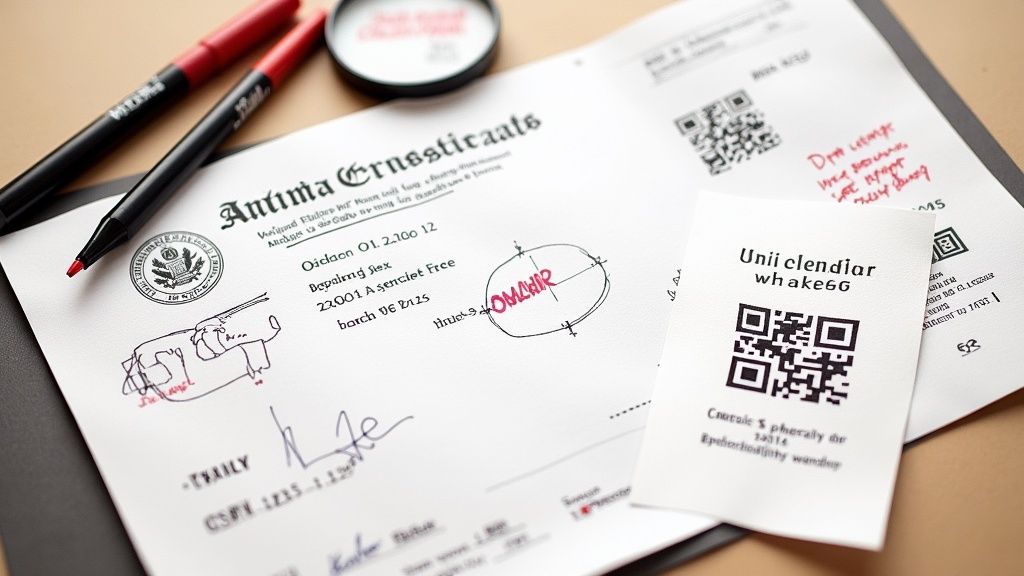
Okay, you’ve got the microchip sorted and the rabies vaccine is done. Now for the main event: the paperwork. If you're traveling to the EU from places like the US or UK, the Animal Health Certificate (AHC) is your most important document. It’s the official piece of paper that pulls all your pet's health info together in one neat package for border officials to review.
Think of it as your pet's temporary passport, confirming they're fit for travel and meet all the rules of your destination country. This isn't just a quick note from your vet; it's a specific, multi-page document where every detail has to be perfect.
Who Can Actually Issue an Animal Health Certificate?
Here's something a lot of pet owners don't realize: not just any vet can sign off on an AHC. This document has to be issued by a government-accredited veterinarian.
In the United States, that means finding a vet accredited by the USDA (United States Department of Agriculture). Over in the UK, you’ll need an ‘Official Veterinarian’ (OV) who is authorized by the Animal and Plant Health Agency (APHA).
Finding the right vet is a critical step. A good place to start is your government’s official veterinary services website, which usually lists accredited professionals. It's a good idea to call your clinic ahead of time to specifically ask if they have a USDA-accredited vet on staff. You don't want to find out they can't help you at the last minute.
Important Timing: The AHC has a very tight expiration date. It should be issued within 10 days of your pet's arrival in the destination country. This is a strict rule and means this vet appointment will be one of the very last things on your to-do list before you fly.
What's Actually on the AHC?
The Animal Health Certificate is a full snapshot of your pet's identity and health status. Accuracy is everything—a single typo or a wrong date can create a massive headache at the border.
Here's what you'll always find on the certificate:
Pet Owner’s Details: Your full name and contact information.
Pet’s Description: All the basics, like species, breed, sex, and date of birth.
Microchip Information: The complete 15-digit microchip number and the date it was implanted or first scanned.
Rabies Vaccination Details: The vaccination date, the vaccine's maker and product name, and when it expires.
Veterinarian’s Declaration: A signed statement from the accredited vet confirming your pet is healthy enough to travel.
For a deeper look into the details of this document, you can learn more about the specifics of a veterinary international health certificate and see why it's so important. Keep in mind that depending on where you're headed, you might also need sections for tapeworm treatment or the results of a rabies titer test.
Understanding Your Destination's Unique Rules
So, you’ve got the microchip, vaccinations, and the Animal Health Certificate sorted. It feels like you should be nearing the finish line, right? Unfortunately, this is where many pet parents get tripped up. Pet travel is anything but a one-size-fits-all process.
Every single country plays by its own rulebook. Assuming the requirements are the same everywhere is a recipe for trouble—and can lead to some truly cat-astrophic mix-ups at the border.
Think about it this way: flying to France with your dog from the US is pretty straightforward. You'll need the basics—microchip, rabies vaccine, and a health certificate. But if you're headed to Australia? It’s a completely different universe.
Australia is a rabies-free country, and they want to keep it that way. Their import requirements are some of the toughest in the world. The process can easily take more than six months, involving a series of blood tests, strict vaccination schedules, and a required quarantine period when you land. It’s not just an extra step; it's an entirely different journey.
Digging Into Country-Specific Requirements
So, how do you figure out exactly what your destination demands? Your best bet is always to go straight to the source. A great starting point is the official embassy or consulate website for the country you’re visiting. They almost always have a special section on bringing pets into the country.
Your next stop should be your own government's veterinary authority. In the US, that’s the USDA Animal and Plant Health Inspection Service (APHIS). Their website is a goldmine, with a detailed, searchable database of pet travel requirements for just about every country on the planet.
These official sources are your single source of truth. Relying on them will help you avoid the outdated or just plain wrong advice that sometimes floats around online forums.
Common Extra Steps to Watch For
Beyond the basics, many countries have special rules in place, usually to protect against specific regional diseases. You'll want to keep an eye out for these.
Here are a few common requirements you might run into:
Tapeworm Treatment: If you're taking your dog to countries like the UK, Ireland, Finland, Malta, or Norway, they'll need a specific tapeworm treatment. The timing here is key: it should be given by a vet between 24 and 120 hours (that's 1 to 5 days) before you arrive.
Rabies Titer Test: Some destinations require a blood test known as a rabies titer test (or FAVN). This test simply confirms the rabies vaccine is working by measuring the level of antibodies in your pet’s blood. The catch? There's often a required waiting period of 3 months or more after a successful test result before your pet is cleared for travel.
Import Permits: A number of countries require you to apply for and receive an official import permit before your pet can even get on the plane.
Real-World Scenario: Let's say you're flying from the US to the UK. You've got the microchip, the rabies shot, and the AHC all set. But if you forget that crucial tapeworm treatment within that 5-day window before landing, your dog could be refused entry or, worse, put into a long and expensive quarantine.
This is the part of the process that calls for careful research and planning. The details really, truly matter. Don't be afraid to double- and triple-check everything directly with official sources, because rules can and do change. A little work now is what separates a smooth, happy arrival from a nightmare at the border.
Creating Your Pet Travel Timeline
Getting your pet’s travel documents in order isn't a weekend project. It’s a marathon, not a sprint, and starting early is the single best thing you can do to keep stress levels low for both you and your furry co-pilot.
Putting it off is not your friend here. Some requirements have mandatory waiting periods that can stretch on for months, and there’s simply no way around them. Think of this as your project plan for a purr-fectly smooth departure. When you break the process down into a clear timeline, a big task becomes a series of manageable steps.
Your 6+ Month Countdown Begins
The moment you even think you might be traveling, the clock starts. This is your research and planning phase, and honestly, it’s the most important part of the whole process.
Initial Research: Dive deep into the specific import requirements for your destination country. Don't rely on blogs or forums—go straight to the source. Official government and embassy websites are your best bet for accurate, up-to-date information.
Consult Your Vet: Schedule an appointment to talk about your travel plans. You need to confirm your pet has an ISO-compliant microchip and that all their routine vaccinations are current. This is also the perfect time to ask if they have a USDA-accredited vet on staff, since you'll need one for the final paperwork.
This early legwork is very important, especially if your destination requires a rabies titer test. This blood test has to be done at an approved lab, and many countries enforce a strict three-month waiting period after the blood is drawn before your pet is even allowed to enter.
The Final 3 Months Before Travel
With your initial research in the bag, it’s time to start taking action. During this window, you’ll be locking in key appointments and making firm travel arrangements.
Your main priorities should be:
Book Pet-Friendly Travel: Get your pet’s spot on the flight secured and triple-check the airline's specific rules for crates, check-in times, and any documents they require at the airport.
Schedule Key Vet Visits: If a rabies titer test is needed, get that blood drawn right at the start of this three-month window. You’ll also want to get the final health certificate appointment on the books for about 10 days before you fly.
This methodical approach is becoming more common as pet travel explodes in popularity. The global pet travel services market was valued at around $2.4 billion in 2024, partly because more of us see our pets as true family members. With roughly 78% of U.S. pet owners traveling with their companions annually, planning ahead is the new standard. Discover more insights about the rise in pet travel trends on hotelagio.com.
The Final 10-Day Sprint
This is where everything comes together. Your final vet visit for the Animal Health Certificate (AHC) has to happen within 10 days of your arrival at your destination—not your departure.
After your vet completes the AHC, you’ll likely need to get it endorsed by a government body like the USDA. If your destination requires a tapeworm treatment, that will also need to be given by a vet within a very specific window, usually 1 to 5 days before you land.
For more tips on planning your journey, check out our other articles on pet travel.
Your Top Pet Passport Questions, Answered
Feeling a little swamped by all the details? You're not the only one. Getting a pet passport isn't always straightforward, so let's clear up some of the most common questions we hear from pet owners.
Figuring out the timing is probably the trickiest part of the whole process. This visual gives you a good sense of the key milestones you'll need to hit for a stress-free trip.
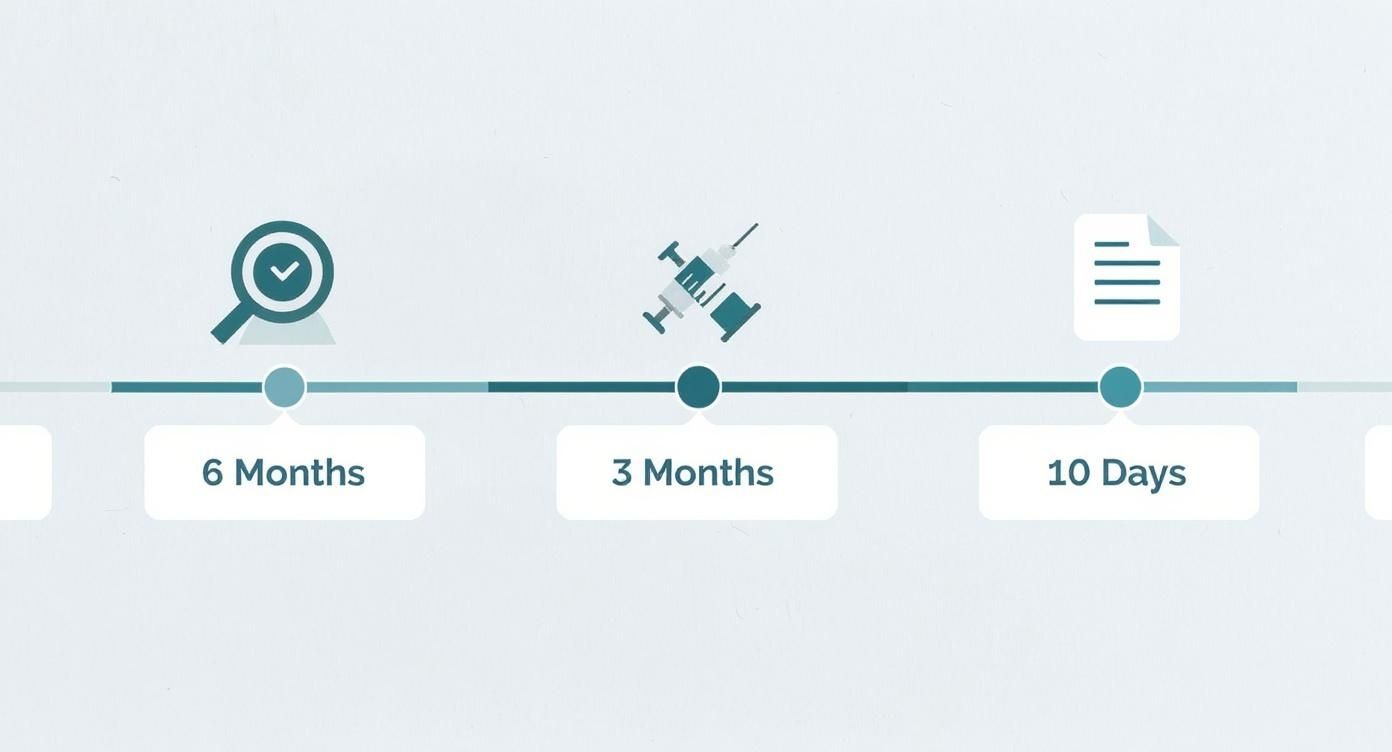
As you can see, you need to start thinking about this months in advance. The most important health checks and paperwork all happen much closer to your actual travel date.
How Long Does It Take to Get a Pet Passport?
This is the big question, and the answer is: it depends entirely on where you're going. There's no single timeline.
If you're heading to the European Union, plan on it taking anywhere from 1 to 4 months. The timeline gets longer if your pet needs a rabies titer blood test, which comes with a required waiting period after the sample is drawn. For countries with really strict rules, like Australia, you could be looking at 6 months or even more. The bottom line? Start your research and vet visits as early as you possibly can.
Can I Get a Real EU Pet Passport if I Live in the US?
In short, no. Official EU pet passports can only be issued by veterinarians working within the European Union.
When you travel from the US, your pet will receive an Animal Health Certificate (AHC) that gets an official endorsement from the USDA. This document acts as a temporary passport for your entry into an EU country. Once you've arrived, you can then visit a local vet to get an official EU pet passport issued, which makes any future travel between EU member countries much, much simpler.
What Is the Difference Between a Pet Passport and an AHC?
This is a really common point of confusion, but the difference is important. A true "pet passport," like the blue booklet issued in the EU, is a reusable document. It's valid for your pet's entire life, as long as you keep their rabies vaccinations current. It makes hopping between EU countries a breeze.
An Animal Health Certificate (AHC), on the other hand, is basically a one-time-use document for a single trip into a specific country or region (like entering the EU from a non-EU country). It's usually only valid for 10 days after it's issued for entry and allows for onward travel within the EU for a limited time (usually 4 months). Think of it as a single-entry visa, not a permanent travel document.
How Much Do Pet Travel Documents Cost?
The cost can vary a lot, from a few hundred dollars to well over a thousand. It's a good idea to budget more than you think you'll need, just in case any unexpected requirements pop up.
The total cost is a sum of several parts. In the US, you can expect to pay for the vet visits, microchipping ($25–$50), rabies vaccination ($15–$35), the health certificate exam ($50–$250), and the USDA endorsement fee, which can be over $100.
Don't forget to factor in other potential costs, like expensive blood titer tests or any other treatments specific to your destination.
Feeling overwhelmed by the paperwork and deadlines? Passpaw is here to help. Our platform makes it simple for veterinary practices to manage all your pet's travel documents, ensuring every detail is correct and on time. Ask your vet about Passpaw or visit us at https://passpaw.com to learn more.

More articles
From regulatory changes to best practices for veterinarians and pet owners, our resources keep you ahead of the curve.