Are you a team member in a veterinary practice?
Are you a pet parent planning a trip with your furry pal?
Health Certificate Pet - The Essential Travel Guide (health certificate pet)
Ready for an adventure with your furry co-pilot? A pet health certificate is your pet's official ticket to ride. Think of it as a "fit to fly" note from your vet, giving airlines and officials the green light for your journey.
What Is a Pet Health Certificate and Why You Need One
Planning a trip with your pet means packing more than just their favorite toys. The most important item on your checklist is the health certificate, an official document that shows your pet is healthy enough to travel.
This isn't just a friendly suggestion; it's a common requirement for most commercial travel, whether you're flying to another state or crossing an ocean. Without it, you could face stressful delays, unexpected quarantine, or even being turned away at the gate. A valid health certificate is your key to a smooth, hiccup-free travel day.
The Purpose of a Health Certificate
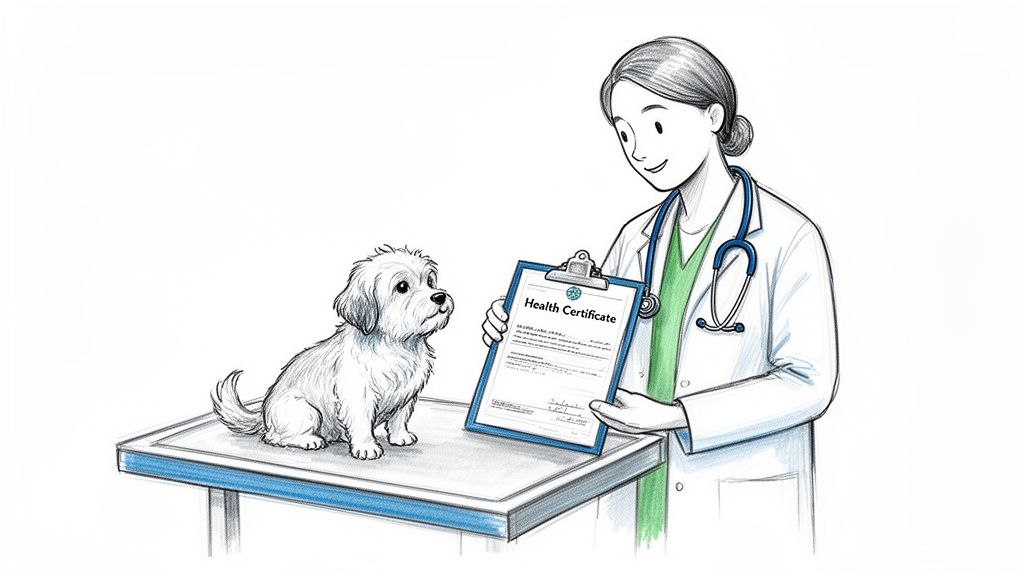
At its core, a health certificate for a pet is all about public safety and animal well-being. Moving animals between regions carries a risk of spreading diseases. Rabies, for example, is carefully controlled in many parts of the world, and clear documentation helps keep it that way.
A health certificate acts as a standard, trustworthy record of an animal's health. It helps ensure that traveling pets meet certain health requirements, which helps protect local animal populations at your destination.
This is why regulatory bodies like the USDA's Animal and Plant Health Inspection Service (APHIS) and the airlines themselves take these documents so seriously. They are a key part of keeping animals healthy around the world.
To give you a quick overview, here's what the certificate covers and why it matters for your trip.
Pet Health Certificate at a Glance
Key Aspect | What It Means for Your Trip |
|---|---|
Official Document | An official form signed by an accredited veterinarian confirming your pet’s health. |
Why It's Needed | Often needed for airline travel and entry into new states or countries. |
Who Requires It | Airlines, state authorities, and international governments all have rules about it. |
Key Information | Includes pet ID (like a microchip), vaccination records, and a health statement. |
This table boils it down, but the details on the form itself are what really count.
What Information Is on the Certificate
While the exact layout might differ depending on your destination, all health certificates include the same core information. Getting familiar with these details helps you and your vet nail the appointment. It’s more than a quick check-up; it’s a detailed documentation process.
You'll always find these key parts:
Owner Information: Your full name, address, and contact details.
Pet Identification: Your pet’s name, breed, age, color, and, most importantly, their microchip number.
Vaccination Records: Proof of current vaccinations, with the rabies vaccine being the non-negotiable star of the show.
Veterinarian’s Statement: A formal declaration from a licensed—and often specially accredited—veterinarian confirming your pet is healthy and free of obvious signs of contagious diseases.
This document is a complete health and identity snapshot of your pet. Making sure every last detail is accurate is the first step toward a paw-some adventure.
Just like you wouldn't use a driver's license to fly overseas, your pet's travel documents change depending on the destination. Understanding the difference between a domestic and an international health certificate is the very first step to a trip without any last-minute drama.
It's not a one-size-fits-all deal, and figuring this out early will save you a world of headaches. Think of it this way: a domestic certificate is for a road trip, while an international one is more like a passport with extra layers of official sign-offs. Let's break down what that means for your next adventure.
Domestic Travel: The Certificate of Veterinary Inspection
If you and your furry co-pilot are staying within the United States, you’ll likely need a Certificate of Veterinary Inspection (CVI). You might also hear it called an interstate health certificate. This document is the official all-clear, confirming your pet is healthy enough to cross state lines without posing a risk to other animals.
Each state has its own rules, but a CVI generally verifies three key things:
Your pet shows no signs of infectious or contagious diseases.
They're current on their rabies vaccination.
Their microchip number and other ID details are correct.
It might seem like a bit of a hassle for a simple trip, but the CVI is a tool for state veterinarians to track and stop animal diseases from spreading. It's a simple piece of paper that helps keep every traveling pet safe.
International Travel: A Whole New Ball Game
The moment your plans involve leaving the country, the paperwork gets more involved. This is where you run into official government forms that need special handling and signatures. It’s time to get your pet’s "passport" in order, and that means understanding a few key documents and processes.
The rules aren’t just about your pet's health—they’re about biosecurity. Many countries have worked hard to become free of certain diseases, like rabies, and they have strict rules to keep it that way. This is why international health certificates are so detailed.
An international health certificate is way more than a simple vet's note. It's an official document that may go through multiple layers of verification, including a final sign-off from the federal government, before it's valid for entry into another country.
The USDA APHIS 7001 Form
For many people leaving the U.S. with a pet, the first form they hear about is the USDA APHIS Form 7001. This is a general international health certificate. But here’s the catch: while it was a common standard for a long time, many countries now ask for their own specific forms instead.
It is very important to check your destination's rules. Just assuming the 7001 will work is one of the most common—and costly—mistakes people make. You can get a deeper look at the complexities of global pet travel in our complete guide on the pet health certificate for international travel.
Destination-Specific and EU Health Certificates
Many popular spots, including the entire European Union, have moved away from the generic APHIS 7001 for their own unique health certificates. The EU, for instance, has a very precise "EU Health Certificate" that is used for pets entering any of its member nations.
These country-specific forms are usually much more detailed and might include:
Bilingual text (English alongside the language of the destination country).
Dedicated sections for rabies titer test results.
Specific language about required parasite treatments.
Showing up with the wrong form is a surefire way to get flagged by border officials and could even get your pet denied entry. Before you even book the vet appointment, you have to confirm the exact document your destination requires. This isn't a time for guesswork; you have to be purr-fectly precise.
The Essential Checklist for Your Pet's Health Certificate
Getting a health certificate for your pet is all about the details. Think of it as your pre-flight checklist—missing one small item can cause big delays, so it pays to be organized. You and your vet become a team, ticking off each box to ensure a smooth, stress-free journey.
It all starts with a solid foundation of preventative care. Let's walk through the key items, from vaccines to microchips, that form the backbone of a travel-ready document.
Up-to-Date Vaccinations Are Key
First things first: vaccinations. No health certificate is complete without proof of current shots, and one vaccine stands above all others in the world of travel rules.
The rabies vaccine is the undisputed star of the show. It's the one requirement nearly every country and state enforces. For many destinations, it's not enough for the vaccine to be current. There's often a waiting period (typically 21 days) after the primary vaccination before your pet is even allowed to travel.
Beyond rabies, other vaccinations may be needed depending on where you're headed. These often include:
DHPP (Distemper, Hepatitis, Parainfluenza, and Parvovirus) for dogs.
FVRCP (Feline Viral Rhinotracheitis, Calicivirus, and Panleukopenia) for cats.
Vaccinations for conditions like Kennel Cough or Leptospirosis.
Always confirm the specific list for your destination. To understand the documentation involved, check out our guide on getting a proof of rabies vaccine for your pet.
Understanding Rabies Titer Tests
For some destinations, a current rabies vaccine just isn't enough. Many rabies-free or rabies-controlled regions, like Japan, Australia, and Hawaii, ask for a rabies titer test, also known as a FAVN test. This is a blood test that measures the level of rabies antibodies in your pet’s system, proving the vaccine is actively working.
A rabies titer test is like a final exam for the vaccine. It confirms not just that your pet got the shot, but that their body responded properly and is protected against the virus.
Be warned: this process has a very long timeline. The blood sample usually has to be drawn at least 30 days after the rabies vaccination, and getting results from an approved lab can take weeks. On top of that, many countries have a waiting period of 3 to 6 months after a successful test result before the pet can enter. This is one step you absolutely cannot rush.
Microchips: The Universal Pet ID
Next up is the microchip. This tiny electronic chip is your pet’s permanent, scannable ID and a standard requirement for all international travel. It's the most reliable way for officials to confirm that the pet in front of them is the same one listed on the health certificate.
For international travel, the chip should be ISO-compliant (specifically, ISO 11784/11785). This 15-digit chip is the global standard, readable by scanners worldwide. If your pet has an older, non-ISO chip, you might need to carry your own scanner or have a second, compliant chip implanted. The microchip number must be recorded perfectly on every single travel document.
Necessary Parasite Treatments
Finally, many countries require specific treatments for internal and external parasites, which must be given within a strict timeframe before you travel. This is all about preventing the spread of pests that could harm local animal populations.
The most common requirements are:
Flea and Tick Treatment: This has to be administered by a veterinarian within a specific window, often 24-120 hours before arrival.
Deworming (Tapeworm Treatment): Many countries, including the UK and Finland, require a specific tapeworm treatment containing praziquantel. A vet must administer it between 1 to 5 days before arrival.
Your vet has to record the exact date, time, and product used right on the health certificate. Failing to follow these tight timelines can lead to your pet being denied entry, making this final step just as critical as all the others.
A Step-by-Step Guide to Getting Your Certificate
Feeling a bit lost in the paperwork maze? You're not alone. Securing a health certificate for a pet can feel like a huge task, but breaking it down into a clear timeline makes the whole thing much more manageable. Think of it as a step-by-step mission to get your furry co-pilot ready for take-off.
Your first move, always, is to research your destination. Every country, and even some states, has its own unique rulebook. This initial homework is the foundation for everything that follows—and it ensures you don't waste time or money chasing the wrong requirements.
Once you know what’s needed, the real action begins. This isn't something you can leave until the last minute; proper planning is the secret to a smooth journey.
Find a USDA-Accredited Veterinarian
Here’s a crucial detail: not just any veterinarian can sign an international health certificate. You need a USDA-accredited veterinarian. These are vets who have completed specialized training and are authorized by the U.S. Department of Agriculture to handle these travel documents.
Think of them as the official travel agents of the vet world. They know the procedures and have the authority to sign off on the specific forms required for international journeys. You can find one using the USDA’s online search tool, or just by calling your local clinic and asking if they have an accredited vet on staff.
Schedule the Health Certificate Appointment
Timing is everything. Many popular destinations, including the EU, operate on a strict 10-day rule. This means the health certificate must be issued by your accredited vet no more than 10 days before your pet is scheduled to arrive in the destination country.
This tight 10-day window is one of the most common reasons for travel hiccups. Booking this critical appointment well in advance ensures you can get a slot that fits perfectly within this timeline, avoiding a last-minute scramble.
During this appointment, the vet will perform a thorough physical exam to confirm your pet is healthy and shows no signs of contagious diseases. They will also carefully fill out the official health certificate form, checking every single detail from the microchip number to vaccination dates.
This visual guide breaks down the core preparation steps for your pet's travel, covering vaccination, microchipping, and parasite treatments.
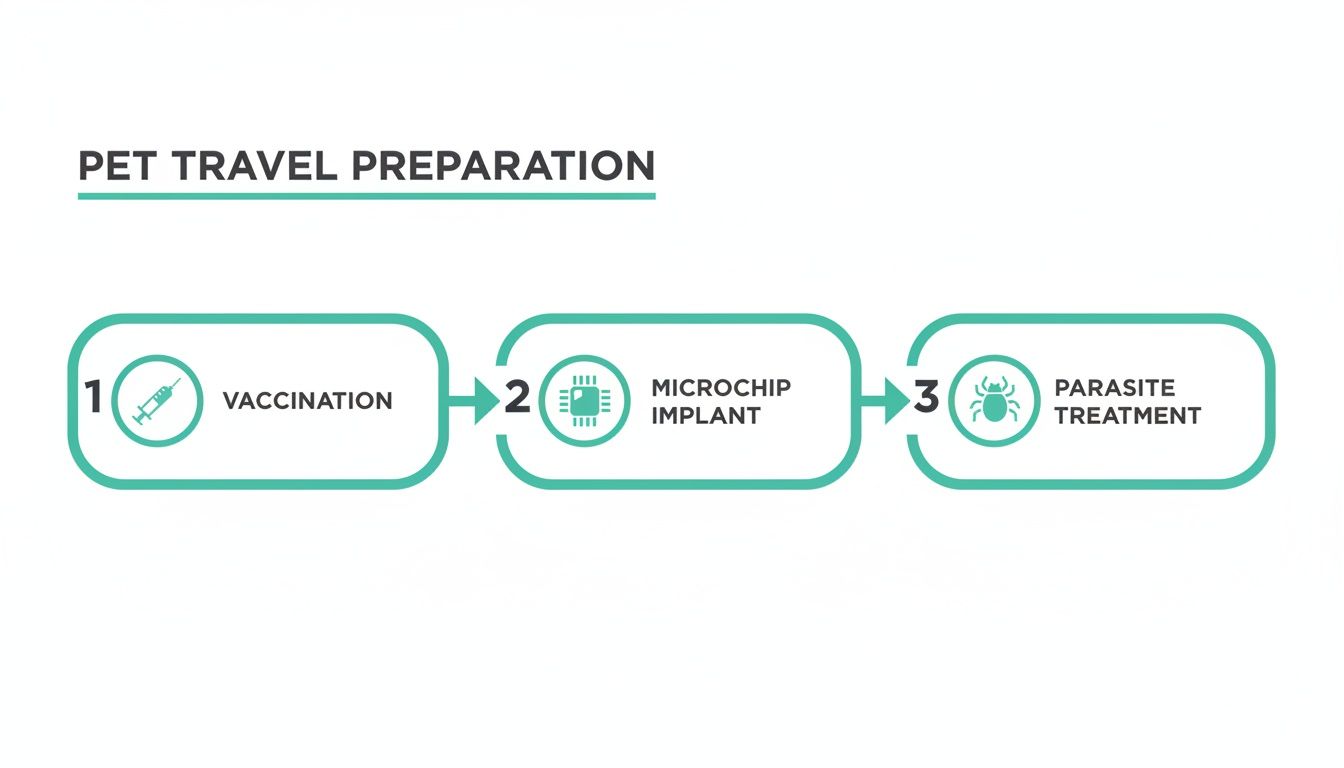
As the flowchart shows, a successful trip depends on a sequence of well-timed veterinary actions leading up to your departure.
Obtain the Final USDA Endorsement
After your accredited vet has completed and signed the health certificate, there's one final, important step for many international trips: USDA endorsement. This is the government's official stamp of approval, which turns your pet’s paperwork into a valid international travel document.
Think of it as getting your pet's passport officially stamped by the authorities. Without this endorsement, the certificate is just a piece of paper and may not be accepted for entry into another country. The process involves submitting the completed forms to your state's APHIS Veterinary Services office.
You have two main options for getting this done:
Mail-in: You can overnight the documents to the USDA office. This requires careful planning to account for shipping times and processing.
In-person: Some offices allow you to make an appointment and get the documents endorsed on the same day.
Each method has its pros and cons, so you’ll need to plan based on your travel date. If you're looking for a complete walkthrough, you can learn more about how to get a USDA-endorsed pet health certificate in our detailed guide. This step is a key hurdle to clear before your documents are travel-ready. With that final stamp, you're cleared for adventure.
Why Pet Travel Rules Are Becoming Stricter
More people are traveling with their pets than ever before, turning what was once a rare event into a common one. If you've tried to get a health certificate for a pet recently, you might have noticed the process feels a lot more complicated. This isn't just for fun; it’s a direct response to this global travel boom.
The number one reason for the stricter rules is biosecurity. Every country has a unique ecosystem to protect, and when pets cross borders, they can unintentionally carry diseases or parasites. Something harmless in one region could be devastating in another. These rules are the world’s way of keeping everyone’s furry family members—and local animal populations—safe.
The Growing Wave of Global Pet Travel
The idea of bringing a pet along on an international trip has exploded. This surge means millions of animals are on the move each year, which has fueled a much larger industry and, in turn, a lot more regulation.
The global pet travel market was valued at an incredible USD 2,403.5 million in 2024 and is expected to hit USD 3,978.2 million by 2030. This growth comes from a huge shift in how we see our pets. Today, 37% of families travel with their pets, a figure that’s jumped by 19% in the last decade. With roughly 2 million pets flying commercially in the U.S. alone each year, the need for clear rules is more critical than ever.
A New Era of Responsibility
This global movement has put a laser focus on getting the paperwork right. An incomplete or inaccurate health certificate isn't just a small hiccup anymore—it's a real biosecurity risk. As a result, countries are tightening their import requirements to close any gaps that could let diseases slip through.
Think of the complex paperwork less as jumping through hoops and more as a vital part of being a responsible global pet owner. It’s all about protecting animal health on a worldwide scale.
This heightened awareness has also created a real opportunity for veterinary teams. Clinics that can confidently guide clients through this maze provide a priceless service, making sure pets and their families can travel safely and without stress. To keep up, it's a good idea to review the recent changes in pet travel regulations that affect both owners and vet practices.
With these stricter rules, every single detail on the health certificate matters. From precise vaccination dates to correctly documented parasite treatments, accuracy is your pet’s ticket to a smooth and safe journey.
Common Mistakes That Can Derail Your Pet's Travel
One tiny error on a health certificate for a pet can turn your travel dreams into a logistical nightmare. It happens: pet owners are turned away at the airport check-in counter or face a mandatory and expensive quarantine for their pet upon arrival. The stakes are high, and getting every single detail right isn't just a suggestion—it's absolutely essential.
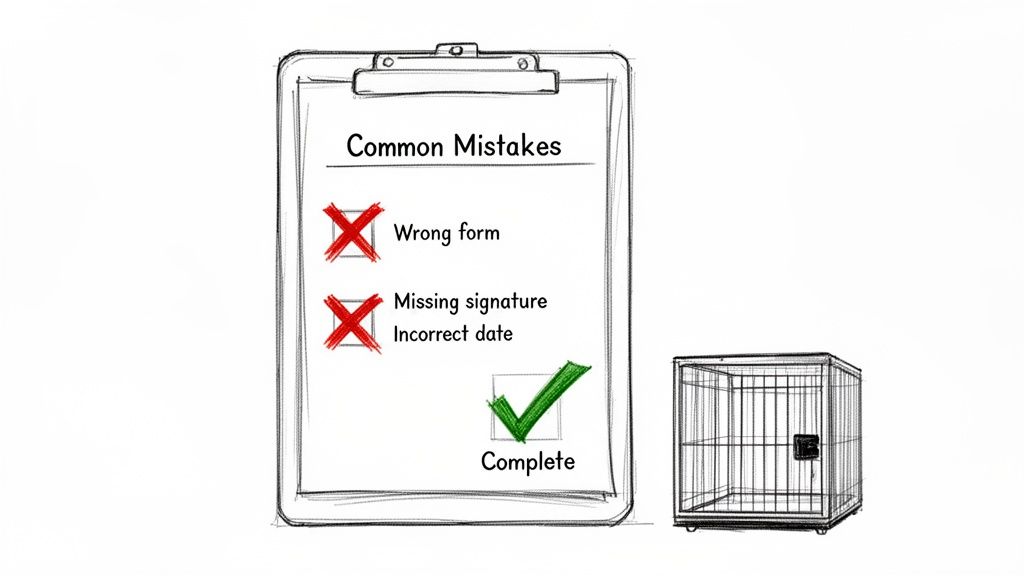
Even the smallest issues can cause the biggest problems. A simple typo in a microchip number, a date written in the wrong format (DD/MM/YYYY vs. MM/DD/YYYY), or a missing signature can invalidate the entire document. These are the kinds of mistakes that can leave you stranded, trying to sort out paperwork while your flight takes off without you and your furry companion. It’s a completely avoidable headache with a little extra care.
Timing and Paperwork Pitfalls
From my experience, some of the most common—and stressful—mistakes are related to timing and using the wrong documents. These errors are particularly frustrating because they often aren't discovered until the very last minute.
Keep an eye out for these frequent slip-ups:
Missing the USDA Endorsement: Your vet's signature is just the first step. Forgetting to get the final government stamp from the USDA can make your international certificate unusable.
Ignoring the 10-Day Window: Many countries require the vet exam to be completed within 10 days of arrival, not departure. Miscalculating this timeframe is a frequent cause of travel denial.
Using the Wrong Form: Showing up with a generic APHIS 7001 form when your destination requires its own specific, often bilingual, certificate is a surefire way to hit a wall.
The paperwork process is less of a sprint and more of a carefully timed marathon. Rushing the final steps or failing to double-check every requirement for your specific destination can undo months of careful planning.
The Dreaded Quarantine Conundrum
The biggest fear for any traveling pet owner is quarantine. A perfect health certificate is your pet’s best defense against a long, lonely, and stressful stay in an unfamiliar facility. International pet quarantine requirements vary dramatically, with some nations implementing extremely strict rules. For instance, Australia and New Zealand have some of the world's most rigorous protocols, with mandatory quarantine periods of 10 days or more in some cases.
A single mistake on the health certificate, like an incorrectly recorded tapeworm treatment or a missed vaccination deadline, can easily trigger an extended and costly quarantine. It’s not just an inconvenience; it’s a significant emotional and financial burden that proper documentation can help you avoid. Don't let a small oversight lead to a cat-astrophe.
Your Pet Travel Questions Answered
Trying to figure out the world of pet travel can feel like you're untangling a giant knot of questions. From nerve-wracking deadlines to very specific vet requirements, getting everything right on the health certificate for your pet is absolutely critical. Let’s tackle some of the most common questions to help you get ready for a stress-free trip.
How Long Is a Pet Health Certificate Valid?
This is easily one of the most time-sensitive parts of the entire process. For many international trips, particularly to places in the European Union, the health certificate is only valid for 10 days. That clock starts ticking the moment your accredited vet signs the form and stops when you arrive at your destination.
That tiny window means timing your final vet appointment is everything. You can't get it done too early, or it will expire. But you also can’t leave it for the last second, because you still need to get the official USDA endorsement. It's a tricky balancing act that requires serious planning.
Can Any Vet Issue an International Certificate?
Nope, and this is a mistake you don't want to make. While your regular vet is fantastic for check-ups and routine care, only a USDA-accredited veterinarian has the authority to complete and sign an international health certificate. These vets have gone through special training on import rules for different countries and are officially recognized by the U.S. government.
Before you book anything, double-check that your vet has this specific accreditation. Showing up with a certificate from a non-accredited vet is a recipe for disaster—the document may not be valid, and you could face major delays.
What if My Pet Has a Chronic Health Condition?
Traveling with a pet managing an ongoing health issue, like diabetes or a heart condition, is definitely doable—it just calls for some extra prep work. The key is to have a detailed chat with your accredited veterinarian well before your travel date.
Your vet will need to confirm your pet is stable enough for the journey and will make a note of the condition on the health certificate. They can also help you figure out how to manage medication schedules across different time zones and make sure you have more than enough supplies to last the whole trip.
Do I Need a Certificate to Drive Across State Lines?
The rules for road-tripping between states are usually more relaxed than for flying, but that doesn't mean you're totally off the hook. Many states do have rules requiring a Certificate of Veterinary Inspection (CVI) for pets coming across their borders, even in a car.
While it's unlikely you'll be stopped at the state line and asked for it, having that paperwork is just plain smart. It’s your proof that your pet is healthy and current on their shots. This can be a lifesaver if you need to unexpectedly board them or see a new vet while you're away from home. When it comes to your pet, it’s always better to be safe than sorry.
You don't have to navigate these rules on your own. Passpaw gives veterinary practices a modern way to create accurate, compliant international pet health certificates, making the whole process simpler. Take the guesswork out of the equation and ensure every detail is perfect for your clients' travel plans by visiting https://passpaw.com.
More articles
From regulatory changes to best practices for veterinarians and pet owners, our resources keep you ahead of the curve.