Are you a team member in a veterinary practice?
Are you a pet parent planning a trip with your furry pal?
Health certificate for pets: Your travel-ready guide
Planning a trip with your furry best friend? Before you pack their favorite toys, there's one key document you'll need: a health certificate for pets. Think of it as your pet's official passport—a document signed by a licensed veterinarian confirming they're healthy, vaccinated, and ready for adventure. Airlines and places you're traveling to often require it to make sure your pet isn't carrying any contagious diseases.
What Is a Pet Health Certificate
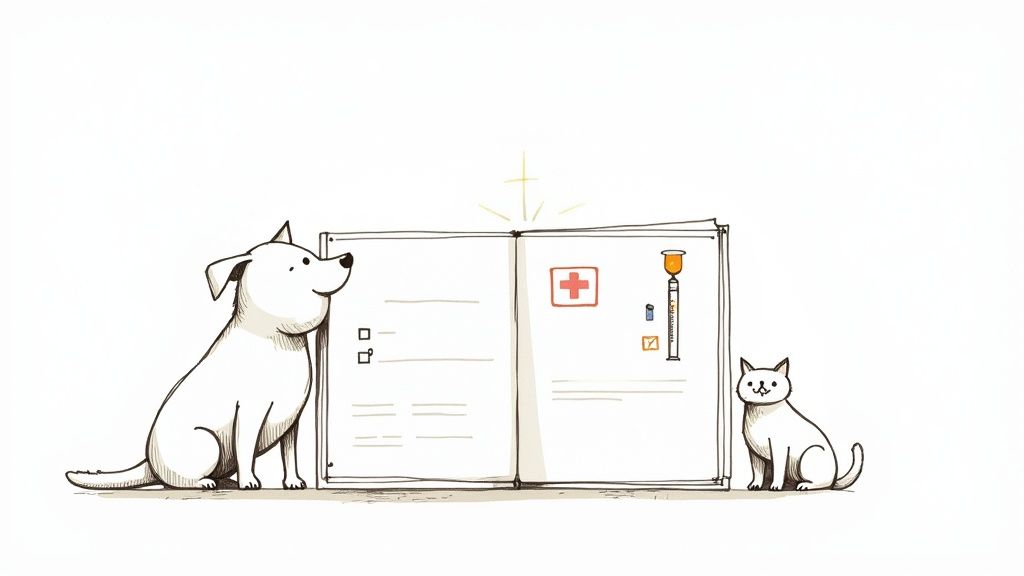
A pet health certificate is more than just a piece of paper. It's an official way to protect animal health across state and international borders. It acts as proof that your companion has been examined and meets the health rules for your destination. It's the key to a smooth and stress-free journey.
It's a lot like sending a child to summer camp with a doctor's note. The camp needs to know the child is healthy and won't spread germs to others. A pet health certificate does the same thing, but for our four-legged family members. It’s a simple, official way of saying, "They're good to go!"
This single document provides important information to officials, including:
Proof that your pet is up-to-date on key vaccinations like rabies.
Confirmation of a recent physical exam showing they are free of contagious diseases.
Details about required parasite treatments.
Your pet’s identification, including their microchip number.
Domestic vs International Certificates
Now, not all travel documents are created equal. The type of certificate you need depends entirely on where you're headed. A trip across state lines has much simpler rules than a journey across oceans. For instance, a health certificate is very important if you are flying your dog internationally.
The two main categories you'll see are:
Domestic Health Certificates: Often called a Certificate of Veterinary Inspection (CVI), this is for travel within the same country, like flying from California to New York.
International Health Certificates: These are much more complex and detailed, as they must meet the specific import rules of a foreign country. You can learn more about the complexities in our detailed guide on the veterinary international health certificate.
Here's a quick breakdown of what sets them apart:
Domestic vs International Health Certificates at a Glance
Feature | Domestic Travel Certificate | International Travel Certificate |
|---|---|---|
Purpose | Travel between states or provinces | Travel between countries |
Complexity | Relatively simple, often standardized | Highly complex, varies by country |
Validity Period | Typically valid for 30 days | Often valid for only 10 days |
Endorsement | Usually just a vet's signature | Often requires government (USDA) endorsement |
Requirements | Basic health exam and rabies vaccine | Extensive tests, specific vaccines, and treatments |
Timeline | Can be done close to travel date | Requires weeks or months of planning |
Getting the right document is key. A simple mistake here can cause major delays or even prevent your pet from traveling altogether.
Getting the right document is the absolute first step to a successful trip. A simple mistake here can cause major delays or even prevent your pet from traveling.
A Growing Need for Proper Documentation
The importance of these certificates is clear when you look at the numbers. The global pet travel health certificates market was valued at $1.2 billion and is projected to hit $2.5 billion by 2033. With North America holding 38% of this market, it's obvious that a huge number of pets are on the move. This growth shows just how vital it is for pet owners and vets to get the process right.
Know Your Documents: Not All Pet Health Certificates Are the Same
Trying to figure out pet travel paperwork can feel like assembling furniture with instructions in another language. It's confusing, and one wrong move can leave you with a mess. Grabbing the wrong document can ground your travel plans before you even leave for the airport, so knowing which health certificate for pets you actually need is your first and most important step.
Think of it like this: your driver's license is perfect for getting around your home state, but you’d never try to use it to fly to Italy. You need a passport for that. Pet travel documents work the same way—the right one is all about where you're headed.
The Certificate of Veterinary Inspection (CVI) for Domestic Trips
If you’re traveling within the United States, the document you’ll almost always need is a Certificate of Veterinary Inspection, or CVI. This is your pet's domestic passport, whether you're flying from Florida to Colorado or just driving across a state line for a vacation.
A CVI is pretty straightforward. It’s a form signed by a licensed veterinarian confirming your pet is healthy, free from contagious diseases, and up-to-date on their rabies vaccine. For most trips inside the U.S., a CVI is all you need to show your furry friend is fit to travel.
International Health Certificates: A Whole New Level
The moment your travel plans cross international borders, the paperwork gets a lot more serious. An International Health Certificate (IHC) is a completely different beast from a domestic CVI. There’s no single, universal form; every country has its own specific set of rules and its own unique document.
These certificates typically require a few extra, important steps:
USDA Accreditation: The vet examining your pet should be USDA-accredited. Not all vets are, so this is a key detail to confirm.
Government Endorsement: After your vet signs the form, it has to be sent to a USDA APHIS office for an official government stamp of approval. This is the step that makes it official.
Bilingual Forms: Some countries ask for the certificate to be in English and their native language.
The process is much stricter because it’s about protecting the destination country's public health and agriculture from foreign pests and diseases.
The single biggest mistake pet owners make is thinking a standard domestic CVI will work for an international flight. They are two totally different documents, and showing up with the wrong one is a surefire way to have your pet denied entry.
Destination-Specific Documents
Just to keep things interesting, some places have their own branded, very specific health certificates. The European Union Animal Health Certificate (AHC) is a perfect example. If you’re traveling to any EU country (plus Northern Ireland) from a non-EU country like the U.S., you'll probably need to use this exact document.
The AHC has a standard format with strict rules about microchip verification, rabies vaccination timelines, and more. It’s a highly specialized IHC built only for entry into the EU.
Getting this right from the very beginning saves a world of stress. To get a better handle on the specifics, check out our full guide on what you need for a pet health certificate for travel. Knowing what to ask for ensures you and your vet are on the right track from day one, making the whole process a lot less ruff.
Your Step-by-Step Guide to Getting the Certificate
Getting a health certificate for your pet can feel like you're staring at a mountain of paperwork. But with a solid plan, it's a completely doable process. The best way to think of it is like a travel checklist. If you tackle one step at a time, you can turn a potentially overwhelming task into a series of simple actions for a purr-fectly smooth journey.
Let's walk through the entire process, from that first bit of research to the final stamp of approval, so you know exactly what to expect.
Step 1: Research Your Destination
Before you do anything else—seriously, before even calling your vet—you have to research the specific rules for where you're going. This is the single most critical step, because everything else you do will depend on this information. Don't assume the rules are the same everywhere; airline policies and country import laws can vary wildly.
For any international travel, the USDA Animal and Plant Health Inspection Service (APHIS) Pet Travel Website is your absolute best friend. It offers incredibly detailed, country-by-country guides that spell out every vaccination, test, and form suggested for entry. Do not skip this research. It’s the foundation for your entire trip.
This visual guide breaks down the different documents needed for domestic, European, and other international trips.
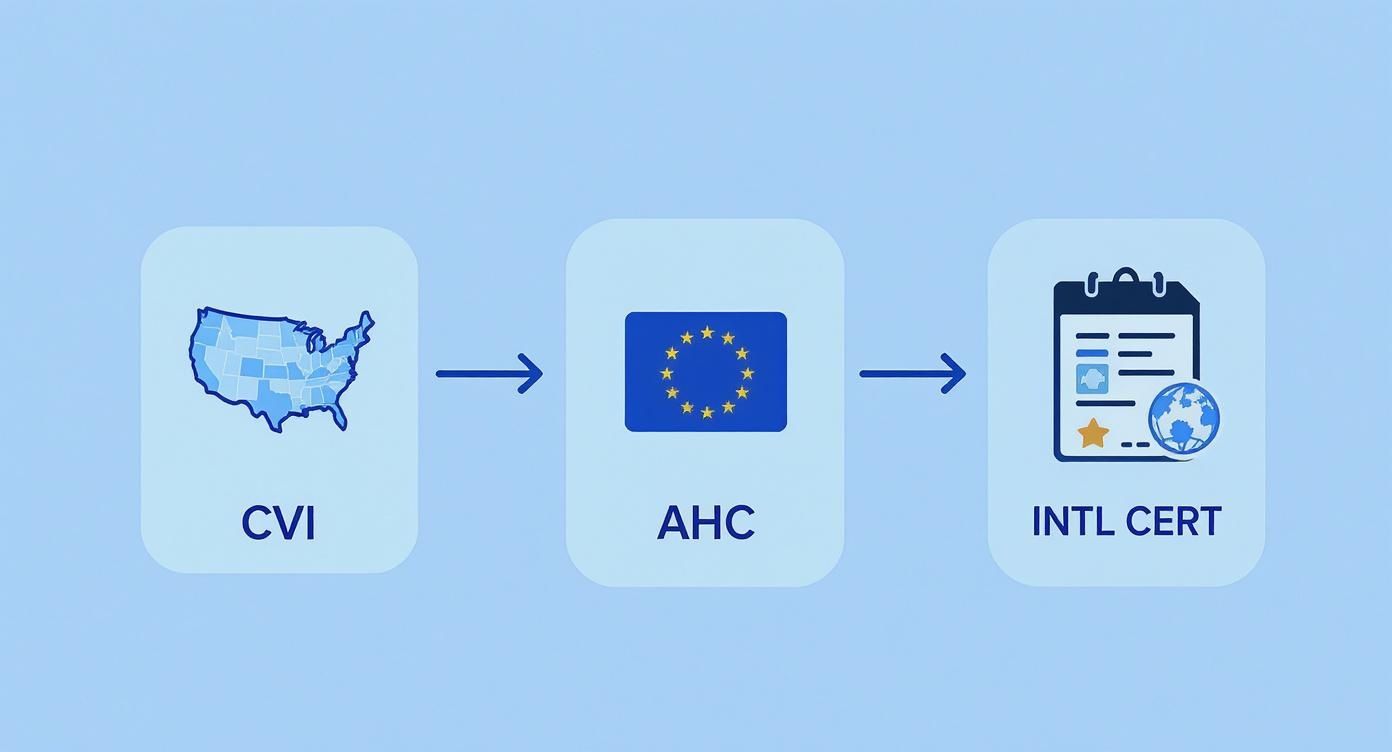
As you can see, while a standard CVI works for travel within the US, international journeys demand very specific forms, like the EU's Animal Health Certificate (AHC) or other unique, country-specific documents.
Step 2: Find the Right Veterinarian
Once you know the rules, your next job is to book an appointment with the right kind of vet. This is an important detail many people miss.
For Domestic Travel: Any licensed veterinarian can issue a Certificate of Veterinary Inspection (CVI). Simple enough.
For International Travel: You will likely need to use a USDA-accredited veterinarian. These vets have gone through special training and are authorized by the federal government to handle and sign international health certificates.
You can find a local accredited vet using the USDA's online search tool. It's always a good idea to call the clinic ahead of time just to confirm their accreditation and save yourself a last-minute headache.
It’s a common misconception that any vet can sign international travel forms. Using a non-accredited vet for an international health certificate will likely result in your paperwork being rejected.
Step 3: The Veterinary Exam and Paperwork
This is the appointment where all your research pays off. During the visit, your veterinarian will conduct a thorough physical exam to confirm your pet is healthy and shows no signs of communicable diseases.
Following your destination's specific rules, the vet will also:
Verify your pet's microchip is present and readable.
Administer any last-minute vaccinations or treatments.
Draw blood for required tests, if that's part of the protocol.
Carefully fill out the official health certificate form.
Come prepared. Bring all your research and travel details to this appointment. Having your flight info and destination address handy makes it much easier to ensure every field on the form is filled out perfectly. Precision is everything here—one small mistake can cause a major travel disruption.
Step 4: Government Endorsement for International Travel
For anyone heading abroad with their pet, there's one final, important step: government endorsement. After your USDA-accredited veterinarian completes and signs the health certificate, the documents must be sent to your state's USDA APHIS Veterinary Services office for an official stamp of approval.
Think of this endorsement as the federal government's final seal, confirming that your pet has met all the import requirements of the destination country. You can usually submit the paperwork by mail or, in some locations, in person. Just be sure to watch the clock, as this step can take several days to complete.
The good news is that the process is getting easier. The shift toward digital solutions has really changed how these documents are managed, with online platforms making issuance and verification much simpler. In fact, online channels now account for 42% of market transactions and are on track to be the main method by 2028. You can read more about this trend in this detailed industry report. This move to digital is making the entire process faster and less prone to human error for everyone involved.
Navigating Vaccinations, Tests, and Timelines

When it comes to getting a health certificate for pets, timing isn't just important—it's everything. The vaccinations, tests, and treatments are the heart of the document, and each has its own strict schedule. A small timing mistake can lead to big travel headaches. A little planning now prevents a lot of stress later.
Think of it like preparing for a big exam. You can't just cram the night before and expect to pass. Pet travel prep works the same way; it requires careful, forward planning to meet every single deadline.
This is especially true for international travel, where some requirements must be completed months in advance. Proactive planning is the only way to avoid the heartbreaking scenario of being turned away at the airport because of a simple timing error.
Core Vaccination Requirements
The one vaccine that's almost universally required for pet travel is rabies. It's the key part of nearly every health certificate, whether you're flying across the country or across the world. But just getting the shot isn’t enough. The timing is what truly matters.
Many destinations, particularly rabies-free places like Hawaii, the UK, and Japan, enforce a strict waiting period after the vaccination. This period, often 21 to 30 days, is there to ensure the vaccine has become fully effective.
The rabies vaccine should be administered after the microchip is implanted. If the shot is given before the microchip, officials will likely consider the vaccination invalid, forcing you to start the process all over again.
Beyond rabies, other common vaccinations may be required or recommended depending on your destination and the airline. These often include:
For Dogs: Distemper, Hepatitis, Parvovirus, and Parainfluenza (DHPP), and sometimes Bordetella (kennel cough).
For Cats: Feline Viral Rhinotracheitis, Calicivirus, and Panleukopenia (FVRCP).
Getting the vaccination requirements right is an important first step. For a deeper look, check out our guide on what constitutes valid proof of rabies vaccine for travel.
Essential Tests and Treatments
Beyond vaccinations, your pet will likely need other health checks and treatments to get their travel certificate approved. These steps are just as time-sensitive and just as critical.
A microchip check is standard procedure. The vet will scan your pet to confirm the chip is present, readable, and matches the number on the paperwork. For any international travel, an ISO-compliant 15-digit microchip is the standard.
Many countries also ask for specific parasite treatments. This usually involves giving treatments for internal parasites (like tapeworms) and external parasites (like fleas and ticks) within a specific window, often between 24 and 120 hours before you arrive.
For some of the strictest destinations, a rabies antibody blood test, known as a titer test, is needed. This test confirms the rabies vaccine has produced an adequate level of immunity. This is often the longest part of the process, since the blood sample must be drawn at least 30 days after the rabies shot, and you may need to wait an additional three months after that before your pet can even travel.
A Sample Pet Travel Timeline
To help you visualize how all these pieces fit together, here's a sample timeline for a country with strict requirements. It really highlights just how far in advance you need to start planning.
Sample Pet Travel Preparation Timeline
Time Before Travel | Action Item | Key Considerations |
|---|---|---|
6+ Months | Research destination rules & verify microchip. | Confirm your pet has an ISO-compliant microchip. If not, get one implanted before any new vaccinations. |
4-5 Months | Administer rabies vaccination. | The vaccine should be given after the microchip. Your pet must be at least 12 weeks old. |
3-4 Months | Perform rabies titer test (if required). | The blood draw should be at least 30 days after the rabies shot. Results can take weeks to come back. |
1 Month | Book flights and a USDA-accredited vet appointment. | The final health exam must be within 10 days of travel, so book this appointment strategically. |
Within 10 Days | Final health exam & certificate issuance. | The vet completes the health certificate. All information must be perfectly accurate. |
Within 10 Days | USDA endorsement. | Submit the signed certificate to the USDA for the final official stamp. Plan for shipping and processing time. |
1-5 Days | Final parasite treatments. | Administer required flea, tick, and tapeworm treatments within the destination's specific window. |
As you can see, the timelines are tight and the sequence of events matters immensely. A clear plan is your best tool for a smooth journey.
Common Mistakes to Avoid on Your Journey
Navigating the world of pet travel can sometimes feel like you’re trying to herd cats. Even the most organized and well-intentioned pet owner can get tripped up by one small oversight. The best way to guarantee smooth sailing is to learn from the common slip-ups others have made before you.
This isn’t about adding stress to your plate. It's about giving you the foresight to sidestep costly, frustrating, and entirely avoidable problems. Let's walk through the most frequent mistakes so you can tackle your pet’s travel prep with confidence.
Mixing Up Airline and Country Rules
A frequent and painful mistake is assuming an airline's rules are the same as a country's import rules. They are two completely separate sets of requirements, and you have to satisfy both. An airline might just want a simple health certificate, but your destination country could demand extensive blood tests, specific parasite treatments, and a government-endorsed form.
Think of it like this: the airline is the bus driver checking your ticket to get on board, but the country's border control is the authority who decides if you're even allowed to enter. Always check both the airline’s pet policy and the official government import regulations for your destination.
One of the biggest pitfalls is confusing airline requirements with the destination country's import laws. They are not the same, and you are responsible for meeting both sets of rules independently.
Not Using a USDA-Accredited Vet
This one is a real showstopper. For any international travel leaving from the U.S., the health certificate for pets will likely need to be completed and signed by a USDA-accredited veterinarian. Not all vets have this special designation. Showing up to your appointment only to discover your vet isn't accredited can throw your entire timeline into chaos.
Before you book that crucial health certificate exam, just call the clinic and ask one simple question: "Is the veterinarian who will be seeing my pet USDA-accredited for signing international health forms?" That single phone call can save you from a massive last-minute scramble.
Missing the 10-Day Exam Window
When it comes to pet travel, timing is everything. Most international health certificates are only valid for a very short period—typically just 10 days from the date your vet performs the exam. This means that final check-up has to be scheduled perfectly within that tight window before you leave.
Booking this appointment too early or waiting too long can invalidate the entire document. As soon as you have your travel dates confirmed, map out your timeline and book this critical appointment. It's a deadline you can't afford to miss.
Forgetting About the Microchip
A tiny microchip can create a giant headache if it’s not the right kind. Many countries, particularly in the European Union, require a specific 15-digit ISO-compliant microchip. If your pet has an older, non-compliant chip, it might not be readable by scanners abroad, which is a big problem at the border.
Even more critical is the timing: the microchip should be implanted before the rabies vaccination is given. If the order is reversed, the vaccine might be considered invalid, forcing you to start the process all over again. Always ask your vet to scan the chip at every appointment to confirm it’s working and that the number matches your paperwork.
This level of detailed health screening is quickly becoming the norm. In fact, the pet health screening market is projected to hit $3,754 million in 2025, which shows just how much focus is being placed on verified animal health. You can explore more on this trend by looking into the growing pet services market and how it’s shaping travel rules.
How Passpaw Makes Pet Travel Simple
Let's be honest, figuring out the paperwork for pet travel can feel like trying to solve a puzzle with half the pieces missing. Between shifting regulations, tight deadlines, and country-specific forms, it’s a lot to handle. But what if you could sidestep the confusion and ditch the manual grunt work? That’s where a little modern tech comes in.
Imagine having a smart assistant that already knows every requirement for your destination. It pings you with reminders for key appointments and keeps all your documents perfectly organized in one spot. For pet parents, this means an end to frantic Googling and worrying about missed deadlines. It’s about replacing stress with peace of mind.
Veterinary clinics face a different, but equally challenging, side of this puzzle. They’re juggling multiple clients traveling to dozens of different countries, each with its own unique and constantly changing rulebook. Prepping and double-checking every document by hand is not only time-consuming but also leaves the door wide open for human error. A single misplaced date can derail a family’s entire trip.
Your Digital Partner for Pet Travel
This is exactly the problem Passpaw was built to fix. Our platform acts as a central hub that simplifies the entire health certificate for pets journey, from the first appointment to the final sign-off. We swap the guesswork and paperwork headaches for clarity and efficiency, making sure every detail is handled perfectly.
Here’s how our system helps vet clinics:
Automate Document Prep: Our software helps generate the correct, destination-specific forms with accurate information, cutting down on prep time.
Validate Requirements: The platform automatically cross-references your pet’s records against the destination's rules to ensure every vaccination, test, and treatment is accounted for.
Improve Client Communication: Keep pet owners in the loop with automated updates, reminders, and easy-to-follow checklists.
Think of it as a digital co-pilot for your veterinary team. Passpaw helps manage the tangled logistics of pet travel compliance, freeing up your staff to focus on what they do best—caring for animals.
A Clearer Path for Everyone
For pet owners, the benefit is simple: clarity. The platform gives you a transparent, step-by-step view of the process, showing you exactly what’s needed and when. You get straightforward checklists and timely notifications for crucial appointments, so you’re always ahead of the game.
Ultimately, Passpaw brings order to the chaos. By using smart technology to guide the process, we help ensure nothing falls through the cracks. The result is a smoother, more reliable experience for the vet teams managing the paperwork and a much less stressful journey for the families they serve.
To see exactly how we do it, take a look at the full range of Passpaw features for vet clinics. It’s all designed to make sure every furry friend gets to their destination safely and without a hitch.
A Few Common Questions
Navigating the world of pet travel documents can leave you with a lot of questions. Don't worry, you're not alone! Here are a few straightforward answers to the things pet owners ask us most.
How Long Is a Pet Health Certificate Good For?
This is probably the most critical question, and the answer comes down to one thing: your destination. The validity isn’t a countdown from when the certificate is issued, but rather a very specific window of time leading up to your departure date.
For Domestic Travel: A Certificate of Veterinary Inspection (CVI) for travel within the U.S. is generally valid for 30 days.
For International Travel: The rules get much tighter here. Most countries require the final veterinary exam and certificate to be completed within 10 days of your flight.
You should always confirm the exact timeline for your destination, as some countries have unique and very strict rules. Getting this timing wrong is one of the easiest ways to have your paperwork rejected at the last minute.
Do I Need a Health Certificate if I’m Just Driving?
It depends on where you’re driving. If you’re just crossing state lines, you probably won’t be stopped at a checkpoint. However, many states do technically suggest you carry a current CVI for any pet you bring in. It's a low-risk situation, but having one is always the safest bet.
But if you're driving into another country, like Canada or Mexico, a formal health certificate is generally needed. You will likely be stopped and asked for it. It's far better to have the right paperwork ready than to be turned away at the border.
Can Any Vet Issue a Health Certificate?
This is a common mix-up that can cause major problems.
For travel within the United States, any licensed veterinarian can issue a domestic health certificate (CVI). Simple enough.
For international travel, however, the veterinarian who signs the paperwork will likely need to be USDA-accredited. This is a special federal accreditation that not all vets have. Before you even book an appointment, you should confirm your vet holds this specific credential. Using a non-accredited vet for international forms is a common reason for documents to be rejected.
A pet health certificate is your furry friend's ticket to a safe and hassle-free trip. Think of it less as a chore and more as the first step in your shared adventure, ensuring everyone arrives happy and healthy.
Getting the process right from the start means you can focus on the exciting parts of your trip instead of scrambling over paperwork. A little preparation goes a long way.
Ready to simplify the entire health certificate process for your clinic? Passpaw helps you manage pet travel compliance with automated document prep, clear client communication, and accurate requirement validation. Ditch the paperwork pile-up and give your clients peace of mind. Visit https://passpaw.com to see how we can help.
More articles
From regulatory changes to best practices for veterinarians and pet owners, our resources keep you ahead of the curve.