Are you a team member in a veterinary practice?
Are you a pet parent planning a trip with your furry pal?
Health certificate for dog travel: Your Complete Guide
If you're planning an international trip, your dog's health certificate is the single most important document you'll need. It's an official form, signed by a special type of veterinarian, that shows your pet is healthy enough to travel and meets all the specific entry rules for your destination.
Think of it as your dog's passport. It's the key that unlocks international travel and, in some cases for travel within a country, confirms your dog is fit for travel and free from contagious diseases.
This Is More Than Just a Piece of Paper
It’s easy to get caught up in the excitement of planning a trip with your four-legged best friend. But before you start packing the tennis balls, there's one document that can make or break your entire journey: the international health certificate.
This isn't just a simple "my dog is healthy" note from your vet. It's an official document that confirms your dog's identity, health status, and vaccination records. Its main purpose? To prevent the spread of diseases across borders, protecting both animal and public health.
Why This Paperwork Suddenly Matters So Much
If it feels like pet travel rules have gotten stricter, you're not wrong. As more people bring their furry family members along on their travels, countries are tightening their security measures to keep new diseases out.
This isn't just a feeling; it's a massive global trend.
The market for pet travel health certificates was valued at $1.2 billion and is on track to more than double by 2033. This growth is driven by two things: more people owning pets and stricter government import rules. You can dig into the numbers in the full analysis on MarketIntelo.com.
What does this mean for you? It means getting every single detail on that certificate right is super important. One small mistake—a wrong date, a missing signature—can derail your plans in a hurry.
What’s Actually on the Certificate
While the forms might look a little different from one country to the next, they all share the same core information. Understanding these parts is the first step to a smooth check-in and an easy time with customs officials.
Let's break down what you'll find on a typical health certificate.
Anatomy of a Dog Travel Health Certificate
Here’s a closer look at the key information found on a standard international health certificate for dogs and why each part is so important.
Component | What It Is | Why It's Important |
|---|---|---|
Pet & Owner Info | Your name and address, plus your dog’s name, breed, age, and sex. | This officially links you to your dog. Any mismatch can cause big delays or even prevent entry. |
Microchip Details | Your dog's unique microchip number and the date it was implanted. | This is your dog's main, permanent ID. It must be scannable and match the number on the form perfectly. |
Rabies Vaccination | The date of vaccination, vaccine maker, serial number, and expiration. | This is the most checked section. Countries have strict rules about timing and vaccine validity. |
Vet's Statement | A formal declaration from the vet that your dog is healthy and free of disease. | This confirms your dog was examined by a professional and seemed safe for travel at a specific point in time. |
Govt. Endorsement | An official stamp or signature from a government body (like the USDA). | This is the final step that makes the document officially recognized for international border crossings. |
Getting these details right is a must. For instance, the rabies vaccination section is often where travelers run into trouble. We cover exactly what you need for a valid proof of rabies vaccine in our detailed guide. Make sure you understand the timing, as some countries require the vaccine to be given a certain number of days before travel.
Getting Your Dog's Travel Certificate Step by Step
Getting a health certificate for your dog might sound like a mountain of paperwork, but it's really more like a series of small, manageable hills. If you break it down into clear stages, a confusing task becomes a simple checklist. This guide will walk you through the entire journey, from the first search to getting that final government sign-off.
To make this feel real, let's use an example. Imagine you and your Beagle, Buddy, are moving from Texas to the sunny fields of France. We'll use this journey as our map to navigate the process.
Start with Destination-Specific Research
Before you even think about booking a vet appointment, your first and most important move is to become an expert on your destination's import rules. Every single country has its own unique set of requirements, and assuming they're all the same is a recipe for a ruff time. While France, being in the European Union, has a relatively standard process, it's still full of tiny details you just can't afford to miss.
For our trip to France, a quick search on the official USDA Animal and Plant Health Inspection Service (APHIS) website shows several key rules. Buddy will need an ISO-compliant microchip, a current rabies vaccination given after the microchip was implanted, and a health exam performed within 10 days of his arrival in France. Missing any one of these details could stop your trip before it even starts.
This is the foundational step for a reason. These health certificates are global requirements designed to prevent the spread of disease. They're your official proof that your dog is free from contagious illnesses, has the right microchip, and is up-to-date on vaccinations like rabies—all within that very strict travel window.
Find and Book Your Accredited Vet Appointment
Here's a key detail: not just any veterinarian can sign off on international travel papers. You need a USDA-Accredited Veterinarian. These vets have completed specific training and are authorized by the U.S. government to handle these official documents. If your regular vet isn't accredited, any paperwork they sign will likely be rejected.
For our Texas-to-France move, you'd start by searching for a local USDA-accredited vet. When you call to book the appointment, be crystal clear about what you need.
"Hi, I'm calling to book an appointment for an international health certificate. My dog, Buddy, and I are traveling to France, and our flight arrives on July 20th."
That one sentence gives the clinic all the vital information: the service (international health certificate), the destination (France), and your timeline (arriving July 20th). This lets them schedule you within the required 10-day window, which would be sometime between July 10th and July 19th.
Getting your dog's travel certificate is a journey with a few key milestones, each one building on the last.
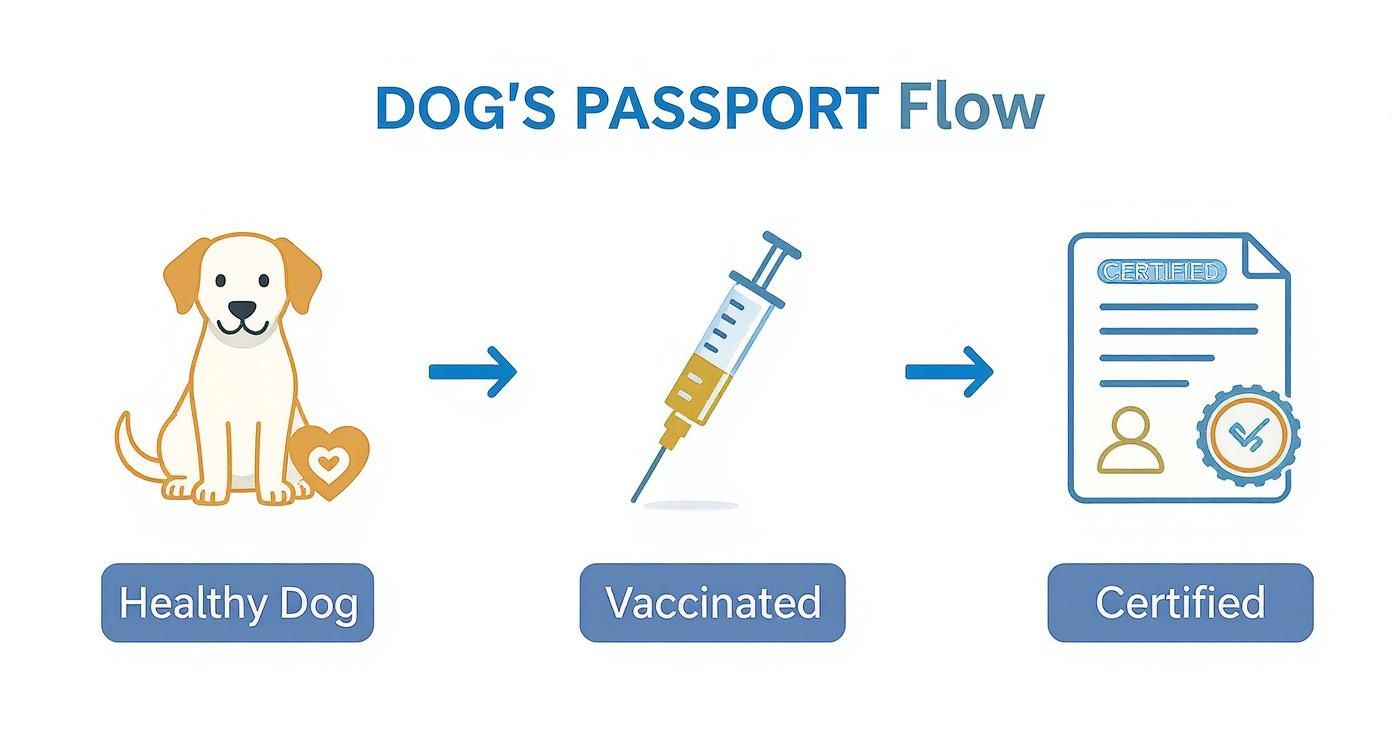
This visual breaks down the progression from a healthy, vaccinated pup to having the final, certified document that makes the whole trip possible.
Prepare for the Health Exam
Your appointment with the accredited vet is the main event. During this visit, they'll perform a thorough physical exam to confirm your dog is healthy and shows no signs of communicable diseases. They are, in a sense, certifying that your pet is "fit to fly."
To make this go smoothly, you need to show up prepared. Don't walk in empty-handed!
What to Bring to Your Vet Appointment:
Previous Vaccination Records: Specifically, bring the original, signed rabies certificate. The vet must record the vaccine's maker, lot number, and expiration date exactly as they appear on it.
Microchip Information: Have the microchip number and the date it was implanted ready. The vet will scan the chip to make sure it matches your records.
Travel Details: Be ready with your full name and address, your dog’s details (name, breed, age), and your destination address in France. Accuracy here is everything.
During Buddy’s exam, the vet will fill out the official health certificate form for France. They will carefully check that every piece of information is perfect, from the rabies vaccine serial number to the microchip details. Once they're satisfied, they'll sign the document, often in blue ink as is commonly suggested.
Get the Final Government Endorsement
You're on the home stretch! But the vet's signature isn't the final step. To be officially recognized for international travel, the health certificate must be endorsed—stamped and signed—by the USDA-APHIS office. This is the government's official seal of approval.
You have two main options for getting this done: mailing your documents or using the online Veterinary Export Health Certification System (VEHCS). For our trip, let's say you decide to mail it. You would send the completed, vet-signed certificate, a payment form, and a pre-paid, self-addressed return envelope to the APHIS office in Austin, Texas.
Timing here is very important. You have to account for shipping time in both directions while staying within that tight 10-day window. This is where many pet owners feel the pressure—it's a logistical puzzle that requires careful planning. For a deeper dive, check out our guide on how to get a USDA-endorsed pet health certificate, which has more tips on this final, vital step.
Once that endorsed certificate with the official raised seal arrives back at your door, you're golden. You've successfully navigated the process, and Buddy is one step closer to sniffing around his new French home. It takes some planning, but it's completely doable.
Decoding Different Country Requirements
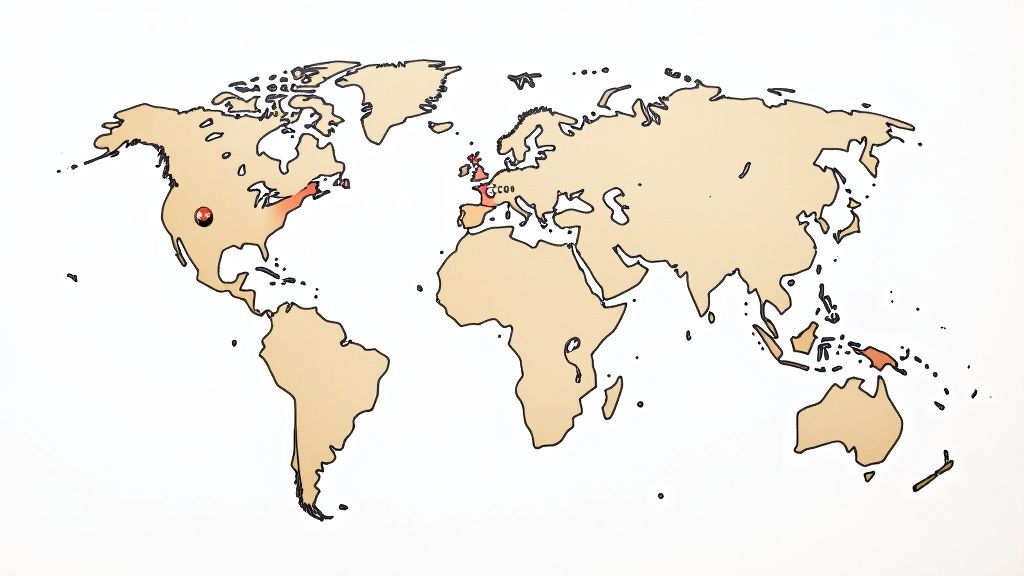
If you've ever thought, "a health certificate is a health certificate," it's time to press paws on that idea. When it comes to international travel, no two countries have identical rulebooks. The requirements for a health certificate for dog travel can change a lot from one border to the next.
This is where the real detective work begins. What works for a trip to Paris won't necessarily get you into London, and the rules for Tokyo are in a league of their own. Understanding these differences is the key to avoiding a heartbreaking and expensive situation at customs.
The European Union: A Standardized Approach
For many American travelers, the European Union (EU) is a popular destination. The good news? The EU has a fairly harmonized system for pet travel, which makes planning a trip to countries like France, Spain, or Italy a bit more predictable.
Generally, for non-commercial travel (with five or fewer pets), you'll need:
An ISO-Compliant Microchip: This has to be implanted before the rabies vaccination is given.
A Valid Rabies Vaccination: The vaccine must be given at least 21 days before your arrival.
An EU Health Certificate: This specific form needs to be completed by your USDA-accredited veterinarian and endorsed by APHIS within 10 days of your arrival in the EU.
While this process is fairly standard across the member states, it's always smart to double-check the specific country's rules for any local differences.
The United Kingdom: A Little Extra Homework
Since Brexit, the rules for taking your dog to the United Kingdom (that’s England, Scotland, Wales, and Northern Ireland) have changed. While many requirements look similar to the EU's, there's one extra step that often catches pet owners by surprise.
In addition to the microchip and rabies shot, your dog will need a specific tapeworm treatment.
This treatment (for Echinococcus multilocularis) has to be given by a vet no less than 24 hours and no more than 120 hours (that's one to five days) before you're scheduled to arrive in the UK. The vet must write down the exact time and date of treatment on the health certificate.
That narrow window requires precise planning. A treatment given too early or too late could mean your dog is denied entry or, worse, put into a lengthy quarantine at your expense.
Japan: The Gold Standard of Strictness
Traveling to a rabies-free country like Japan involves one of the most demanding and lengthy import processes in the world. This is not a trip you can plan a month out—the timeline often starts six months or more before you even think about booking a flight.
Preparing for Japan is a multi-step marathon:
Microchip and Two Rabies Vaccinations: Your dog needs a microchip followed by at least two rabies shots given at specific intervals.
Rabies Antibody Titer Test: After the second vaccination, the vet must draw blood and send it to an approved lab to test for rabies antibodies. The sample has to be drawn at least 180 days before you arrive in Japan.
Advance Notification: You must notify Japan's Animal Quarantine Service (AQS) at your port of arrival at least 40 days before your trip.
Final Vet Exam: The final health certificate is then completed in the days just before your flight.
This long and complex process really shows why researching your destination's rules is the absolute first thing you should do. Our guide on international pet travel requirements offers more insights into what you can expect for various destinations.
How International Pet Travel Requirements Compare
To see just how much these rules can vary, let's look at a few popular destinations side-by-side. It quickly becomes clear that a one-size-fits-all approach just won't work.
Requirement | European Union (e.g., France) | United Kingdom | Japan |
|---|---|---|---|
Microchip | ISO-compliant, before rabies vaccine | ISO-compliant, before rabies vaccine | ISO-compliant, before first rabies vaccine |
Rabies Vaccination | At least 21 days before arrival | At least 21 days before arrival | Two vaccinations required at specific intervals |
Rabies Titer Test | Not required from the U.S. | Not required from the U.S. | Required, sample drawn at least 180 days before arrival |
Tapeworm Treatment | Only required for Finland, Ireland, Malta, Northern Ireland | Required, 1-5 days before arrival | Not required |
Health Certificate Validity | Valid for 10 days from issue until arrival in EU | Valid for 10 days from issue until arrival in UK | Must be issued within 2 days of departure |
Advance Notification | Not typically required | Not typically required | Required, at least 40 days before arrival |
As you can see, the details matter—a lot. From vaccination timelines to specific parasite treatments, each country sets its own bar for entry.
The growing complexity of these rules is part of a much larger trend. The international pet travel market is projected to reach nearly $4 billion globally by 2032, with dogs making up about 44% of that market. As more of us travel with our pets, countries are implementing stricter rules to protect their local animal populations. You can find more insights on this growing industry over at AmericanBusinessTimes.com.
Always Use Official Sources
With so much at stake, you can't rely on advice from a friend or an old blog post. Rules can and do change. Your single source of truth should always be the USDA APHIS Pet Travel Website.
This site lets you select your destination country and gives you the most current, official import requirements and the correct health certificate forms. It's the best resource to ensure you have the right information, straight from the source.
Common Mistakes That Can Ground Your Trip

Navigating the world of pet travel can feel like walking a tightrope. One tiny misstep on your dog’s travel paperwork, and your carefully laid plans can come crashing down. Even the smallest error on a health certificate for dog travel can lead to big problems, turning your dream trip into a logistical nightmare.
The good news? These mistakes are almost always avoidable with a little extra planning and attention to detail. Let’s walk through the common pitfalls that catch even the most prepared pet owners off guard so you and your furry copilot have a smooth takeoff.
Miscalculating the Validity Window
This is, without a doubt, one of the most frequent errors travelers make. Most international health certificates are only valid for a very short period—often just 10 days. The confusion starts when people miscalculate this window.
It’s not 10 days from your departure. It's typically 10 days leading up to your arrival in the destination country. For a long-haul flight that crosses multiple time zones, this difference is very important.
Here’s a real-world scenario: Sarah is flying with her Corgi from Los Angeles to Rome. Her flight leaves on June 5th but lands on June 6th. She gets her vet exam done on May 27th, thinking she's well within the 10-day window of her departure. But because the window is based on her arrival date of June 6th, her certificate is already invalid by the time she lands. This simple mistake could mean her dog is denied entry.
The rule of thumb is to always count backward from your arrival date. A day or two can make all the difference between a warm welcome and a trip to quarantine.
Using a Non-Accredited Veterinarian
Here’s another big one. You go to your beloved family vet—the one who’s known your pup since he was a baby—and have them fill out the paperwork. The problem? If they aren't a USDA-Accredited Veterinarian, their signature is not considered valid for international travel documents.
Only vets who have completed special training and are authorized by the USDA can sign these forms. Without their specific signature and accreditation number, the USDA endorsement office will reject your paperwork instantly. You'll be left scrambling to find an accredited vet and start the process all over again.
Overlooking Airline-Specific Rules
Many pet owners focus so much on the destination country’s import rules that they completely forget about another key player: the airline. Airlines often have their own set of pet policies that can be even stricter than government regulations.
These rules can cover everything from the size of your pet's travel crate to breed-specific restrictions, especially for "flat-faced" breeds. Some airlines also ask for an "acclimation certificate" if your dog will be traveling in cargo during very hot or cold weather.
Common Airline-Specific Requirements to Check:
Crate Specifications: Your carrier should be IATA-compliant, with proper ventilation, secure locks, and enough room for your dog to stand up and turn around.
Health Certificate Timing: While a country might give you 10 days, an airline might ask that the certificate be issued within 72 hours of the flight.
Breed Restrictions: Certain breeds may not be allowed to fly in cargo at all, regardless of what the destination country says.
Failing to check these rules can result in being denied boarding right at the check-in counter, even if all your government paperwork is perfect. Unexpected issues like these are just one example of the hidden costs of pet travel-don-t-realize-until-it-s-too-late) that can arise without careful planning. Don't let a preventable mistake ground your trip before it even begins.
Tips for a Pawsitively Smooth Process
Getting all the paperwork lined up for your dog’s big trip can feel like a massive hurdle. But it doesn't have to be a last-minute scramble. A little bit of organization and some clear communication can make the vet visit and final government sign-off a surprisingly smooth experience.
Think of your vet appointment as the main event. Walking in prepared will save you time, slash your stress levels, and prevent those heart-stopping "oh no" moments. This isn't just about the health exam; it's about handing your vet everything they need to fill out the paperwork perfectly the first time.
Preparing for Your Vet Appointment
When you walk into that clinic, your mission is to make the process foolproof for the accredited veterinarian. This means having all your documents organized and ready to go. Don't make them hunt for details—lay it all out for them.
Here's what you should bring:
Complete Travel Itinerary: Your flight details are essential, including departure and arrival dates and times. This is how the vet confirms the 10-day validity window.
Destination Address: Have the full address where you and your dog will be staying. This is a required field on most international health certificates.
Original Rabies Certificate: A photocopy or a picture on your phone won't cut it. You need the original, signed paper certificate. The vet has to copy the vaccine maker and serial number exactly as they appear.
Microchip Information: Know the microchip number and the date it was implanted. Your vet will scan your dog to verify it matches what's on the paperwork.
Previous Medical Records: If you're seeing a new vet, bring your dog's health history, especially records of other vaccinations or treatments.
And a key point: communicate your departure date clearly. Mention it when you book the appointment and repeat it when you arrive. This gets everyone on the same page and working toward the correct deadline.
Managing the USDA Endorsement
Once your accredited vet signs off on the health certificate, the final step is getting that official government stamp from USDA-APHIS. You’ve got two ways to tackle this: old-school mail or the modern online portal. Each has its pros and cons.
Mailing your documents is the traditional route. You’ll send the completed certificate, payment, and a pre-paid return shipping envelope to the right APHIS office. It’s straightforward if you’re not a fan of technology. The big drawback? Time. You're completely at the mercy of shipping speeds, which can be seriously nerve-wracking on a tight 10-day schedule.
Pro Tip: If you decide to mail your documents, always use a service with rock-solid tracking, like FedEx or UPS. It gives you peace of mind knowing you can watch your precious cargo every step of the way.
The other option is the online Veterinary Export Health Certification System (VEHCS). This digital portal lets your vet submit everything electronically, which is often much faster. You can pay online and receive an electronic endorsement to print. Speed is the name of the game here, but it does rely on your vet being set up and comfortable with the system.
No matter which method you pick, a perfectly prepared return shipping label is a must. Double and triple-check that your address is correct and that the shipping is pre-paid. One simple mistake here could delay the return of your health certificate for dog travel and put your entire trip in jeopardy.
Your Dog Travel Health Certificate Questions Answered
Even with a perfect plan, it's easy to have a few nagging questions about your dog's travel documents. Let's be honest, the world of international pet rules can feel like a maze of fine print. Getting the details right is the secret to a journey that's exciting, not stressful.
We've pulled together the most common head-scratchers we hear from pet owners to give you clear, straightforward answers. The goal is to help you feel completely confident as you lock in those final travel plans.
How Long Is a Dog Travel Health Certificate Valid For?
This is a big one, and it trips up a lot of people. For most international trips, the health certificate has to be signed by your vet within 10 days of your dog's arrival in the destination country.
It's a common mistake to count forward from your departure date. You have to work backward from the day your flight lands, especially if you're crossing multiple time zones on a long-haul flight. Miscalculating this is one of the top reasons for travel headaches, so it's worth checking your math twice.
What Is a USDA Accredited Veterinarian?
Your regular vet is amazing for annual check-ups, but they may not be able to sign an international health certificate unless they have a specific qualification. Only a USDA-Accredited Veterinarian is authorized to complete and sign these official forms.
These vets have gone through special training with the USDA to understand the ins and outs of animal import and export rules. Their signature is the one the government will recognize for the final endorsement. Before you book that health certificate appointment, you should confirm your vet has this accreditation. Most clinics have at least one on staff, but you can always use the USDA's official search tool to find one nearby. This is a non-negotiable step.
Think of it like this: you wouldn't ask your family doctor to perform brain surgery. In the same way, you need a vet with specialized government training to handle this official document. It ensures every last detail meets strict international standards.
Can I Use a Digital Copy of the Health Certificate?
For nearly all international travel, the answer is a firm no. You must travel with the original, hard-copy health certificate in hand. This is the one with your vet's actual ink signature and the official embossed seal or ink stamp from the USDA.
Airlines and border officials generally will not accept photocopies, scans, or a picture on your phone of the health certificate for dog travel. It's important to treat this piece of paper like a passport.
Here’s how to keep it safe:
Slip it into a waterproof folder to protect it from coffee spills or bad weather.
Always keep it in your carry-on bag. Never, ever pack it in your checked luggage.
Make a digital copy for your own records, but remember it’s just a backup—not the real deal.
This original document is your dog’s golden ticket. Getting it right isn’t just about following the rules; it's about making sure your best friend’s big adventure starts off without a hitch.
Navigating pet travel paperwork can feel overwhelming, but you don't have to figure it all out alone. Passpaw is a platform built to simplify this entire process for veterinary teams, making sure every requirement is met with total accuracy. See how we can make your next journey seamless by visiting https://passpaw.com.

More articles
From regulatory changes to best practices for veterinarians and pet owners, our resources keep you ahead of the curve.