Are you a team member in a veterinary practice?
Are you a pet parent planning a trip with your furry pal?
Your Guide to Hawaii Animal Quarantine Rules
So, you’re thinking about bringing your furry best friend along for a move or vacation to Hawaii? The first thing to get a handle on is the Hawaii animal quarantine process. It sounds like a big deal, but with the right plan, it's completely doable. The state’s rules are there for a good reason—to protect its unique, rabies-free environment—and following them is your ticket to a smooth arrival for your pet.
A Pet-Friendly Journey to Paradise
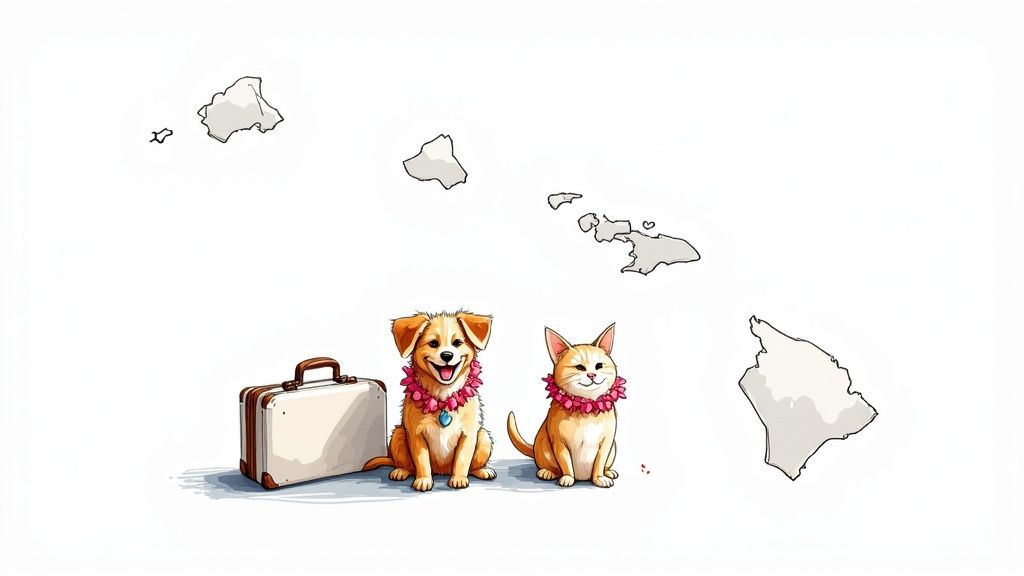
Bringing a pet to the Hawaiian Islands is an amazing adventure, but it’s one that definitely requires some homework. As the only rabies-free state in the U.S., Hawaii has a special set of rules to protect its residents, wildlife, and all the pets that call it home. Think of it less as a hurdle and more as a VIP health screening for your animal.
This guide is your complete roadmap, built to make the whole process as clear and stress-free as possible. Our main goal is to help you sidestep the dreaded 120-day quarantine. And don't let that number scare you; with good planning, most pets never spend more than a few hours in a holding facility.
The Two Paths to a Quick Reunion
Thankfully, you don't have to plan for a four-month separation. Hawaii offers two pathways that get you reunited with your four-legged family member much faster. These programs are your golden tickets to starting your new island life together right away.
The two main options are:
Direct Airport Release (DAR): This is the best-case scenario. If you nail all the pre-arrival requirements perfectly, your pet can be released to you right at the airport just after you land. It’s the goal everyone aims for.
5-Day-or-Less Program: This is an excellent backup plan. If there are minor issues with your paperwork or you just miss one of the DAR deadlines, this program allows for a very short stay at a quarantine facility instead of the full 120 days.
The real secret to success is planning ahead. We suggest starting the process at least four to six months before your travel date. This timeline gives you plenty of breathing room for vet visits, lab tests, and paperwork, so you aren't scrambling at the last minute.
Getting a grip on these pathways from the get-go is the first step to a successful move. For a complete, step-by-step checklist, check out our pet travel planner for moving from the United States to Hawaii. It’s time to get this journey started on the right paw.
Why Hawaii's Pet Quarantine Laws Are So Strict
Ever wondered why bringing a pet into Hawaii feels like a high-stakes operation? The detailed checklists, tight timelines, and pages of paperwork all boil down to one important fact: Hawaii is the only state in the U.S. that is completely rabies-free.
That’s not just trivia; it’s the entire reason for the strict import process. Keeping rabies out is a massive priority for the islands. An outbreak would be a disaster not only for people and pets but also for Hawaii’s unique native wildlife, much of which exists nowhere else on earth. The state’s quarantine laws are essentially a protective bubble to keep paradise safe for everyone.
A Fierce Commitment to Staying Rabies-Free
This isn't just a casual policy—it's a deeply held commitment to protecting an entire ecosystem. Because Hawaii is such an isolated island chain, it has been naturally shielded from many diseases common on the mainland. If a disease like rabies were to take hold, it would be incredibly difficult, if not impossible, to get rid of.
Think of it like a perfectly balanced, sealed terrarium. Before you can introduce a new plant, you have to be absolutely certain it isn't carrying any pests that could wreck the delicate environment inside. The Hawaii animal quarantine process is that same careful screening for our furry family members. And it's not just about rabies; officials also check for other serious threats. For instance, you can learn more about how they work to prevent other dangerous parasites in our article on screwworm prevention for pet travel).
The Legal Framework Behind It All
The state's authority to enforce these strict rules isn't just a guideline; it's backed by decades of legal history. These are enforceable laws designed with public health as the top priority. The regulations are taken so seriously that even well-intentioned requests for exceptions have been carefully weighed and denied to avoid putting the public at risk.
A notable legal challenge, the 1994 case of Crowder v. Kitagawa, really solidified the state's position. In this case, individuals with guide dogs argued for an exemption from quarantine, but the court ultimately ruled that the policy was a necessary public health measure. This decision underscored Hawaii's unwavering dedication to its rabies-free status. You can dig into the details of this important public health legal case if you're curious.
Understanding this "why" helps reframe the whole process. It's less of a bureaucratic headache and more of a shared responsibility. Every correctly filled-out form and perfectly timed vet visit is a direct contribution to keeping Hawaii safe. It’s a group effort to protect paradise for both its two-legged and four-legged residents.
Choosing Your Path to a Quick Reunion
The thought of a long Hawaii animal quarantine can be stressful, but here's the good news: the dreaded 120-day quarantine is almost always avoidable if you plan ahead. Hawaii has two fantastic, much faster options for pets arriving from the mainland. Think of them as express lanes designed for owners who follow the rules to a T.
Choosing the right program really comes down to your travel plans, budget, and how comfortable you are with hitting strict deadlines. Let's walk through each path so you can decide which makes the most sense for you and your furry family member.
Direct Airport Release (DAR)
Direct Airport Release, or DAR, is the golden ticket for most pet owners. It's exactly what it sounds like—if you nail every single requirement perfectly and on schedule, your pet is released to you right at the airport after a quick inspection. This is by far the fastest and most popular option, letting you kick off your island adventure together without missing a beat.
Think of it as the TSA PreCheck of the Hawaii animal quarantine system. You've done all the homework, your documents are flawless, and the state can quickly confirm that your pet is good to go. It’s a seamless reunion that’s the direct result of your careful planning.
But this path demands perfection. There is very little room for error. All your paperwork should be in the hands of the Animal Quarantine Station at least 10 days before your pet lands. This is a hard deadline.
The 5-Day-or-Less Program
The 5-Day-or-Less program is an excellent alternative and a fantastic safety net. This option is perfect for pets that meet all the critical health requirements (like the microchip and rabies tests) but maybe missed a DAR deadline or have a minor paperwork hiccup upon arrival. Instead of the full 120-day quarantine, your pet will have a short stay—up to five days—at a quarantine facility.
This program gives you a much-needed buffer, ensuring a small mistake doesn't turn into a four-month separation. It offers real peace of mind, knowing that even if something isn’t quite perfect, you won't be apart for long. The cost is a bit higher than DAR, as it covers the care your pet receives during their brief stay.
This option truly changed the game for pet travel to Hawaii. When it was introduced back in 2003, it made the entire process far more manageable for thousands of families. In fact, by October of that year, more than 80% of arriving pets qualified for this shorter program, a massive jump from the old standard. You can read more about the program's successful launch on the State of Hawaii's official site.
Key Takeaway: Both the DAR and 5-Day-or-Less programs require the exact same core health prep: a microchip, two rabies vaccinations, and a successful FAVN rabies antibody test. The real difference comes down to paperwork deadlines and what happens on arrival day.
Direct Release vs 5-Day-or-Less Program Comparison
Seeing the details side-by-side makes the choice much clearer. Here’s a simple table to help you compare the two main expedited programs for the Hawaii animal quarantine.
Feature | Direct Airport Release (DAR) | 5-Day-or-Less Program |
|---|---|---|
Reunion Time | Immediately at the airport after inspection. | After a stay of up to 5 days at a facility. |
Paperwork Deadline | All documents must be received at least 10 days before arrival. | Documents can be submitted upon arrival. |
Arrival Airport | Available at specific airports like Honolulu (HNL), Kona (KOA), and Kahului (OGG). | Primarily processed through Honolulu (HNL). |
Cost | $185 per pet. | $244 per pet. |
Best For | Meticulous planners who can meet every deadline without fail. | Those who want a backup plan in case of minor paperwork delays. |
One of the most important documents you'll need for either path is the official health certificate.
In the end, both programs lead to the same happy outcome: you and your pet, together in paradise. Your choice just shapes the timeline and logistics of that very first aloha hug.
Your Step-by-Step Pre-Travel Checklist
Getting a pet to Hawaii without quarantine isn't about luck—it's about perfect timing and following the rules to the letter. Think of it less like a suggestion and more like a detailed recipe where every single step has to be done in the right order.
This is your roadmap to a smooth arrival. Nailing these details is the difference between your pet walking out of the airport with you and getting stuck in a lengthy, unexpected quarantine.
Step 1: Laying the Foundation with a Microchip
Before you do anything else, your pet needs a working microchip. Seriously, this is the first step you can't skip. No rabies shots, no blood tests—nothing counts until that chip is implanted and scannable. It’s your pet’s permanent ID for this entire process.
Think of it like building a house: the microchip is the foundation. If you put up the walls (vaccinations) or the roof (blood tests) first, the whole thing is structurally unsound and won't be approved.
Action Item: Get a microchip implanted by your vet. If your pet already has one, have the vet scan it to make sure it’s working and the number is correct.
Important Detail: The date of microchip implantation must be on the record and it has to happen before the first qualifying rabies vaccine is given.
Step 2: The Two-Shot Rabies Vaccination Rule
Hawaii asks that your pet has at least two rabies shots in its lifetime. You can't just get them back-to-back, either. There has to be a gap of more than 30 days between them.
The most recent vaccination is the one that sets your travel timeline. This final shot must be given more than 30 days before your pet lands in Hawaii, but it also has to be current (not expired) on the day of arrival. Getting this timing right is a huge piece of the puzzle.
Step 3: The All-Important Rabies Antibody Test
Once the microchip and vaccines are squared away, you’re ready for the big one: the OIE-FAVN rabies antibody blood test. This isn't your average blood draw. It’s a specific test that proves the vaccine is actively protecting your pet. Your vet will take a blood sample and mail it to a state-approved lab for analysis.
The countdown begins the day the lab officially receives that sample.
Your pet must wait a full 30 days after the lab receives the blood sample before they are eligible to arrive in Hawaii. If you show up even one day early, they're disqualified from Direct Airport Release.
This 30-day waiting period is one of the biggest trip-ups for pet owners. Don't cut it close. Labs can take weeks just to run the test and get the results back to your clinic, so build in plenty of buffer time.
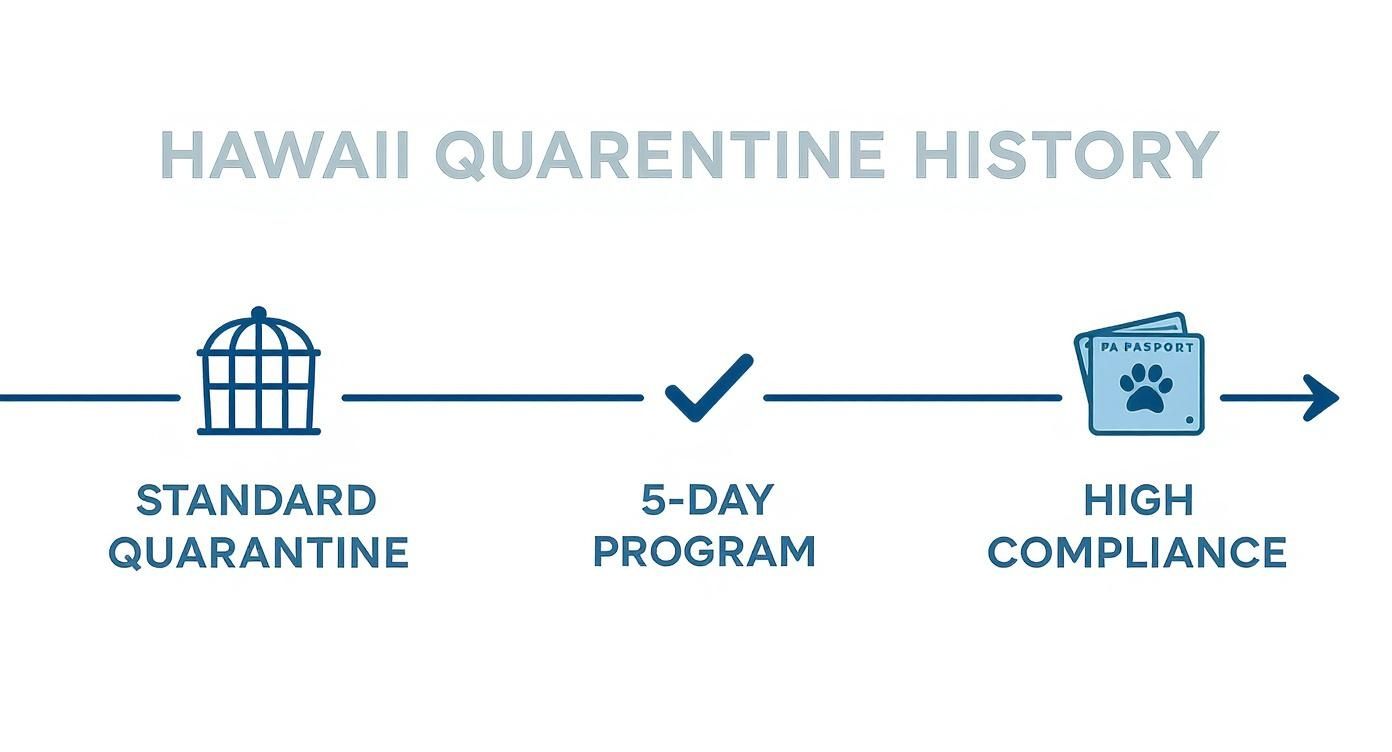
This graphic really shows how things have changed. Hawaii has moved away from long, mandatory quarantines toward a system that rewards owners who do their homework and get everything right ahead of time.
Step 4: Tick Treatment and the Health Certificate
As your departure date gets closer, you have two final vet appointments to check off. First, your pet needs a preventative tick treatment, which must be done within 14 days of landing in Hawaii.
Second, you'll get the official health certificate. This is the key document that pulls everything together, confirming your pet is healthy and ready to fly. A licensed, USDA-accredited vet must complete it, also within that 14-day pre-arrival window.
Tick Treatment: The product name and the date it was given must be listed on the health certificate.
Health Certificate: This form is incredibly detailed, requiring microchip info, vaccination dates, and more. Precision is key.
Getting the health certificate perfect is important. We've got a whole article dedicated to the ins and outs of getting a pet health certificate for travel if you want to dive deeper.
Step 5: Submitting Your Documents
With all your paperwork finally in hand, it's time to send it all to Hawaii's Animal Quarantine Station (AQS). To qualify for Direct Airport Release, the AQS needs to receive your complete, original documents and payment at least 10 days before your pet arrives.
Here’s a quick rundown of what to send:
Dog & Cat Import Form (AQS-279): The main application for your pet.
Original Rabies Vaccination Certificates: The actual ink-signed certificates for the last two rabies shots. No copies!
Original Health Certificate: The one issued within 14 days of your flight.
Payment: A cashier's check or money order for the program fees, which is $185 per pet for Direct Airport Release.
Do yourself a favor and send this package with a tracking number so you have proof of delivery. This final step is what seals the deal for a happy, stress-free reunion in the Aloha State.
Common Mistakes That Lead to Quarantine Delays
Getting through the Hawaii animal quarantine process is really an exercise in precision. Even the most organized and well-intentioned pet owners can make small mistakes that spiral into big consequences—namely, an unexpected and stressful quarantine stay for their pet.
Knowing the common pitfalls ahead of time is the absolute best way to make sure your pet sails through the process and qualifies for a swift airport release.
Think of it like proofreading an important document. One tiny typo or missed date can change the entire outcome. Let’s walk through the most frequent errors we see so you can avoid these potential "cat-astrophes."
The Microchip Mix-Up
One of the easiest—and most costly—mistakes revolves around the microchip. The rule here is simple but absolute: the microchip must be implanted before the FAVN test.
If your pet gets a rabies shot and then the microchip, that vaccine is considered invalid for Hawaii's requirements. This single timing error can reset your entire timeline, forcing you to re-vaccinate your pet and start the clock all over again.
How to avoid it: Before you do anything else, have your vet scan your pet’s existing chip to confirm it’s working and readable. If your pet needs a new one, make it the very first thing that happens at the vet clinic. Make sure the implantation date is clearly recorded on all records.
Miscalculating Important Waiting Periods
The timeline for Hawaii animal quarantine is rigid, with waiting periods that are enforced to the day. Two specific countdowns often trip people up.
First is the wait after the OIE-FAVN rabies antibody test. Your pet cannot land in Hawaii until at least 30 days have passed from the date the lab receives the blood sample. Arriving on day 29 means automatic disqualification from Direct Airport Release.
Second, your pet's most recent rabies vaccine must have been administered more than 30 days before your arrival date. Getting a booster too close to your travel date will also land your pet in quarantine.
A small miscalculation can have a big impact. Always use a calendar to count the days, and give yourself a buffer of a few extra days just to be safe. Don’t book your flight until you are 100% certain all waiting periods will be complete.
Incomplete or Incorrect Paperwork
Even with perfect timing, simple paperwork errors can derail everything. A missed signature, an incorrect date, or a missing vaccine lot number on the health certificate can be enough to prevent a direct release. Believe me, these documents are checked with a fine-tooth comb upon arrival.
The success of the fast-track programs depends on perfect paperwork. Official records from February 2005 showed that while approximately 87% of the 3,559 arriving pets qualified for immediate release, the other 13% did not. This shows that while the system works for most, small errors are common enough to cause real problems. You can dig into these historical program statistics on Hawaii's government site.
Missing Document Submission Deadlines
For anyone aiming for Direct Airport Release, this is a make-or-break rule. The Animal Quarantine Station must receive your complete packet of original documents and payment at least 10 days before your pet arrives. Not postmarked, received.
Common slip-ups here include:
Sending it too late: Waiting until the last minute without factoring in potential mail delays.
Sending incomplete documents: Forgetting to include one of the original rabies certificates or the main import form.
Using the wrong payment method: They don't accept personal checks. It has to be a cashier's check or a money order.
To nail this, send your documents using a trackable mail service well before that 10-day deadline hits. This gives you proof of delivery and, more importantly, peace of mind. Getting these details right ensures you and your furry friend can start your Hawaiian adventure together, right from the airport.
Frequently Asked Questions
Figuring out the ins and outs of Hawaii's animal quarantine rules can feel like a massive undertaking, and it's totally normal to have questions. Getting clear, simple answers is the best way to feel confident as you get your furry family member ready for the trip.
Here are a few of the most common things we hear from pet owners.
How Far in Advance Should I Start This Process?
Honestly, the sooner the better. We suggest starting the process at least four to six months before you plan to travel. This gives you a comfortable cushion for everything—vet appointments, vaccinations, and especially the 30-day waiting period after the FAVN blood test.
Starting early is your best defense against stress. It gives you plenty of time to meet every deadline for the faster release programs without scrambling at the last minute, which is when expensive mistakes tend to happen.
What Happens if My Paperwork Has a Mistake?
This is the big one. If there's an error on your paperwork, if a document is missing, or if it doesn't arrive on time, your pet may be disqualified from Direct Airport Release or the 5-Day-or-Less program.
Unfortunately, that means they may be taken to a quarantine facility for a much longer stay, and you'll be responsible for the cost until everything is sorted out. This is why we can't overstate the importance of double-checking every single detail with your veterinarian. A tiny oversight can cause a huge delay, so being meticulous is the key to a happy reunion right at the airport.
Can I Hire Someone to Help Me?
Absolutely, and for many people, this is a fantastic option. Professional pet shipping companies are experts in navigating Hawaii's very specific rules. They can manage the whole process for you, from booking vet visits to making sure every document is submitted perfectly and on time.
While it's an added expense, the peace of mind it offers is often worth every penny. It significantly cuts down on the risk of errors that could land your pet in quarantine.
Are the Rules Different for Service Animals?
When it comes to health and safety, the rules are the same for everyone. Service animals must meet all the same requirements as any other pet to prevent rabies from entering the state. That includes having a working microchip, the right rabies vaccinations, and a passing FAVN test result.
However, the state sometimes has different procedures for where service animals can complete their arrival inspection. It's a good idea to contact the Hawaii Department of Agriculture long before your trip to coordinate the specific arrangements for your service animal.
Planning your pet's move to Hawaii doesn't have to be a headache. Passpaw provides tools specifically designed to help veterinary practices manage all the complex requirements, ensuring every detail is correct for a smooth journey. Learn more at https://passpaw.com.
More articles
From regulatory changes to best practices for veterinarians and pet owners, our resources keep you ahead of the curve.