Are you a team member in a veterinary practice?
Are you a pet parent planning a trip with your furry pal?
The Ultimate Alaska Airlines Pet Policy Guide
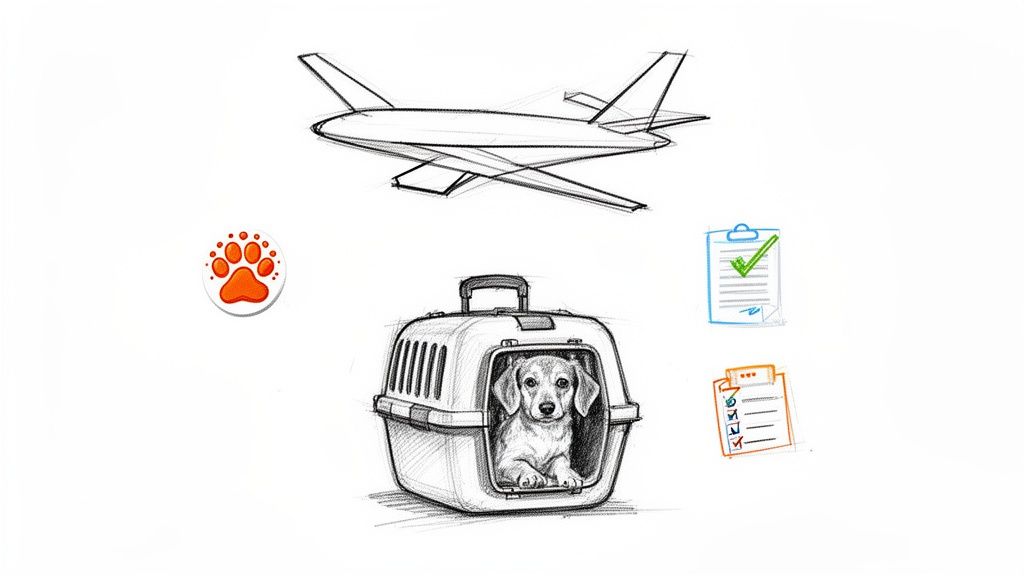
Flying with a pet can feel like a huge headache, but Alaska Airlines has a solid reputation for making it as smooth as possible. They even call it their "Fur-st Class Care," and they're known for being one of the more friendly airlines for our animal companions.
Yes, Alaska Airlines is definitely a pet-friendly airline. They welcome small pets right in the cabin with you and have dedicated space for larger pets in the baggage compartment on most flights. The key is understanding the Alaska Airlines pet policy before you book, as they have specific rules for carriers, fees, and which animals can fly.
Your Quick Guide to Alaska Airlines Pet Travel
Thinking through all the rules can feel overwhelming, but we'll break it down for you. This guide will give you a quick, clear overview to get you and your pet ready for takeoff.
We'll start with the most important details—where your pet can travel, what it'll cost, and which types of animals are allowed. The goal is to give you the essential info upfront so you can plan your trip with confidence.
Alaska Airlines Pet Policy at a Glance
To get started, here’s a simple table that breaks down the most important parts of the policy. Think of it as your cheat sheet for fees, travel options, and the main rules you'll need to follow.
Travel Option | Fee (Each Way) | Eligible Pets | Key Requirements |
|---|---|---|---|
In-Cabin | $100 | Small dogs, cats, rabbits, household birds | Must fit in a carrier that slides under the seat in front of you. |
Checked Pet (Baggage) | $150 | Dogs, cats, ferrets, guinea pigs, hamsters | Pet and carrier combined weight can be up to 150 lbs. |
PetStreak® Cargo | Varies | Most warm & cold-blooded animals | For unaccompanied pets or those over 150 lbs. |
This table covers the basics, giving you a quick reference as you begin planning your pet's travel arrangements with Alaska Airlines.
Deciding Where Your Pet Will Travel
The first big decision you'll make is whether your pet will fly in the cabin with you or travel in the climate-controlled baggage hold. Almost always, this comes down to one thing: size.
A small dog, cat, or even a rabbit that can rest comfortably in a carrier under the seat in front of you is a perfect candidate for in-cabin travel. Larger animals will need to be checked.
This flowchart makes it easy to see which option is right for your pet.
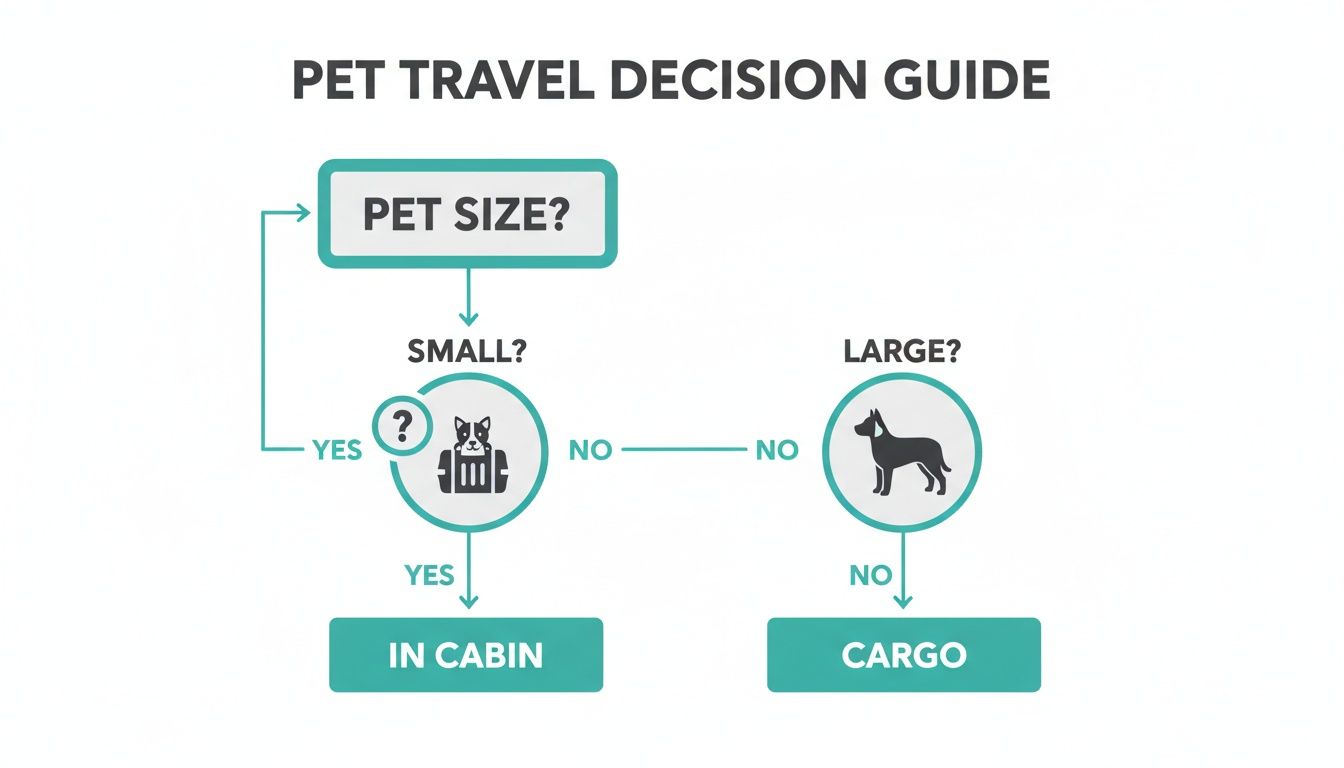
As the chart shows, it's all about fitting under the seat. Once you know where your pet will be, you can start preparing for a stress-free experience. For more general tips on getting your animal ready for the skies, check out our other guides on pet travel. By figuring out these first steps, you're already well on your way to a successful trip.
Flying with Your Pet in the Cabin
Bringing your pet on the plane with you is a huge stress reliever for both of you. Having them right under your seat means you know they're safe and sound. Alaska Airlines gets this, and their process for in-cabin pets is pretty straightforward, but it definitely pays to plan ahead.
First things first, let's see if your pet can fly in the cabin. Alaska gives the green light to a surprising variety of small companions.
Dogs and cats are, of course, the most common travel buddies.
Household birds are also welcome on most domestic flights (just not to Hawaii).
Rabbits can hop on board with you in the cabin, too.
Keep in mind, though, if you're heading to Hawaii or an international destination, only cats and dogs get a ticket for the cabin.

The Carrier: Your Pet's Ticket to Ride
Your pet's carrier is their home for the flight, so it's got to be just right. More importantly, it has to meet Alaska's size rules to slide safely under the seat in front of you. Think of it as their own personal pod.
Alaska has different dimensions depending on the type of carrier:
Hard-Sided Carrier: Can't be larger than 17" L x 11" W x 7.5" H.
Soft-Sided Carrier: Can be a little taller, up to 17" L x 11" W x 9.5" H.
No matter which you choose, the carrier must be clean, totally leak-proof, and have plenty of ventilation. Your pet also needs enough space to comfortably stand up and turn around inside. For a deeper dive, check out our guide on picking the perfect airline travel pet carrier.
Booking Your Pet's Spot
This is one part you absolutely can't leave to the last minute. You have to reserve a spot for your pet, and space is limited on every single flight—it's strictly first-come, first-served. There are only three pet carriers allowed in the First Class cabin and eight in the Main Cabin.
The best advice? Call Alaska Air Reservations to book your pet's spot the moment your own ticket is confirmed. Don't wait.
The fee is another key part of the Alaska Airlines pet policy. It’s $100 each way for a pet in the cabin. If you're checking them into the baggage hold, that fee goes up to $150. This applies only to flights operated by Alaska; if you're on a partner airline, they'll have their own fees and rules.
At the Airport and On the Plane
Once you're at the airport, things are pretty simple. Your pet carrier counts as your one personal carry-on item. When you get to the security checkpoint, you’ll need to take your pet out of the carrier and walk through the metal detector with them in your arms. The carrier goes on the belt to be X-rayed separately.
During the flight, the rules are clear: your pet must stay inside their carrier, with the door secured, for the entire flight. The carrier has to be tucked under the seat in front of you during taxi, takeoff, and landing. It's all about keeping everyone on board safe.
Here are a few quick tips to make the journey easier for your little traveler:
Carrier Comfort: Get your pet used to the carrier at home, weeks before you fly. Toss in treats and toys to make it a happy, familiar space.
Pre-Flight Burn-Off: A tired pet is a calm pet. A long walk or an energetic play session right before leaving for the airport works wonders.
Potty Break: Don't forget to visit the airport's pet relief area before you head to the gate. It's a must to prevent any accidents on board.
Traveling with Larger Pets as Cargo
What if your pet is too big to slide under the seat in front of you? Don't sweat it—they don't have to miss out on the adventure. Alaska Airlines has a solid system for larger animals to travel safely in a climate-controlled, pressurized baggage compartment. It ensures your bigger buddy can join the trip, even if they aren't right at your feet.
For a lot of pet owners, this is a huge relief. It means dogs, cats, and even smaller critters like ferrets or guinea pigs can fly on the same plane as you. Think of it as their own private suite for the journey.
Weight and Crate Requirements
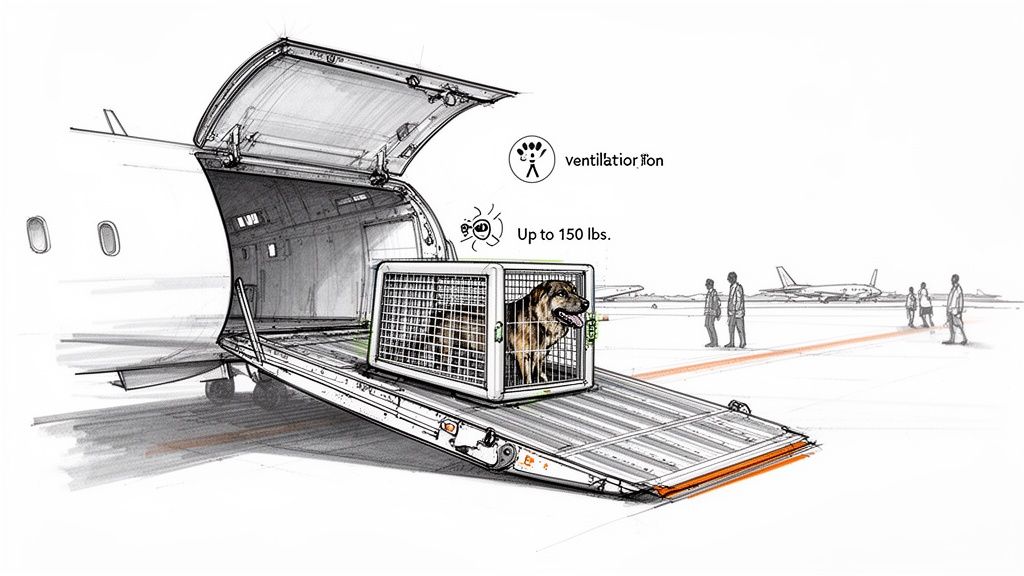
The biggest rule to remember for checking your pet is the all-in weight limit. Your pet and their crate combined can't weigh more than 150 lbs (68 kg). If you tip the scales over that, you’ll need to look into Alaska's dedicated cargo service, PetStreak®.
Your pet’s crate is easily the most important piece of gear for a safe flight. It’s their protective bubble.
Construction: The kennel has to be made of rigid plastic, wood, or metal. Soft-sided carriers just won't cut it for the baggage hold. It needs to be tough enough to prevent any escape artist moves.
Security: The door needs a secure, spring-loaded lock. Also, the top and bottom halves of the crate must be bolted together with actual metal nuts and bolts—plastic clips or twist locks are a no-go.
Ventilation: Proper airflow is critical, so the crate must have ventilation on at least three sides.
Size: Your pet needs enough space to comfortably stand up, turn around, and lie down in a natural position.
These aren't just suggestions; they’re all designed to keep your animal safe and sound from takeoff to touchdown.
Understanding Key Safety Restrictions
Alaska Airlines puts the safety of its four-legged passengers first, which means there are a few important restrictions you absolutely need to know. These policies are in place to shield animals from potential health risks during their journey.
Brachycephalic (Short-Nosed) Breeds
Certain short-nosed breeds of dogs and cats, like Pugs, Bulldogs, and Persian cats, are not allowed to fly in the baggage compartment. Their unique breathing anatomy makes them extra sensitive to changes in air pressure and temperature. They are still welcome to fly in the cabin, provided they meet the size requirements.
Temperature Embargoes
To protect pets from extreme heat or cold on the tarmac, Alaska has strict temperature restrictions. If the current or forecasted temperature at any point on your pet's trip—departure, arrival, or connection—is below 20°F (-7°C) or above 85°F (29°C), your pet might not be accepted to fly in the baggage hold. Always, always check the weather forecast for every city on your itinerary.
Alaska Airlines has been a leader in pet travel for a long time. They flew over 730,000 animals between January 2015 and December 2020, more than any other U.S. carrier in that period. Their safety record is impressive, with an average incident rate of just 0.26 per 10,000 animals—that's over 6 times lower than United Airlines' rate during the same time.
Checked Pet vs. PetStreak® Cargo
It's really helpful to know the difference between checking your pet and using the airline's dedicated cargo service. Checking a pet means they travel on your same flight, just like checked baggage. This is the go-to option for most pets under the 150 lbs limit.
PetStreak® is Alaska's formal cargo program. You would typically use this if:
Your pet and their crate weigh more than 150 lbs.
Your pet needs to travel unaccompanied.
You're shipping an animal not permitted as checked baggage (like certain birds or reptiles).
Getting a feel for different airline policies can give you a better big-picture view of pet travel. For instance, our guide on the Delta pet travel policy shows how rules and services can vary. Knowing your options ensures you pick the safest and smartest way to fly with your larger companion.
Navigating Pet Health and Travel Documents
Let's be honest, getting your pet's paperwork in order can feel like the most ruff part of the whole trip. It might seem like a lot of hoops to jump through, but tackling it ahead of time is the secret to avoiding any last-minute panic at the check-in counter.
Think of these documents as your pet's official passport to the skies. They aren't optional, and they're your proof that your furry friend is ready for the journey.
The All-Important Health Certificate
The main document you'll need for almost any flight is a health certificate, sometimes called a Certificate of Veterinary Inspection (CVI). This is simply an official form signed by a licensed veterinarian confirming your pet is healthy enough to travel and has all its required vaccinations. It’s the airline’s peace of mind that your companion is fit for the flight and won't pose a health risk to other animals.
For domestic travel within the U.S., Alaska Airlines generally requires a health certificate issued no more than 10 days before your flight. Heads up: if you’re taking a round trip that lasts longer than 10 days, you might need a second certificate for the flight home. Plan for that.
This timeline is important. A certificate issued 11 days out might not be accepted. A pet's health can change quickly, so airlines need the most up-to-date assessment possible.
A valid health certificate is more than just a piece of paper; it's your proof of due diligence. It shows the airline you've taken the necessary steps to ensure your pet is healthy, vaccinated, and ready for a safe journey, protecting everyone involved.
Domestic vs. International Travel Requirements
The paperwork you need changes dramatically depending on where you're headed. Flying from Seattle to Denver is a walk in the park compared to flying from Seattle to Mexico, and the document requirements reflect that.
For U.S. Domestic Flights:
Health Certificate: As mentioned, this is generally required for pets traveling as checked baggage and must be issued within 10 days of your flight.
Rabies Vaccination Proof: This is usually included on the health certificate, but it’s always a smart move to carry a separate copy of your pet’s rabies certificate.
State-Specific Rules: Some states, especially Hawaii, have very strict entry rules to prevent diseases from being introduced. Always, always check the specific requirements for your destination state well in advance.
For International Flights:
International travel is a whole different ball game. Every country writes its own rulebook, and they can get complicated. One wrong move could mean your pet is denied entry.
Common international requirements include:
Bilingual Health Certificate: The certificate may need to be in both English and the official language of your destination country.
Government Endorsement: Many countries require the health certificate to be officially stamped and signed by the USDA. This is an extra step that takes time.
Microchip: Most destinations require an ISO-compliant microchip for identification.
Specific Vaccinations & Treatments: Beyond rabies, some countries may ask for specific parasite treatments or other shots, all administered within a very precise timeframe.
The complexity here is why starting early is absolutely critical. For those needing a government-approved certificate, our guide explaining how to get a USDA-endorse-d pet health certificate is a must-read. This isn't something you can handle the day before you fly.
Making the Process Easier
Trying to manage all these details while also packing and planning the rest of your trip can feel overwhelming. The good news is, you don’t have to go it alone.
Your veterinarian is your most critical partner in this. They’ll perform the health exam and fill out the CVI. When you book the appointment, be crystal clear that it’s for air travel and tell them your exact destination so they use the correct forms.
Modern tools can also take a huge weight off your shoulders. Platforms like Passpaw are built to help veterinary practices manage travel documents, making sure every "i" is dotted according to your destination's specific rules. This kind of preparation helps prevent common errors and ensures all your paperwork is accurate, complete, and ready for inspection. A little prep goes a long way in making the documentation process a breeze.
Understanding Service Animal Policies
Trying to figure out the rules for assistance animals can feel like a maze, especially with all the policy shifts in recent years. The most important thing to know about the Alaska Airlines pet policy is that it aligns with U.S. Department of Transportation (DOT) regulations, which have a very specific definition of what a service animal is.
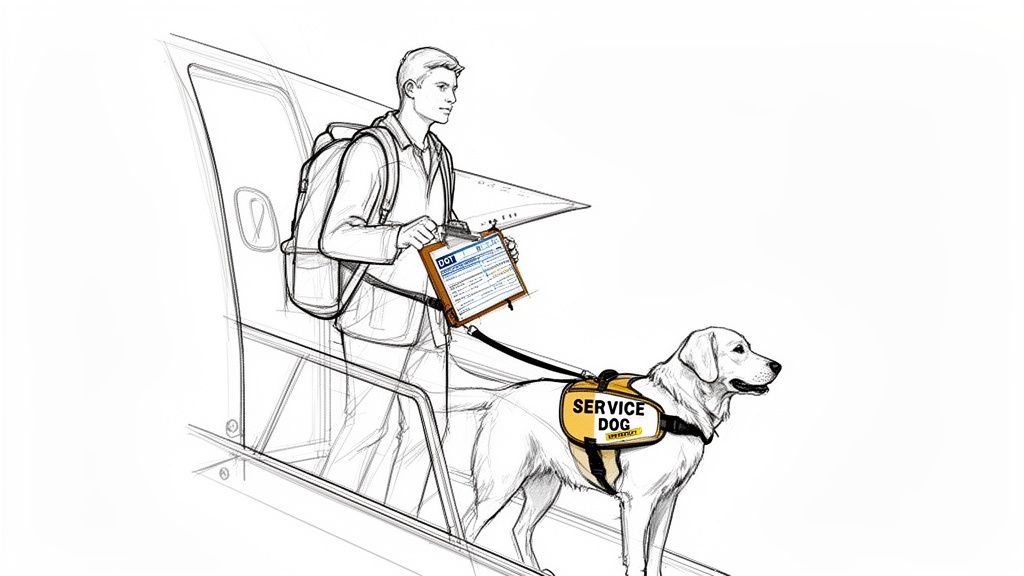
This means only dogs that are individually trained to perform specific tasks for a person with a disability are considered true service animals. Getting this distinction right is the key to a smooth travel day.
What Qualifies as a Service Animal
A service animal isn't just a well-behaved pet; it's a highly trained partner whose work is directly tied to its handler's disability. This could be anything from guiding a person who is blind and alerting someone who is deaf to pulling a wheelchair.
It’s this intensive training that really sets them apart. This preparation helps them stay calm and focused in a hectic airport and on a full flight, behaving perfectly the entire time. For anyone looking to understand what goes into this, resources on professional dog training can offer some great insights.
The Required DOT Forms
If you're flying with a trained service dog on Alaska Airlines, you’ll need to fill out and submit the official DOT Service Animal Air Transportation Form. Think of this form as your official declaration that your dog is a legitimate, trained service animal.
On the form, you'll need to confirm details about:
Your dog's health and vaccination records.
The specific training your dog has completed.
Your agreement that your dog will be harnessed, leashed, or tethered at all times.
The best move is to submit this form online via Alaska's website at least 48 hours before your flight. If you book a last-minute trip, you can give the completed form to an agent at the airport, but getting it done ahead of time is the surest way to avoid any hiccups.
A Note on Emotional Support Animals
One of the biggest changes in air travel recently has been the policy on Emotional Support Animals (ESAs). Under current DOT rules, airlines are no longer required to recognize ESAs as service animals.
This is a critical point: Emotional Support Animals now travel under the standard pet policy. This means they are subject to the same fees, carrier requirements, and booking procedures as any other pet traveling in the cabin or as checked baggage.
This shift was made to create a consistent and safe standard across the industry. While ESAs provide incredible comfort, they don't have the specific, task-oriented training that defines a dog as a service animal under federal regulations. Understanding this difference is essential for planning your trip and avoiding any mix-ups at the airport. It isn't about the airline being difficult; it's simply about following a clear federal rule.
A Pre-Flight Checklist for Pet Parents
Let's be honest, travel day can be a little chaotic. A bit of planning beforehand makes a world of difference, turning a potentially stressful experience into a smooth one. This checklist breaks everything down into simple, manageable steps so you and your furry co-pilot are ready for a purrfect trip.
Weeks Before Your Flight
Getting a head start is the single best thing you can do to avoid last-minute panic. These first few steps lay the groundwork for a successful journey.
Book Your Pet’s Spot: The moment your own ticket is booked, call Alaska Air Reservations at 1-800-252-7522 to add your pet. In-cabin spots are incredibly limited on every flight, so this needs to be your absolute first move. Don't wait.
Schedule a Vet Visit: Get an appointment on the books for a full health check-up. Chat with your vet about your travel plans to make sure your pet is fit to fly. This is also when you'll get the health certificate, which should be issued within 10 days of your departure.
Make the Carrier a Happy Place: Don't let the first time your pet sees their carrier be on travel day. Weeks in advance, leave it open in your living room with their favorite blanket or a toy inside. Let them explore it on their own, using treats to build a positive association. The more comfortable they are with it, the calmer they’ll be during the flight.
The Day Before Departure
With the flight just around the corner, it's time to tackle the final details. A quick double-check now saves a lot of headaches later.
Pack a Pet Go-Bag: Get a small bag ready with all their essentials. Think leash, a small amount of food (just enough for the journey), a collapsible water bowl, and any medications they need.
Organize Your Paperwork: Gather up your pet’s documents, especially the health certificate and vaccination records. Put them in a waterproof folder right alongside your own travel documents so everything is in one, easy-to-grab spot.
Final Crate Inspection: If your pet is traveling in the baggage hold, give their crate one last look. Make sure every nut and bolt is tight, the door latches securely, and it's clean and ready for the trip.
Day of Travel
The big day is finally here! These last steps are all about keeping your pet comfortable, calm, and ready for takeoff.
A little pro-tip: plan your pet’s last big meal for at least four hours before you leave for the airport. This simple step can help prevent an upset stomach or motion sickness mid-flight. A little water is perfectly fine, but skip the full meal right before you head out.
Finally, remember that a tired pet is a happy traveler. A long walk or an energetic game of fetch before leaving for the airport will help them burn off that extra energy, making it easier for them to settle down once you're on the move. Just before you head into the terminal, make a quick stop at the airport’s designated pet relief area for one last potty break. It’s a small step that makes a huge difference in their comfort.
Frequently Asked Questions About the Pet Policy
Even with the best-laid plans, a few last-minute questions always seem to pop up. Here are some quick answers to the most common things travelers ask about the Alaska Airlines pet policy, so you can feel completely ready for your trip.
Can Two Small Pets Travel in the Same Carrier?
Yes, Alaska Airlines allows two small pets to travel together in a single carrier, which is a big relief for owners of bonded pairs. The key rules are that they must be the same species (like two puppies or two kittens) and both need to be small enough to comfortably stand up and turn around inside the carrier at the same time.
While it’s a great way to keep pals together, their comfort is what matters most. If it looks like a tight squeeze, the kinder and safer option is to book a second spot for another carrier.
Does My Pet Carrier Count as a Carry-On Bag?
It sure does. When you bring a pet into the cabin, their carrier takes the place of your standard carry-on bag. You’re allowed to bring the pet carrier plus one personal item, like a purse or a small backpack that fits under the seat.
This is a big one to remember when you're packing. You won't be able to bring a regular rolling suitcase on board in addition to your pet carrier and personal item.
What Happens if My Flight with a Pet Is Canceled?
Flight disruptions are always stressful, but they feel even more intense when you have an animal with you. If Alaska Airlines has to cancel your flight, their customer service team will work with you to get you and your pet rebooked on the next flight where there’s space for animals.
Just keep in mind that if you end up on a partner airline, you may have to follow their specific pet policies and fees. It's always a good idea to have some extra food, a leash, and a portable water bowl ready, just in case you face an unexpected delay at the airport.
Navigating airline pet policies and getting the health documents right can feel like a maze. Passpaw is designed to help veterinary practices prepare travel paperwork correctly the first time, ensuring a smooth, stress-free journey for you and your pet. Learn more about how we can help at https://passpaw.com.
More articles
From regulatory changes to best practices for veterinarians and pet owners, our resources keep you ahead of the curve.